Kildare Community Rally As Council Gives Data Centres Green Light
The protest didn’t happen spontaneously; a planned hyperscale Data Centre by Herbata Ltd in Naas sparked outrage and thus galvanised the community to establish Data Centre Awareness Kildare (DCAK).


On Monday, 28 September at 13.30, a protest was held outside Áras Chill Dara, where the head office of Kildare County Council is located. This protest was attended by a diverse strata of the public, from retirees, to moms and dads, and even young children, many of whom were still in their school uniforms. This scene might have been mistaken for a community festival at first glance, but signs and placards such as “Imigh leat Microsoft” and “AI is a bubble” along with a resolute anger quickly burst any such illusions.
The protest didn’t happen spontaneously; a planned hyperscale Data Centre by Herbata Ltd in Naas sparked outrage and thus galvanised the community to establish Data Centre Awareness Kildare (DCAK). This was then followed by a Town Hall meeting that saw over 250 residents gather together to discuss the plans for both the Herbata site and P2, the nearby proposed location for a Microsoft Data Centre. This latter site has not yet had formal planning proposed, and was the target of the protestors on this Monday afternoon, while the Herbata site has its planning locked in the appeals process. The rezoning of this site to exclude Data Centres is the first of three demands by the DCAK campaign, and while a meeting on 8 September by the Naas Municipal District included it as Motion 25 on its Agenda, it appears that they do not have the authority to rezone this site. This led to a referral from the Naas Municipal District Committee regarding the “P Data Centre” rezoning to the Full Council under Motion 16, just this past Monday.
It has been reported that prior to the vote, Sinn Féin Cllr Noel Connolly said that this motion had received “the biggest response to any motion” in his time on the council, and implored “Please listen to the public outcry, respect democracy”.
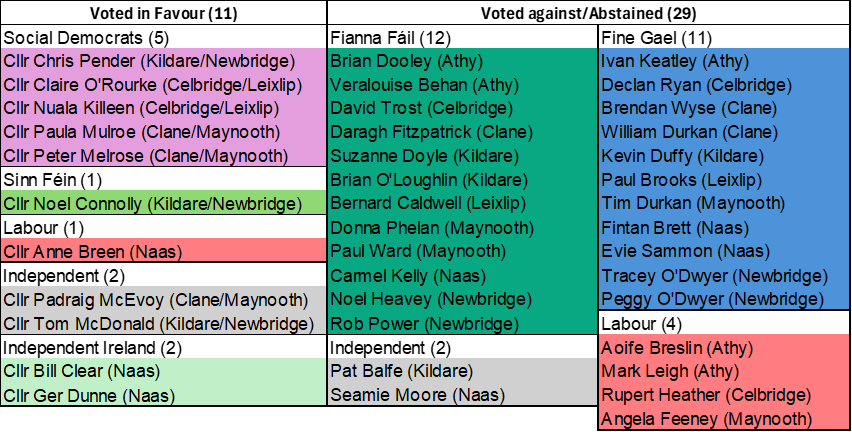
Ultimately, the council voted against considering the rezoning of this site, with 11 who voted to review the Area plan, while 22 voted No and seven abstained from voting. There was no roll-call vote, so the precise voting records are not officially available, however based on reporting of those who have voted in favour of the motion, the following voting record can be deduced, with some particularly disappointed Naas constituents stating that “We will not forget those names” online.
Kildare County Council said in a Facebook post that the meeting would be live streamed to their Youtube channel, but no recording of the meeting appears to be publicly available on their channel after the fact. Additionally, Kildare County Council reported that their phone lines were experiencing technical difficulties on the day of the meeting, but that these were restored the next day.
A joint statement following the meeting by Fianna Fáil and Fine Gael states that “It is disappointing that members of the public were advised to focus their efforts on overturning the zoning rather than engaging with the planning process itself” but that they acknowledge “the frustrations and anxieties felt by public with regard to some elements of technological development” before claiming that “it is not our role to regulate these complex entities”. The final paragraph of the five paragraph statement proceeds to call social media a valuable tool for campaigning before warning campaigners that an inadequate code of conduct “only serves to undermine this medium for future use” and stating that “The scale of this campaign has made it impossible for many Councillors across the County, to reply to every email”.
The protestors however appear determined in their campaign, with one speaker raising the possibility of bringing the case to judicial review with the High Court, or even possibly to a European level. The speaker, amongst cars beeping in support as they passed by, raised the possible need to fundraise to achieve this, mentioning that the government has been seeking to make it more difficult for such cases to be brought before judicial review. This is in reference to the Civil Reform bill 2026, which the Free Legal Advice Centres (FLAC) have raised major concerns over. Eilis Barry, the chief executive of FLAC, stated that “If implemented, this restrictive time limit will put access to judicial review out of reach for people who don’t have the resources to pay for and access immediate legal assistance” and that it “would effectively block public-interest cases that raise complex or new legal issues”.
This comes at a time when resistance to Data Centre development is ever increasing, with recent actions resisting Data Centres in both Drogheda and Waterford having been covered by Aontacht. Globally, the resistance to Data Centre construction has been steadily increasing amidst concerns that the rollout of hyperscale infrastructure is economically unviable in addition to being environmentally hazardous and socially unacceptable. Only days prior to the protest, Oracle declared force majeure in order to delay its contractual payments as part of the development of its Project Jupiter data centres, which in turn are part of the larger Stargate AI data centre rollout in the US. While this kicks the debt down the road, Oracle saw an immediate 3.3% drop in share price, possibly hinting at the first signs of bubble collapse due to an inability of tech companies to deliver on the economic promises made to their investors. Previous reporting by Aontacht highlighted the precarious nature of the promises of such hyperscaling infrastructure as it relates to the planned Herbata complex in Naas and its similarities to the development bubble of the Celtic Tiger, noting that Oracles credit rating had just been adjusted to one level above junk at the time of publishing.
Whether this case is brought before the high court in a judicial review, or whether planning permission is even applied for by Microsoft remains to be seen. The economic certainties as proposed by Big Tech appear to become less self-evident with every passing day and every new piece of information, and whether our current political leaders will continue to be so loudly in favour of making Ireland the Data Centre capital of the world is as of yet unknown. What is certain however, is that when a boy of maybe seven years old, still clad in his red school uniform is given a megaphone on a Monday afternoon protest and confidently professes “Kildare is strong… and we are not letting AI take over”, there is sure to be community resistance against it.