RSYM Condemn Sinn Féin Capitulation To The Poppy in Belfast City Hall
The annual Remembrance Sunday spectacle at Belfast City Hall has once again laid bare the deepening political chasm within Irish republicanism. This reality was sharply articulated this week by the RSYM in a blistering social media rebuke of Sinn Féin’s participation.

The annual Remembrance Sunday spectacle at Belfast City Hall has once again laid bare the deepening political chasm within Irish republicanism. As the star of establishment republicanism is hoisted ever higher, the symbols of British militarism are being increasingly embraced by those who once claimed to stand against them in an attempt at signaling “maturity”.
This reality was sharply articulated this week by the Republican Socialist Youth Movement (RSYM) in a blistering social media rebuke of Sinn Féin’s participation. The RSYM post cut through the sanctimonious fog of the mainstream media, stating plainly: "Another year of Sinn Féin bowing to British colonialism."
The RSYM critique strikes at the very heart of the matter. As their statement noted, the poppy and Remembrance Sunday do not fall short on who they remember; the symbol and the event seek to platform and commemorate all British forces in all British missions.
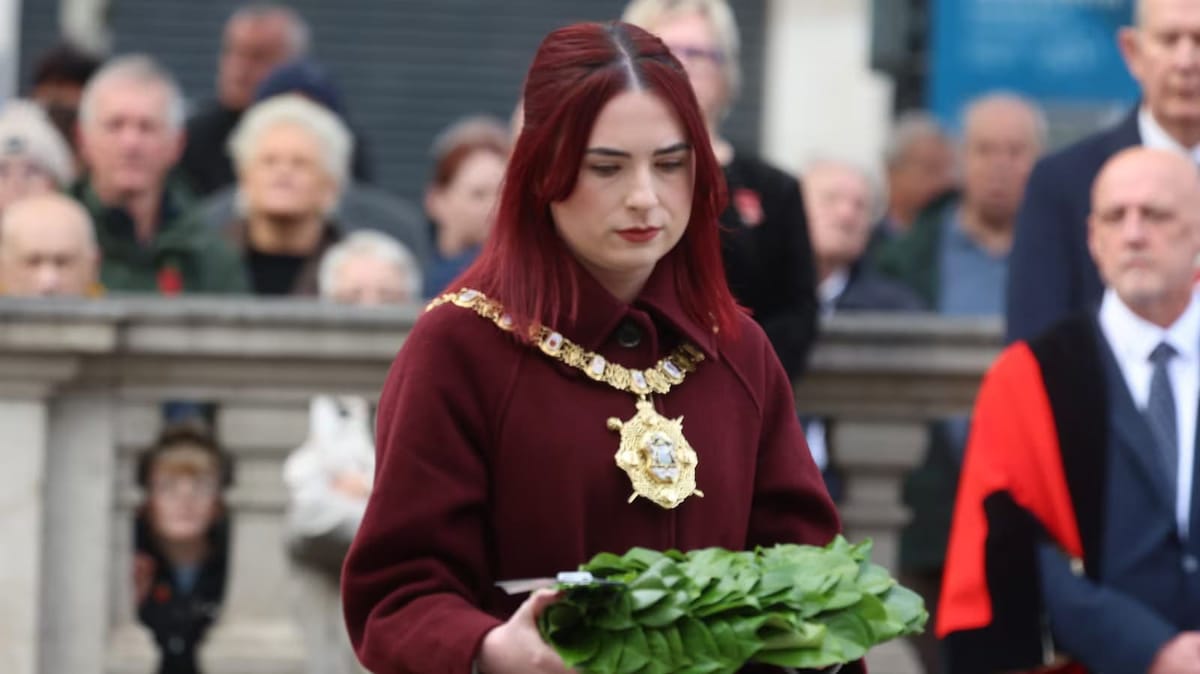
At the centre of this year's controversy is the confirmation that Sinn Féin representatives will, once again, attend the Remembrance Sunday event at Belfast City Hall, laying a wreath to commemorate the British war machine. This follows the precedent set in 2024 when then-First Minister Michelle O'Neill became the first senior Sinn Féin figure to attend the official ceremony. This weekend, Belfast Lord Mayor Rois-Máire Donnelly will continue this, laying a laurel wreath at the cenotaph.
The status quo press will undoubtedly frame this as a magnanimous gesture of "inclusivity", paint the capitulation as “maturity” and a commitment to being a "First Minister for all." But let us be unequivocal: this is not a gesture of peace. It is a calculated capitulation to the forces of British colonialism, a surrender of republican principles at the altar of liberal respectability politics.
There are indeed very few in Ireland who would recoil at the sight of a poppy if it was strictly confined to remembrance of the wanton pointless destruction and death of the First World War. Opinions on Ireland's involvement in that imperialist slaughter vary. But the poppy is not a neutral symbol of historical grief. It has been long stripped of it's original anti war “never again” meaning. It is a modern, active tool of state propaganda. It is a badge of honour for British warmongers, it is a dog whistle that you are on board with British Militarism and support the imperialist agenda.
When Sinn Féin lays a wreath, they are honouring the RUC, and the Parachute Regiment, not just the young men who went to fight in France out of either poverty or being fooled into believing Gladstone's false promise of “Home Rule”. They are laying a wreath for the forces that brought terror to Ballymurphy, committed Bloody Sunday, and terrorised countless communities across the Six Counties.
Furthermore, the symbolism of the poppy is inextricably linked to the sectarian apparatus of the northern state. Across the north, the poppy adorns memorials to Loyalist leaders and is woven into wreaths blazoned with the abbreviations of Loyalist death squads. Groups that waged a campaign of sectarian murder against the Catholic working class, and any of the Protestant working class that tried to stand against them. To stand alongside these symbols under the guise of "reconciliation" is a profound insult to the victims of state and loyalist violence.
RSYM went on to ask a question that Sinn Féin's press office will never be able to answer: "Why would any Republican want to lay a wreath for the British war machine? To lay a wreath in memory of those who were complicit in the suffering of our homeland? To those who in the present day continue to aid NATO, the USA and Israel in the subjugation and extermination of innocent people across the world?"
This is the crux of the anti-imperialist critique. British militarism does not exist in a historical vacuum. The same state that occupied the Six Counties for a century is the same state that arms the apartheid state of Israel as it commits genocide in Gaza. The same war machine that Sinn Féin now seeks to commemorate is the same machine that fuels NATO’s proxy wars and global subjugation. By honouring the British military, Sinn Féin aligns itself with the imperial core, abandoning any pretense of internationalist solidarity.
And Sinn Féin's embrace of the poppy is not going unnoticed by the grassroots. The backlash has been visceral. In 2024, following O'Neill's attendance, a banner bearing the word "traitors" was draped over her constituency office in Cookstown, emblazoned with bloody handprints and a poppy. It was an apt, angry message from a community that has not forgotten, because they bled the blood that was shed themselves.
More than 100 relatives of Troubles victims from the republican community signed an open letter expressing that they felt "deeply hurt, frustrated and angry" at the leadership's actions. Sinn Féin’s response to this pain was as cold as it was predictable. O'Neill acknowledged the criticism was "difficult to hear" but defended her actions by stating she is "committed to being a first minister for all."
But who is this "all"? Can one be for all while honouring the institutions that oppressed a specific section of that "all"? You cannot claim to represent the victims of British state violence while sanitising the perpetrators. You cannot wear the mantle of republicanism while bowing to the Crown.
The RSYM post ended with a haunting rhetorical question: "What would the brave men and women who went before us say if they were to witness the largest 'Republican' party honour the British war machine? 'For what died the sons of Róisín?'"
It is a question that cuts deep into the heart of modern Irish politics. The transition from a radical anti-imperialist movement to a party of bourgeois administration has required the abandonment of uncomfortable truths. It requires the erasure of the revolutionary past and the sanitisation of the enemy.
The battle over the poppy is a battle over class, memory, and the unfinished project of Irish liberation. The establishment and its allies in the mainstream media will continue to applaud Sinn Féin's "maturation" into a party of state. But for those of us who remain committed to genuine republican and socialist ideals, Sinn Féin’s Remembrance Sunday spectacle is not a step towards a New Ireland. It is a final, sorrowful bow to the old spirit of rebellion.
Republican Sinn Féin’s post on the matter can be found here