Don’t Mention The War: Why Is Séan Russell And Self-Reflection Off Limits?
Republicanism should not be a cult. It should be a living political tradition, capable of growth, capable of change, and capable of admitting when it went badly wrong.
Republicanism should not be a cult. It should be a living political tradition, capable of growth, capable of change, and capable of admitting when it went badly wrong.”
Social media tag: instagram aprilsheehancorkery_roots
Inspired by the recent commemoration in Dublin of Séan Russell and the fact Aontacht covered it due to it being republican news, I wrote an article, which can be found here, on why I don’t believe that Séan Russell should be commemorated.
To which Peter Irvine wrote a response article which can be found here, and J. McDermott wrote a response article that can be found here.
Firstly before moving onto the cultural weakness of hiding our dirty laundry under the bed and everyone becoming a saint retrospectively from once they pop their clogs I would like to deconstruct Peter Irvine and J. McDermott's articles directly.
Part 1: The Deconstruction Of Irvine's Article
I couldn’t move beyond even the title without disagreement as no one should be placed on the pedestal of uncritical reverence. If you are not critical of even yourself from a year ago you are in the way of your own progress, if we are talking about someone who died 8 decades ago you are in the way of the progress of a movement. Even regarding people I largely agree with (even Ryan and Connolly) I have criticism because I’m from the future looking back. Regarding Russell however he was criticised by other Republicans even in his own time, it does not even require the perfect vision of hindsight. Irvine himself declares that his title is “deliberately maximalist” but qualifies that with “but it is not entirely tongue in cheek either”
He claims this is justified by his “courage, constancy, sacrifice and an extraordinary refusal to reconcile himself to British rule in any part of Ireland.”
I argue that the ends do not always justify the means, and whatever someone’s good qualities, they are often not enough to undo their bad qualities let alone the tangible harm that their actions caused. The shadow of even his good qualities is part of what caused it. The bad side of courage is recklessness, the bad side of constancy and his refusal to perhaps not reconcile but to think about his actions thoroughly are part of what led to his unsavoury legacy.
His valiant actions decades before his vile ones do not entirely negate the ones that led up to the end of his life. At best they present a duality, at worst a man who regressed towards reaction instead of advanced towards revolution.
I stand by my central charge, to be a collaborator does not require one to be a committed Nazi. The Second World War brought us a collection of collaborating opportunists who thought to use the Reich for their own purposes. No one tries to argue their stories are justified because they were out for their own motives.
- Vidkun Quisling was not a German Nazi, he was a Norwegian nationalist with a reactionary streak up until he decided he was acting in Norway's interests by cooperating with the German occupation. He is recognised as the definitive collaborator, motive does not determine collaboration.
- Philippe Pétain, hero of Verdun, became head of Vichy France. Pétain was not a German Nazi. He was a French conservative, a Catholic, a military traditionalist. He believed he was saving France from destruction by cooperating with the occupier. Motive does not determine collaboration.
- Pierre Laval was not a committed Nazi ideologue. He was a pragmatist and political operator who believed collaboration was the only realistic path for France. Motive does not determine collaboration.
- Milan Nedič, Serbian general and politician who led the puppet government in German-occupied Serbia. Nedič was not a Nazi ideologue. He was a Serbian nationalist and anti-communist who believed he was protecting the Serbian people “from communism” by cooperating with the occupier.
- Subhas Chandra Bose was an Indian nationalist who sought help from Nazi Germany and Imperial Japan against British rule. He was not a Nazi and not a fascist in the European sense. He was an anti-colonial revolutionary. Even he did not accept a German-designed mission with SS handlers to coordinate operations with German war aims. His collaboration besides is still considered a stain on his legacy both in India amongst socialists and outside of it. He had a commemorative stamp as recently as 2021 as well as having an airport and several islands named after him. Motive and the good he did besides, still does not determine collaboration. Nor does how much or how little someone is revered or commemorated take it away.
Overall, no new information was presented in Irvine’s article it was entirely counter rhetoric, which given the nature of the discussion is fair enough, as the entire legacy is subject to rhetoric, as the man is dead since the 40s and cannot be reached for comment without staging a séance.
However I take umbrage with the attempt at framing it as part of the Republican tradition of seeking help abroad which Irvine rightly states himself that prior instances are not interchangeable.
There can be no comparison between France in Wolfe Tone’s time or even imperial Germany and the Third Reich as neither of those were engaged in an extermination campaign that was widely known. The genocide in Imperial Namibia wasn’t widely known at the time. While the death camps weren’t widely known in the sense that the gas chambers and experimentation weren’t known, the fact that they were hunting Jews, Roma, Slavs and political dissidents out of their homes in an echo to what Cromwell did to us was.
As was the fact that they were putting them in forced labour. the persecution of Jews, Roma, socialists and trade unionists had been open and well-documented since 1933. Kristallnacht was in November 1938 and was reported worldwide. Dachau had been operating since 1933 and was known internationally. The concentration camps were not a secret, even if the industrial extermination camps were. Russell did not need secret intelligence to know what Nazi Germany was. He needed only to read the newspaper.
As I said in my own article, we know what collaboration is, even far more indirectly, when the subject is Israel. We likely won’t know the full scope of the crimes of that genocide for decades yet. It still doesn’t change the fact that what we know is bad enough for the whole republican movement to boycott anyone who has anything to do with them. Why can’t we turn that same reflection inwards? Would you justify a modern republican movement turning coat and accepting material assistance from Israel?
Overall even though I fundamentally disagree with Irvine’s point of view, as he seems to with mine, it is a well written article besides.
Irvine's article is well written, but it presents no new information because there is none to present. The facts are not in dispute. What is in dispute is whether we have the political maturity to look at an embarrassing chapter of our own history and call it what it is.
Russell is not his era’s Tone. He is Ireland's Quisling. The fact that he died before he could complete the mission and with no real power does not make him a martyr. It makes him a collaborator who never got the chance or the power to finish the job. We can as Irvine says, only speculate at what a German victory would have meant for Ireland, and had he survived, what Russell’s role would have been.
Part 2: The Deconstruction of J. McDermott’s Article
J. McDermott conceded most of the factual ground and posed a more philosophical argument which is therefore more robust than most I have encountered by not trying to play defense with long established facts.
This is of course except for the factor of the nature of the IRA in the 1940s on which we disagree and I was somewhat misrepresented. I never stated that the IRA or Republicanism at large became entirely conservative. Only that the tenure of Russell fostered a far more conservative norm than Irish Republicanism had before it, due to other factors as well but a key turning point was Russell’s tenure and his attraction of reactionary individuals moved the Overton window of Republicanism rightward. McDermott objects to the claim that republicans collaborated with De Valera. He points out that the IRA was repressed, interned and executed by the Free State.
He is right about the repression. Hundreds of republicans were interned. Men died on hunger strike and before firing squads. That is historical fact and no one should minimise it.
But the claim I made was not that the rank and file collaborated with De Valera. The claim was that the conservative elements around Russell shared ideological ground with the State's social agenda, particularly on class and gender. That is a different point.
De Valera's Ireland was built on a conservative Catholic social order. The right wing of the republican movement, even while opposing the state politically, shared that social order's values and vision for Ireland albeit as a 32-county republic. They opposed the state on the national question while accepting its reaction on the social question, the economic question and most other questions besides.
That is the collaboration I meant. Not a formal alliance, but an ideological accommodation. And it is precisely that accommodation that the left-wing of the movement refused both in it's own time and in hindsight.
Barry wasn’t entirely innocent in all of this either it is worth noting, many of the IRA at the time were not entirely innocent, but the subject at hand is Russell. Nor does the fact that John Joe Sheehy was an anti communist change that. Even Barry and Sheehy disagreed with his plans.
McDermott’s listing off of socialists in the IRA including in internment at the time is not a counter point, it proves my point. There were alternative views that could have been taken up on McDermott spends considerable time arguing that the 1940s IRA was ideologically diverse. He lists leftists who served on the Army Council and socialists who were interned in the Curragh. He says the Barry split was about strategy, not ideology.
I do not dispute any of this. It is true that the IRA was not monolithic. It is true that socialists served alongside conservatives. It is true that some of Russell's opponents were themselves reactionary.
But none of this changes what Russell did.
The question is not whether the movement was diverse. The question is whether the Chief of Staff sought material support from Nazi Germany. He did. The question is whether he accepted training, funds and transport from the Abwehr. He did. The question is whether he was returning to Ireland as part of a German military intelligence operation. He was.
The presence of socialists elsewhere in the movement does not dilute those facts. It makes them worse. It shows that there was an alternative. There were republicans who opposed fascism, who fought Franco, who debated turning the movement toward the Soviet Union rather than the Third Reich. Russell did not choose that path. He chose the other one.
McDermott's diversity argument is not a defence of Russell. It is an indictment of him. If the movement contained both anti-fascists and fascists, Russell stood with the fascists. The IRA in it's totality is not what’s on trial here, it is the actions of Russell and the negative effects he had on the republican movement.
The Bundist connection
McDermott makes a fair point that Tom Barry's allegation about the German-American Bund funding Russell's American tour comes from an unreliable British source. Gavin Wilk's research suggests Russell spent most of his time with Clan na Gael, not Bundists.
I am happy to concede this. It does not matter, however with notes attached: The key here is McGarrity.
- McGarrity who hosted and accompanied Russell and was in leadership of Clan na Gael had links to both the German establishment and the German American Bund.
- He was a close friend of De Valera, even naming his son Éamon de Valera McGarrity.
- He was a key player in “The Hindu - German conspiracy” specifically the “Annie Larsen Affair”
- He, using his German links, garnered support for Russell and with the help of German agents such as “V-Rex” helped him escape America via Fascist Genoa.
McDermott is right that the Bundist funding claim is poorly sourced. But the figure who accompanied Russell throughout America, Joseph McGarrity, was a Clan na Gael leader with deep German connections. Those connections helped Russell escape to fascist Italy and then to Berlin. The network around Russell was not clean, whatever the source quality of the Bundist allegation.
The American tour is not the core of the case against Russell. The German mission is. Even if every allegation about the Bund is false, Russell still wrote to the German ambassador in 1936 offering cooperation.
As I said in my original article if you want to find out the measure of a man, watch his hands not his mouth.
Part 3: On Whether Anti-Fascism Is The Right Lens To Judge Republicanism
McDermott spends most of his article arguing that antifascism is unrelated to or at least the wrong lens to view Irish Republicanism. I disagree, it is precisely the right lens.
I would go so far as to say if you support Irish sovereignty without opposing tyranny you aren’t a republican, you are solely a nationalist. My case for this is as follows:
Republicanism did not start in Ireland.
It was born out of the egalitarian ideals of the Enlightenment, with roots reaching back to the democratic experiments of ancient Greece. Irish Republicanism is specifically an offshoot of French Republicanism applied to a national liberation movement, due to the links between Ireland and France going all the way to the Wild Geese.
What was French Republicanism? Even if I denounce France’s colonialism heavily and regularly, primarily because they never applied egalitarian enlightenment ideals to the treatment of the people they were colonising and while they aided our cause of freedom never set them free, which is it's own issue.
French Republicanism was a demand for liberty, equality and fraternity. It was a rejection of arbitrary power, whether exercised by a king, an aristocracy or a church hierarchy. It was a statement that the people, not the monarch, are sovereign. Our flag is inherited from them, as is most of the ideals of our proclamation and the attitude of our national anthem.
The French national anthem translated to English opens with:
“Arise, children of the Fatherland
Our day of glory has arrived
Against us the bloody flag of tyranny
is raised; the bloody flag is raised.
Do you hear it, in the countryside
The roar of those ferocious soldiers?
They are coming right into your arms
To cut the throats of your sons, your comrades!”
The Irish national anthem translated to English opens with:
“Soldiers are we,
Whose lives are pledged to Ireland,
Some have come from a land beyond the wave,
Sworn to be free, no more our ancient sireland
Shall shelter the despot or the slave;
Tonight we man the Bearna Baoil
In Erin’s cause come woe or weal,
‘Mid cannon’s roar and rifle’s peal,
We’ll chant a soldier’s song.”
Both call the children of the nation to arms in equality while simultaneously decrying tyranny.
That is the tradition Wolfe Tone inherited. That is why Tone, a Protestant, could stand as the father of Irish Republicanism. That is why the United Irishmen drew support from Catholics, Protestants and Dissenters, not because they agreed on theology, but because they agreed on the principle that the people of Ireland, not the Crown, should govern themselves.
The 1916 Proclamation did not abandon that tradition. It declared "the right of the people of Ireland to the ownership of Ireland and to the unfettered control of Irish destinies, to be sovereign and indefeasible. " and promised to pursue "the happiness and prosperity of the whole nation." It was addressed to "Irishmen and Irishwomen." It was a document of democratic and egalitarian intent, not one simply of stand alone nationalism.
Crucially it guaranteed absolute equality regardless of the social divisions of the time:
“The Republic guarantees religious and civil liberty, equal rights and equal opportunities to all its citizens, and declares its resolve to pursue the happiness and prosperity of the whole nation and of all its parts, cherishing all the children of the nation equally, and oblivious of the differences carefully fostered by an alien Government, which have divided a minority from the majority in the past.
McDermott's framework would strip all of that away. It would reduce Republicanism to a border demand, an empty vessel into which any politics could be poured. But the idea of a 32-county Republic as envisioned by those preceding russell is not an empty vessel. It is a promise of freedom, liberty and crucially, of rejecting tyranny in all it's forms. The men who fought Franco saw fascism as the enemy of the people, not just the enemy of one nation. They understood that the Irish struggle and the struggle against Franco were connected, because both were struggles against tyranny.
Séan Russell did not understand this. Or if he did, he did not care. He sought help from the most murderous tyranny in modern history. He accepted its training, its money and its transport. He was returning to Ireland as part of its war effort.
McDermott says he can honour both Ryan and Russell. I cannot. Not because I am less generous, but because I am more ideologically grounded about what the Republic is supposed to be.
The modern conception of antifascism may be clouding this point, as the Overton window has moved once again so far to the right that the only open antifascists are Anarchists and Communists. You do not have to be an anarchist or a Communist to oppose Fascism. The majority of the allied service men and women who fought Fascism outside of the Soviets (who won the war) were not Anarchists or Communists, but the majority opposed fascism. As did the majority of the civilian populations across the allied bloc. Before we forgot the dangers of Fascism, antifascism was the majority opinion. It was even in Russell’s time. If you oppose fascism you are an antifascist. Several decades of obfuscation do not change that.
From there, as thought advanced, went on to advance towards the ideals of an explicitly socialist 32-county republic, which is where I stand. It is not exclusively necessary to be a socialist to be a Republican but it is certainly necessary to be at least an egalitarian and opposed to tyranny, otherwise you are only a Nationalist borrowing a label that was never yours. This may hurt the feelings of some reading this, but that is none of my concern.
Russell may have been more of a nationalist than a Republican, that is not my fault. Both were involved in the fight for nationhood, I don’t think Republicans should be going out of their way to claim him.
Part 4: Frank Ryan Whataboutism In The Aontacht Comment Section From The Usual Suspects
The most predictable response from the usual suspects in the social media comments about my article has been to raise Frank Ryan.
Their rhetoric is simple: if Russell was a collaborator because he was in Germany, then Ryan must have been one too. It is an attempt to flatten the distinction between a voluntary mission and a prisoner of war.
Frank Ryan went to Spain to fight fascism. He fought with the International Brigades against Franco, the man whose rebellion was armed and supported by Hitler and Mussolini. He was captured, seriously wounded, and handed over to the Abwehr by Franco's regime. He did not go to Germany voluntarily. He was delivered there as a prisoner, gravely ill, and remained in poverty, in contrast to Russell’s luxury under complete German control amongst socialists that had evaded the camps until his death in Dresden in 1944.
Séan Russell went to Germany voluntarily as IRA chief of staff. He sought arms, money and military support. He trained with the Abwehr for three months. He boarded U-65 as part of a German military intelligence operation. He died on that submarine while returning to Ireland with German funds and equipment to collaborate with German war aims.
These are not equivalent situations. One man was a wounded anti-fascist prisoner. The other was a voluntary military collaborator.
The whataboutism only works if you believe that being in the environs of someone else makes you equivalent to them.
Ryan's presence in Germany was an injury done to him. Russell's presence in Germany was an injury he chose to do to the anti-fascist cause.
I know which one I will be commemorating.
Part 5: The Damage Séan Russell Did To Republicanism
Russell’s defenders present him as a tragic hero who made some mistakes. The legacy of his leadership however was fundamental damage to the republican cause.
The Coventry bombing in August 1939 killed five people and wounded around seventy.
These were not legitimate military targets, these were civilians.
The campaign, which was strategically doomed anyway, handed the Irish state the justification it needed.
De Valera's government introduced the Offences Against the State Act in 1939 and used it to intern hundreds of republicans. Russell's one track mind and rank stupidity gave the state the excuse to crush the left and the republican movement together. The people who paid the price were not Russell and his inner circle. They were ordinary republicans, socialists and trade unionists who found themselves behind bars or under surveillance because of a campaign they hadn’t hand, act nor part in.
With regards to the mission itself, he sought support from a state whose main aim was the crushing of people we had more in common with, not only the various minority groups it put to death but the resistance movements in almost all of Europe.
For Irish Republicanism to be associated with that was not only a blot on our copybook. It was and is a political gift to every enemy of the movement. It allowed the comfortably centrist and middle class Irish state, the British state and conservative opinion everywhere to paint Republicanism as fascist-adjacent. This still goes on today in current British propaganda. Alongside De Valera’s condolences to the German ambassador on Hitler’s death, Séan Russell is dragged out of the grave every time mainstream British nationalism or even pink washed British propaganda wants an ideological stick to beat Irish Republicanism with. It will continue until we recon with it ourselves.
Part 6: Why Critical Self-Reflection Only Increases The Strength Of The Republican Movement
My primary ideological tendency is as a Syndicalist, albeit with Agrarian Socialist and Republican influences. We have our own separate skeletons in the closet. We have George Sorel, Pierre-Joseph Proudhon, and those in the circle of Enrico Corradini. Syndicalism in it's worst strain gave birth to Corporatism and fascism. We have the strange positioning of being recognised as (albeit non-Marxian) Communists by Communists and Anarchists by Anarchists.We are the grandfather ideology of both Italian style Fascism, several strains of left-wing Anarchism and the modern trade union movement at the same time.
More than that, at our best we produced James Connolly, Jim Larkin and Frank Ryan. At our worst we produced Benito Mussolini. We also produced our fair share of collaborators across all fascist regimes in 30’s and 40’s Europe as well as a bulk of the partisans fighting them, before disappearing into obscurity until very recently. If I thought that characters like Russell disqualified a tendency or movement I wouldn’t be a Syndicalist. This is not an attack on Republicanism. When is the last time you saw a Syndicalist, Anarcho-Syndicalist or Anarchist commemorate any of the aforementioned reactionaries regardless of their contributions besides? Be they actual fascists or mere collaborators. When they are mentioned, if at all, it is with either embarrassment or outright condemnation.
That’s the difference between remembering and commemorating. We don’t stand around a statue of Sorel in our Sunday best with armbands and flags, we drag him out of the grave to serve as an example of what can go wrong and why we don’t stray from egalitarianism every time some youngfella begins to stray or think opportunism is a way forward. Sorel’s opportunism aligning with monarchists birthed the same fascist thought Russell would later collaborate with, and neither of them were Nazis. The same fascism that captured Ryan and hobbled him until his death.
The argument against criticising Russell often comes down to loyalty. We should not attack our own. We should not give ammunition to our enemies. We should close ranks.
This is not loyalty. It is weakness pretending to be discipline.
A movement that cannot examine its own history critically is a movement that will repeat its mistakes. If we cannot say plainly that the S-Plan was a disaster, that targeting civilians not legitimate military or economic targets was wrong, and that seeking help from Nazi Germany was a betrayal, then we have no moral ground to condemn anyone else. We cannot oppose British state violence while ignoring our own. We cannot condemn collaboration with oppressive states abroad while making excuses for it at home.
Critical self-reflection is not a concession to the enemy. It is a sign of strength. It binds the enemy from being able to so easily attack you. It shows that we are confident enough in our principles to admit and condemn when those principles were violated by our own side.
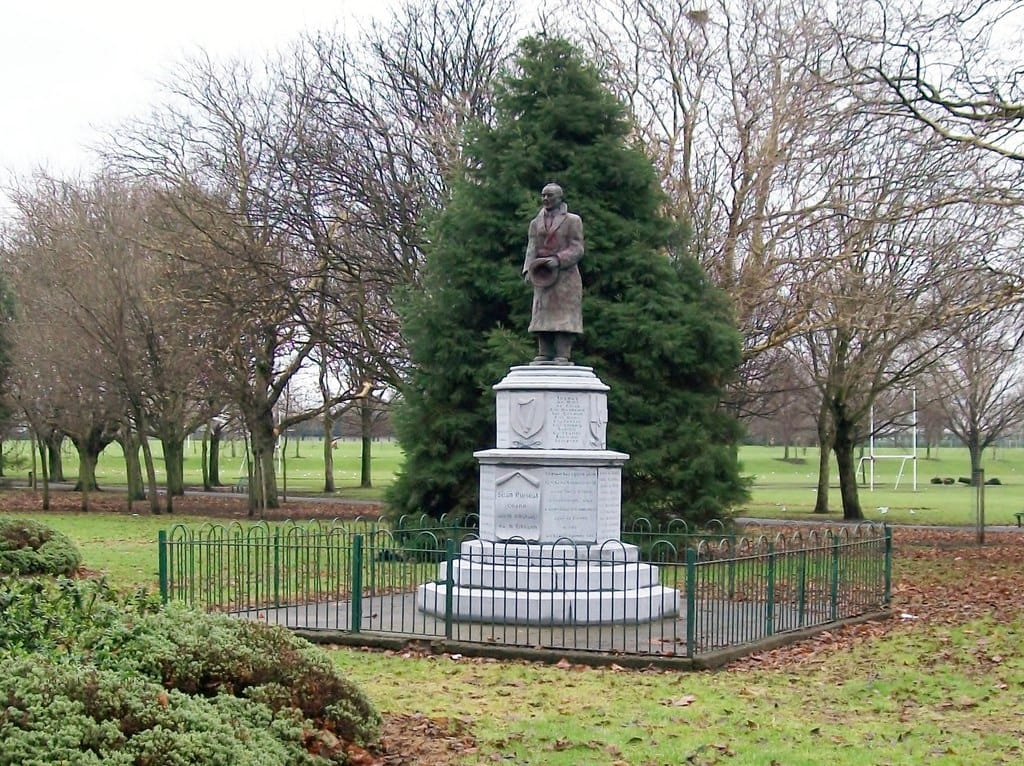
The alternative is what we have now: Younglads standing around a statue in Fairview Park with a plaque claiming Séan Russell gave his life for Irish freedom, commemorating him, while omitting the inconvenient detail that he died on a Nazi submarine while returning as part of a German military operation. That is not memory. It is mythology. I don’t blame or condemn those younglads. They are doing exactly what has been normalised and valorised by a movement and seniors they trust and believe in. I’m not concerned about younglads having a day out in the park, I’m concerned by the revival of his commemoration without the valid criticism and what Russell’s actions and legacy represented and led to being known. What they want to do with that criticism is their own business.
Mythology is brittle. It breaks down when challenged. When the facts about Russell are raised, the instinct of his defenders is to shout, to obfuscate, or to change the subject. That is the behaviour of a movement too afraid to be honest.
A confident movement can say: yes, Russell fought in 1916. Yes, he was a committed republican. And yes, his leadership led the movement into disaster, his campaign killed civilians, and his final mission was undertaken with the support of the Third Reich. All of those things are true. We hold them together because we are not afraid of the truth.
The left-wing of Republicanism has nothing to lose from honesty. Our heroes are not perfect, but their imperfections do not compare to the moral murkiness of Russell's final years. Frank Ryan fought fascism. The Limerick volunteers fought fascism. They are not diminished by an honest look at their lives. Russell is diminished, and that is exactly why his defenders are so afraid of honest scrutiny.
A movement that cannot criticise its dead cannot correct its living. If we cannot say that Russell was wrong, then we cannot say that anyone is wrong. That is cultish.
Republicanism should not be a cult. It should be a living political tradition, capable of growth, capable of change, and capable of admitting when it went badly wrong.
Conclusion
Peter Irvine is right about one thing. Séan Russell was constant. He stayed the same man from 1913 to 1940, refusing to compromise, refusing to bend.
But constancy is not a virtue in itself. It is entirely situational. A man can be constant in his stupidity, constant in his arrogance, constant in his willingness to sacrifice others for his own sense of destiny. Russell was all of those things.
He was brave in 1916. He was reckless in 1939. He was a collaborator by 1940. The first fact does not erase the last. The last fact is the one that matters most.
Irvine asks us to revere Russell's character while criticising his strategy. But the strategy was not a separate thing. The strategy came from the same narrowness, the same disregard for ordinary people, the same willingness to use any tool that came to hand. The man who bombed civilians in Coventry was not a different man from the one who boarded a Nazi submarine. He was the same man, making the same decisions, for the same reasons.
McDermott says he objects to anti-fascism as a metric because it is "conceptually non-essential " to Republicanism. But anti-fascism is not an external ideology imposed on Republicanism. It is the natural political expression of what Republicanism claims to be: the defence of a people against tyranny.
A Republicanism that can collaborate with the most murderous tyranny in modern history has already abandoned its own principles. It does not need anti-fascism to condemn it. It condemns itself.
I will not be honouring him.
I will honour the anti-fascists. I will honour Frank Ryan, who fought Franco while Russell was asking Franco's backers for help. I will honour the Limerick men who went to Spain. I will honour the socialists and trade unionists who refused to bow to fascism at home or abroad. Many who died in the camps, they were the first put into the camps after all.
I am first of all a socialist. I have no loyalty to conservatives even if they are also republicans. Even if he was a socialist, it wouldn’t change the facts of his actions.
Before I even wrote the first article a good friend of mine told me “not to be afraid of liberals” when I was objecting to Aontacht covering the commemoration at all. I have no fear of liberals, I’ve been accused of liberalism on social media since writing the article, which is a farce, because rehabilitating the image of a conservative who collaborated with fascists because they feel it makes other aims easier, is exactly liberalism. My only loyalty lies with the Irish working class and our equivalents around the world. This is the last thing I intend to publish unless seriously called out on the issue of Séan Russell for the moment as I believe this is all I need to say for now, and if this goes on much longer it will choke up Aontacht with nonsense.
But in conclusion I am less concerned with the history of Séan Russell than I am about what the revival of his commemoration may excuse in the present time and may pave the way for in the future. We seem to be having a re-do of the early 20th century in the early 21st century. I’m less concerned about Séan Russell than what could occur here with much of the West slipping towards fascism if we forget or refuse to recognise the mistakes of the past and start commemorating them again.
The republican tradition is bigger than Séan Russell and his ilk. It is better than him. And it is about time we started focusing on commemorating the better part of it as well as realising the ideals of a 32-county, socialist, egalitarian Republic.