Why Seán Russell Should Be Commemorated
Corkery's article is flawed on two fronts: historically, the portrayal of 1940s Republicanism as regressive overlooks its ideological nuance, and philosophically, anti-fascism is not the right lens through which to judge Republicanism.
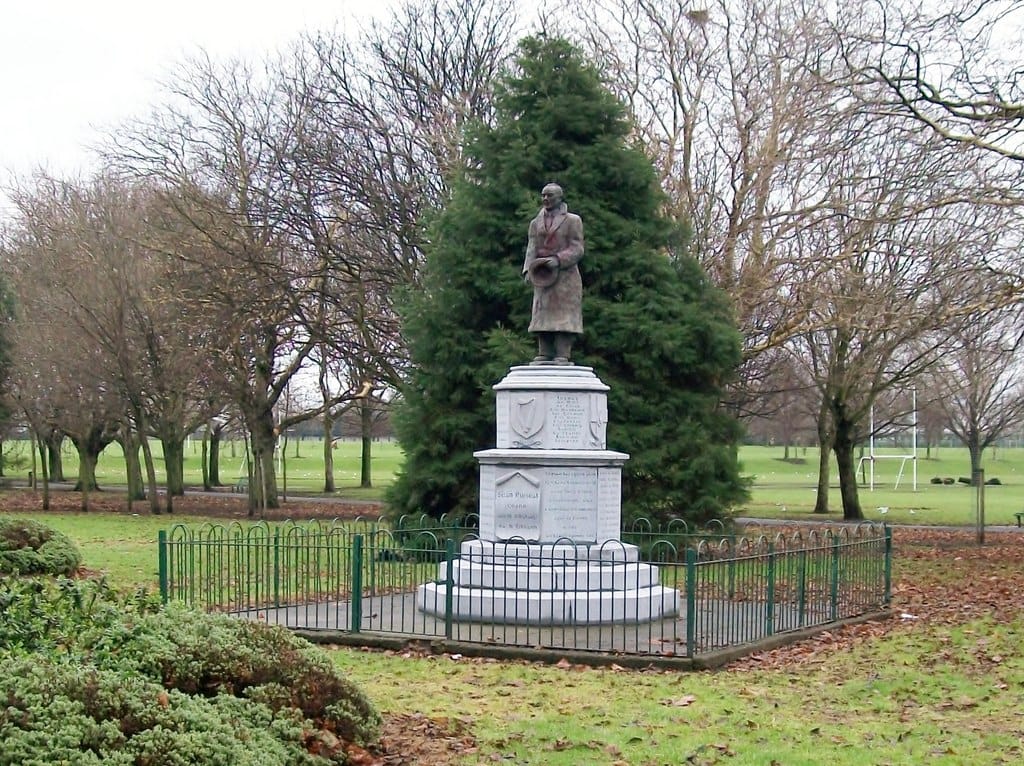
A recent Aontacht article by April Sheehan Corkery makes the claim that Republicans should not commemorate IRA Chief of Staff Seán Russell (1893-1940). While conceding that Russell was not a Nazi in belief, the article maintains that his actions—his association with the Abwehr, his seeking aid from Germany, his meeting with the likes of Joachim Von Ribbentrop—are functionally those of a collaborationist, rendering commemoration inadmissible.
Instead of merely repeating the traditional arguments in Russell’s defense, my response takes issue with two aspects of Corkery’s argument. Firstly, on historical grounds, characterizing 1940s Republicanism as regressive misses much of the movement’s ideological nuance, with some of the evidence deployed in a decontextualized and therefore misleading manner. My second objection stems from a traditional Republican worldview and questions the philosophical premise behind the article’s thesis: namely, is anti-fascism the proper lens for judging Republicanism?
Let us first begin with the historical evidence. Since a large number of points were made, I will only address the most important of these in chronological order.
The most inaccurate historical charge regards the nature of Russell’s ascension to Army leadership and the IRA’s subsequent ideological composition.
Concerning the “hostile” takeover by “conservative dissidents” (Russell’s men) and Tom Barry’s resignation, the juxtaposition of Russell’s conservatism with Barry’s departure is specious. The disagreement between Russell and Barry had nothing to do with conservatism and everything to do with strategy. Since 1936, Barry had objected to Russell's proposed bombing campaign in England, instead favoring an attack on the North. This plan was attempted during Barry’s tenure as C/S and failed, creating a vacuum for an alternate physical force strategy—Russell’s plan—to prevail.
When matters came to a head at the 1938 Army Convention, support for Russell or Barry did not neatly map onto ideological lines. It is correctly mentioned that John Joe Sheehy resigned from the IRA with Barry, for example, but Sheehy was himself against socialism and, as an IRA Executive member in the 1930s, voted against involvement in left-leaning schemes such as Saor Éire and the Republican Congress on multiple occasions. If Barry was associated with certain IRA conservatives, the opposite can also be said of Russell. Corkery is correct that Seamus O’Donovan (who Russell re-recruited into the IRA) was a Nazi, but it is equally true that two leftists sat on Russell’s Army Council. The case of Máirtín Ó Cadhain is well known, but an
additional figure, Army Council Secretary Paddy Fleming, was later associated with Official Republicanism. Clearly, not all of Russell’s supporters were conservative dissidents!
And just as Russell’s Army Council was ideologically mixed, so too was the Army itself. It is certainly correct that the IRA became more conservative in the 1940s, and it is also true that many Republicans of this generation rejected socialism and held right-wing views. At the same time, it should be noted that many socialists played an active and respected role in the IRA, including Seán McCool, Jim Savage, Pierce Fennell, John Joe Hoey, Liam Cotter, Tom Falvey, Derry Kelleher, Seamus Ronayne, and Mattie O’Neill—the list goes on. While interned in the Curragh, many of them debated socialist politics, ran a leftist newspaper, Splanc (named after Lenin’s Iskra, or Spark), and even discussed throwing the IRA behind the USSR in order to stop Nazism.
Furthermore, readers should be reminded that the IRA, far from “collaborat[ing] against our class and against our women readily with De Valera”, were themselves subject to horrific Free State repression. It is shocking to maintain that Republicans collaborated in any way with De Valera when hundreds of Volunteers found themselves “behind the wire” in the Curragh and died by firing squad and hangman’s rope. The likes of Goss, Kerins, McGrath, and Plant may or may not have held to progressive cultural mores, but they were implacable opponents of the Free State and gave their lives for their position.
A close examination of the historical evidence, therefore, suggests that Republicanism was not reactionary during Russell’s time, but rather ideologically diverse, complex, and vibrant. It is true that there existed individuals such as Seamus O’Donovan (other right-wing Republicans could be found in Ailtirí na hAséirghe, for example), but to singularly focus on the movement’s “fascist” affinities elides the period’s nuances and creates an incomplete—and misleading—image of 1940s Republicanism.
Finally, before departing from my argument’s historical dimension, as a New York-based traditional Republican I would firmly disagree with the assertion that Russell “barely met with the Irish American diaspora for support” and met instead with the German-American Bund during his 1940 American tour. As the historian Gavin Wilk shows in his book Transatlantic Defiance, the allegation (echoed by Tom Barry) that Russell visited America to fundraise with German-American Nazis is almost certainly untrue. In fact, Russell spent most of his time in America with Ireland’s exiled children, constantly accompanied by Clan na Gael leaders Joseph McGarrity and James Brislane during his travels. He even addressed a Clan Convention at the Irish-American Club in Philadelphia and met with Republicans in Los Angeles, San Francisco, Portland, Butte, and Chicago. The Bundist connection was a story concocted by a British WWI veteran living in California, Alfred Dinsley, who was declared unreliable by British consular officials and therefore cannot be trusted.
Having covered the historical angle, I wish to end by challenging critics of Seán Russell on the following grounds: Corkery’s article argues that regardless of his rationale in seeking German aid, Russell’s collaborationism is compromising. Even if he was “simply using Germany for Irish ends… anti-fascism does not allow that defence.”
But is anti-fascism the standpoint from which Russell should be judged? If so, I can see why the article comes to its conclusions. There is a certain relationship between Russell and the Third Reich that Republicans must contend with honestly, and I find criticisms along these lines understandable—granting a certain framework. However, that is precisely the problem, because my framework is different. I object to using anti-fascism as the metric to judge Republicans because both fascism and anti-fascism are conceptually nonessential to Republicans qua Republicanism itself.
At root, Irish Republicanism is an assertion of Irish nationality given form and meaning by the establishment of a sovereign All-Ireland Republic during the Irish Revolution. To be a Republican is to hold true to that Republic and to work for its realization. In this sense, genuine Republicanism transcends left and right, for outside of the fundamental Republican demand—from which the other principles of abstentionism and the right to physical force flow—Republicans have historically held contradictory positions. Some have been good Catholics, others atheists. Some were socialists, others staunch anti-communists. Some rejected all isms, preferring only the rock of the Republic. The point is that various belief systems may be held alongside Republicanism, but these systems are not necessary in order to be identified as a Republican. An individual can be an anti-fascist and a good Republican, but an anti-fascist cannot reject the Republic and lay claim to the noble name of Republican.
People should be free to critique Russell’s actions, especially given the nature of Nazi Germany and other Interwar dictatorships. But I do not see why anti-fascism must be the yardstick by which he is measured. If Russell called himself a Republican, let him be judged first and foremost in Republican terms.
Under such a framework, I can celebrate both Seán Russell and Frank Ryan, Pádraig Pearse and James Connolly. All who gave the full measure of devotion to the Irish Republic will have my praise, and by Republican standards it is apparent that Seán Russell—1916 veteran, Quartermaster-General, Chief of Staff—kept his faith as well as the best of our martyrs. Surely, I submit, that is something worth commemorating.