Thousands Of Irish People Take To The Streets To Block A British Loyalist March That Nobody Wants
The Orange Order hasn't marched the Garvaghy Road in 28 years but the Parades Commission just said they could. The community said no. They are still saying no, in the pouring rain, and vow to continue fighting.
Good day, Aontacht readers,
And something is happening in the North of Ireland today that I want to tell you about, because it is one of those stories that tells you everything about where we actually are in this supposed peace process, and about the gap between what Britain says about Ireland and what it does in respect to Ireland.
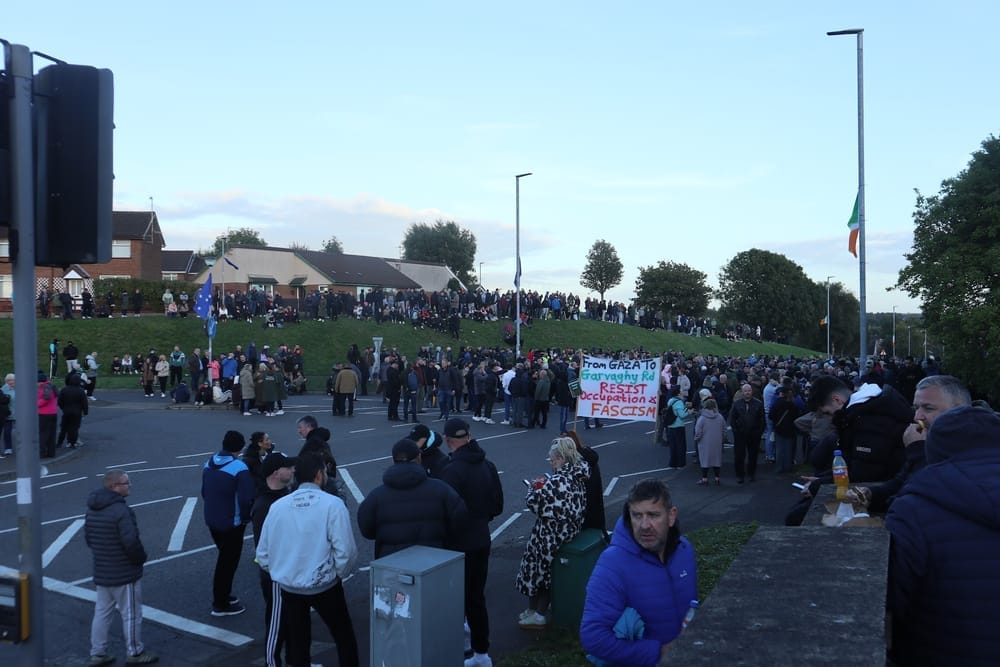
This morning, in the pouring rain, thousands of people gathered on the Garvaghy Road in Portadown to block an Orange Order march that nobody in that community asked for, nobody in that community wants, and which the community has been consistently and clearly rejecting for nearly three decades. Michelle O’Neill, the Sinn Féin First Minister of the North of Ireland, was there. Mary Lou McDonald, president of Sinn Féin Ireland, was there. Breandán Mac Cionnaith, the Garvaghy Road Residents’ Coalition spokesperson who has been fighting this particular battle since the 1990s, addressed the crowd and told them there would be no negotiation, and that if the police wanted to clear the road they would have to use force to do it.
Watch: People sing the ancient Irish war song, Óró, sé do bheatha abhaile, whilst blocking the road.
The crowd linked arms. The march did not start on time. By midday, it still had not moved. The community of the Garvaghy Road, joined by supporters from across Ireland, stood in the rain and said no.
This is where we are. This is what the peace process looks like in 2026.
what the orange order is, and what this march is about.
For readers who are not familiar with the very long and complex history of British colonialism in Ireland, a brief explanation is necessary, because the Orange Order and its marches are routinely presented in the British media as a benign cultural tradition, a bit of pageantry, the kind of thing that reasonable people on both sides ought to be able to accommodate. This framing is, to put it gently, dishonest.
The Orange Order is a Protestant fraternal organisation founded in 1795, explicitly dedicated to the maintenance of Protestant supremacy in Ireland and the connection to the British Crown. Its marches are not neutral cultural expressions. They are deliberate assertions of dominance, routed specifically through Catholic and nationalist areas to make a point about who controls the space, who belongs, and who does not. The Drumcree parade is the most notorious example of this, a march that returns from a church service along the Garvaghy Road, a predominantly nationalist and Catholic area in an otherwise heavily unionist town, specifically because the route passes through a community that does not want it there. That is not incidental to the tradition. That is the tradition.
The Garvaghy Road has been a flashpoint since the mid-1990s, when the dispute drew international attention and threatened to derail the peace process entirely. In 1996, following a loyalist standoff and widespread violence across the North, the RUC forced the march through against the wishes of residents. In 1997, security forces locked down the Catholic area before dawn and let the march proceed, citing loyalist threats to kill Catholics if it were stopped. People were killed during the tensions of those years.
Watch: Marie-Therese Murray protests on Garvaghy Rd. She holds a photo of her 12 yr-old son Darren, who was knocked down and killed 30 years ago after being chased by loyalists. She rarely speaks about her loss but felt she had to today.
The trauma of that period is not abstract history for the people who live on that road. It is lived experience, and it is the reason the Parades Commission banned the march from the Garvaghy Road in 1998 and upheld that ban, year after year, for twenty-eight years.
Until last Friday, when it reversed course entirely.
what the parades commission did, and what the courts did.
On the 25th of September 2026, the Parades Commission granted permission for the Drumcree parade to proceed along the Garvaghy Road for the first time in twenty-eight years. The conditions attached were designed to make it look less provocative: no more than 35 participants, an 8am start, no bands, no supporters along the route. The Garvaghy Road Residents’ Coalition and the community they represent described their reaction as shock and fury. They had made their opposition unambiguous, through signatures, through statements, through every available channel, for decades. The Parades Commission consulted the legal framework and decided that 35 silent Orangemen at 8am was an acceptable imposition on a community that has said, clearly and consistently for a generation, that it does not want them there at all.
Residents immediately sought legal protection. A High Court judge granted a temporary injunction, recognising the potential for the dispute to escalate. That injunction was overturned in the early hours of Sunday morning, after a night of emergency sittings of the Court of Appeal and the High Court. The judges ruled that the Parades Commission’s determination could not readily be substituted by the courts. The legal process, in other words, looked at a community blocking a road in the rain and decided that the procedural rights of the Orange Order took precedence over the clearly expressed wishes of the people who live there.
Mary Lou McDonald described it as madness, as primitive treatment of a community in 2026. O’Neill called it a threat to the peace process and asked aloud how the process is supposed to function if settled questions can simply be reopened at the request of an organisation that has never accepted the ban. Mac Cionnaith told the crowd that if force is used to clear the road, so be it. The community will not yield again.
Watch: Michelle O’Neil, First Minister of the North and leader of Sinn Féin in the North speaks on the issue at the blockade.
The Irish government said it was monitoring the situation closely and was very concerned. The British Secretary of State has been called upon to intervene. Scottish police officers, brought in as mutual aid, are present on the approach roads to Portadown. Armoured vehicles are on standby. All of this, so that 35 members of the Orange Order can walk in silence through a nationalist neighbourhood at 8 in the morning on a Sunday, for no reason except that they have always done it, and because some institutions in the North of Ireland still tilt toward the assertion of Protestant supremacy over the democratic wishes of Catholic communities when the two come into conflict.
This is the last colony. This is what it looks like. The peace process produced real and important gains, and the people defending the Garvaghy Road today know that as well as anyone, because they fought for those gains and they remember what came before them. But the peace process was always fragile, always dependent on both sides operating in good faith, and the Orange Order’s insistence on this march, and the Parades Commission’s decision to grant it after twenty-eight years of settled precedent, is not good faith. It is a test of whether the gains of the past three decades can simply be reversed by institutions that were never fully decolonised in the first place.
The answer, this morning, is standing in the rain on the Garvaghy Road with its arms linked. And it is saying no.
And on that thought, I will let you go.
This article was originally published in the Spectacle.