They Are Killing the Dogs, They Are Killing the Cats: The Calculating Cruelty of Colonial Deflection
An Irish socialist perspective on ICE, weaponised innocence, & the pedigree of exclusion.
They Are Killing the Dogs, They Are Killing the Cats: The Calculating Cruelty of Colonial Deflection
April Maria Sheehan Corkery
An Irish socialist perspective on ICE, weaponised innocence, & the pedigree of exclusion.
They told us they were eating the dogs.
It was a lie, of course, one more piece of cartoonish dehumanisation lobbed into the chaotic 2024 election circus. “They are eating the dogs, they are eating the cats,” the former president seeking a second jab at accelerating the decline of the American regime declared of Haitian migrants, a phrase so absurd it almost defied rebuttal. But in the grotesque logic of American powerstructures, the lie was never meant to be believed literally. It was meant to re-draw a line. On one side: the civilised, evolved, the pet-loving, the morally concerned. On the other: the animalistic, the corrupt, the threat.
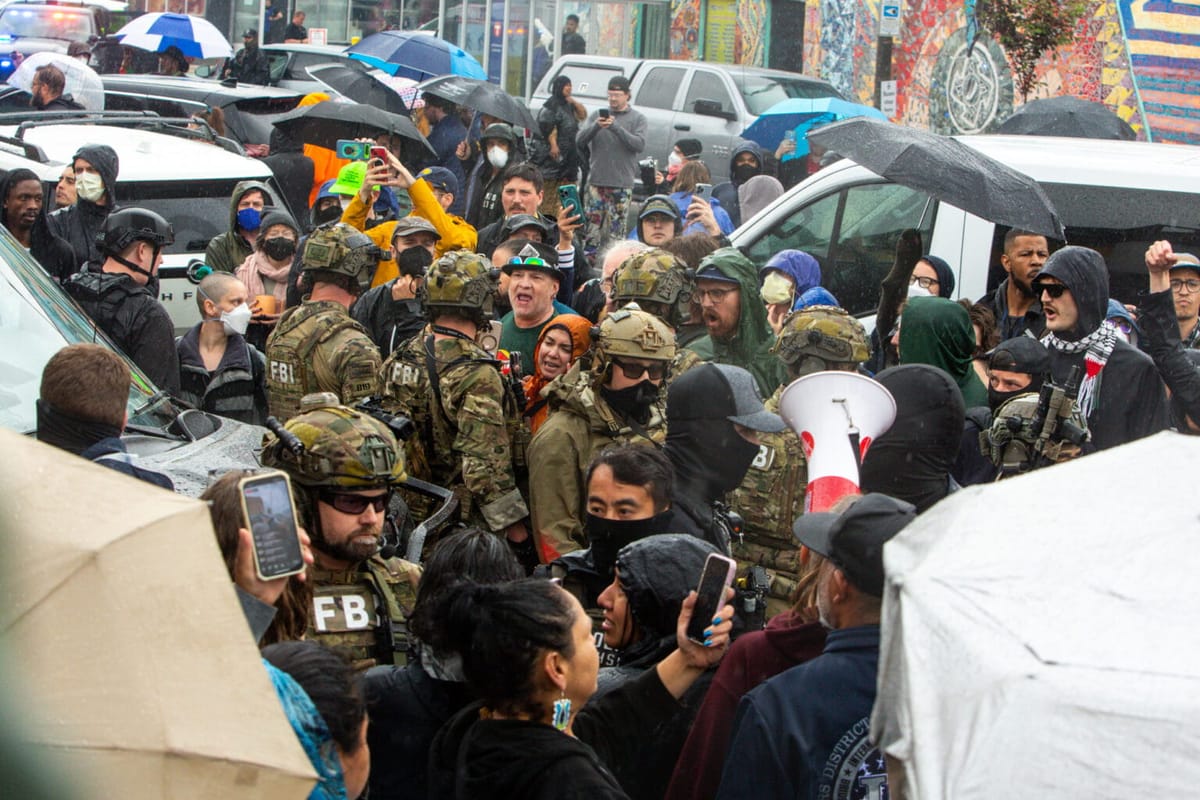
In the brutal winter they have had in America this year, with Ice storms & ICE storming communities, we see the brutal, literal truth that was obfuscated by the absurd lie.
They are eating the dogs, eating the cats says he, while ICE, led by a woman who shot her own 14 month old puppy leaves them to starve or freeze to death.
We are draining the swamp says he, while filling every role in the US government with the creepiest, most depraved & corrupt individuals in public life.
We are protecting the kids says he, while simultaneously being a pedophile amongst pedophiles & rounding up children into camps awaiting deportation.
I could fill a whole article with this alone & might yet.
While ICE paramilitaries conduct sweeping raids, snatching people from homes & streets, citizens & migrants alike, their common trait often only the color of their skin; a quieter tragedy unfolds in their wake. Pets are left behind. Dogs whimper in locked cars towed to impound lots. Cats stare from silent windows at empty homes. A small dog was found in a St Paul Minnesota impound lot a full month after his owner disappeared into ICE custody; he survived, barely, a testament to animal resilience. He unlike many survived & is now in a rescue who named him Otto. Others were not so lucky. They die of starvation, of thirst, of cold. They die because the state that seized their people could not be bothered to so much as call animal control.
Here, in the public reaction, we see the twisted machinery of American “morality” snap into its familiar alignment. There is outrage over the fate of the animals. “How could they leave their pets?” some ask, the question already tilting toward blame. Comment sections fill with condemnations of such heartlessness, donation links for shelters are furiously shared, pet alert posts go viral. Meanwhile, the disappearance of tens of thousands, perhaps hundreds of thousands, of human beings into an expanding network of camps, detention centres & deportation flights in cargo planes, the green-lighting of deportations to El Salvador for even U.S. citizens, the whispered reports of people lost entirely in custody to god knows what fate, these met with a quieter, more complicated, more divided response.
This disparity is not a bug in the liberal moral code. It is its oldest founding feature. In order to understand the present brutality, we must trace the cursed historical pedigree of this selective empathy, a lineage that runs from the founding colonies, through the national parks, into proto fascist eugenics movements, & straight into today’s detention camps. It is a story of how America has always defined some lives as worthy of protection by defining others as dangerous or disposable & how the “innocent” animal, white child or white woman has often been the foil for this violence.
The Founding Hierarchy: Protecting Livestock, Enslaving People
The legal architecture of American compassion was built on a foundation of explicit exclusion. In 1641, the Massachusetts Body of Liberties enacted one of the earliest animal anti-cruelty statutes in the Western world, prohibiting “Tyranny or Cruelty towards any brute creatures which are usually kept for man’s use.” In the same breath, the colony legally codified chattel slavery. Enslaved Africans were property, not persons under the law. They weren’t even afforded the protection of the livestock. Their suffering was legally irrelevant unless it damaged their owner’s asset. Native Americans, when not being massacred or displaced, were placed entirely outside the moral & legal community.
This was not an oversight, but a deliberate ordering of creation. The European settler, the human at the apex, could extend his benevolent dominion downward to the beasts of the field, while those he racialised as sub-human existed in a zone of legal non-being. A century & a half later, this logic held firm. In the 1829 case State v. John Mann, the North Carolina Supreme Court overturned a fine imposed on a white man for shooting an enslaved woman named Lydia in the back as she fled. The court ruled the master’s (or hirer’s) authority absolute; an enslaved person was not a moral subject but a willful piece of property. At the same time, beating a horse to death in the public square could land a man in the stocks for “unnatural cruelty.”
The first child abuse case in the United States, that of Mary Ellen Wilson in 1874, had to be prosecuted under animal cruelty statutes because no laws existed to protect children from their guardians. The New York Society for the Prevention of Cruelty to Children was founded after & modelled on the American Society for the Prevention of Cruelty to Animals (ASPCA). The pattern is unmistakable: legal & moral concern trickled down a hierarchical chain of being. First, the white man’s property (animals), then his vulnerable dependents (white children), & always, always later, if ever, the racialised other.
This appears to be a feature of colonial powers, as the same is true of Britain & Germany. Earlier in 1824 the RSPCA was founded, The NSPCC wasn’t founded until 1883 actually taking inspiration from the New York Society for The Prevention of Cruelty to Children.
See also the transformative political & legal reaction to the publishing of Black Beauty which was the biggest single event in history to the rights of working animals, compare that to the works of Dickins, while people sympathised to a degree they did not have the same public outcry resulting in structural change effect.
Nazi Germany expanded animal rights at the same time as they started stripping human rights. Motivated by a twisted ideology that venerated nature while dehumanising “enemies”
The reasons why are complex, & should be separated from the anti extractive dual care for humans, the animals & the environment exemplified by modern socialism.
- Lower Threat to Power: Regulating individual acts of animal cruelty does not challenge the political, social, or economic order. Extending voting rights, free speech, or equality to all humans directly threatens established hierarchies.
- Moral Simplicity: Preventing obvious, gratuitous suffering resonated & resonates with religious and emerging humanitarian sentiments without requiring complex political philosophy.
- Social Control: Animal welfare laws were sometimes seen as a way to “civilise” the lower classes or ethnic minorities & promote order. (A modern Irish example would be the control of horses laws, which largely serve to curtail the travelling community while providing almost no actual welfare for horses & a blind eye is turned to the abuse of horses by the wealthy which is usually on a much larger, semi industrial scale) The 1933 German law is the extreme case, showing how a regime can rhetorically elevate “animal protection” while utterly annihilating human rights, as part of an ideological worldview that placed the purity of nature and the Volk above universal humanity.
Conservation & Eugenics: Breeding a Pure Nation
This ideology entered its most perverse form in America, in the Progressive Era, where the movements for animal welfare, wildlife conservation, & human eugenics converged. They were not strange bedfellows but branches of the same philosophical tree: a drive to manage, purify, & protect what its adherents deemed “fit” & “noble” from the threat of degradation & “mongrelisation.”
Madison Grant is the patron saint of this convergence. Today, he is nostalgically remembered as a co-founder of the Save the Redwoods League & a pivotal figure in the creation of the Bronx Zoo & the movement to save the American bison. He is also the author of The Passing of the Great Race (1916), the racist tome that became a cornerstone of Nazi ideology. Actually referred to by Hitler as “My Bible”.
For Grant, there was no contradiction. Protecting the “majestic” redwoods & the “noble” bison from extinction was of a piece with protecting the “Nordic race” from pollution by “inferior immigrant stock”. He was a vice president of the Immigration Restriction League & helped draft the 1924 Immigration Act, which slammed shut America’s doors to Jews, Italians, & Slavs.
He was not alone. Much like today the elite of the day were full of hubris & passion for “modern” social control & engineering the human race, the world & everything in it, into a monument to their own Narsisism. John Harvey Kellogg, of cereal fame, promoted vegetarianism & animal welfare while founding the Race Betterment Foundation, advocating for the forced sterilization of the “unfit.” William T. Hornaday, the fiercely dedicated director of the Bronx Zoo who championed bison conservation, was also a virulent racist who, in 1906, placed a young Congolese man, Ota Benga, in the zoo’s monkey house as a living exhibit next to an Orangutan. The conservationist & the eugenicist shared a worldview: a hierarchy of life where value was determined by purity, nobility, & usefulness to a prescribed order. The “unfit” human & the “vermin” animal were alike candidates for eradication; the “noble” human & the “majestic” animal were alike candidates for preservation at the expense of the others.
The Wilderness as a Treaty-Land Loophole
This exclusionary impulse found its ultimate physical expression expressed on the land itself. The creation of America’s cherished National Parks, often hailed as a noble act of preservation, was in fact a final, devastating act of settler-colonial dispossession. The “wilderness” needed to be saved, but first it had to be emptied of the Indigenous people who had inhabited, shaped, & belonged to it for millennia. This continues today in much of the global south as well.
Yellowstone, established in 1872, was carved from the ancestral lands of the Shoshone, Bannock, Crow, & others. Treaty-guaranteed hunting & gathering rights were simply overridden by the new federal designation. The U.S. Army was deployed to keep Native people out, recasting them as “poachers” in their own homeland. In Yosemite, the Ahwahneechee people were violently evicted, their villages burned to create the “pristine” vista that inspired John Muir who himself progressed from romanticizing first nations people as part of the scenery to advocating for their removal as a “stain” on the wilderness.
This was the legal & ideological loophole in action armed with good PR. Treaties could be bypassed not by outright seizure for farms or towns, but by the “higher purpose” of preservation for the American people. The land was re-imagined as a virgin wilderness, a terra nullius requiring protection. This required the erasure of Indigenous history & ongoing stewardship. The logic was, & remains, circular: the land is pure because we removed the people; we removed the people to keep the land pure. It is the ecological rendering of the innocence paradigm: the landscape itself becomes the innocent to be protected, while its original inhabitants are transformed into a threat.
From Impounded Dogs to Disappeared Humans
This brings us back to the frozen car in the Minnesota impound lot & the sprawling camp where its owner may now be held. The historical threads converge in the present crisis.
The dehumanising rhetoric (“eating the dogs”) prepares the ground. It marks the migrant, the Muslim, or even the Black activist, the poor, anyone deemed outside the national body as less than fully human, as a corrupting agent. Then, the state acts, with the paramilitary violence of ICE or the targeted revocation of passports. & when the collateral damage includes the truly innocent: the pets who are, in our cultural schema, the definition of blameless dependency a moral short-circuit occurs.
The liberal conscience, heir to the hierarchical compassion of Grant & Kellogg, is activated by the innocent animal. The suffering of the animal is simple, apolitical, & absolving. To care for it is to be a good person. The suffering of the detained human, however, is complex, politicised, & demanding. They may have crossed a line, they may have a “record,” they may be framed as agents of their own misfortune. Empathy always stalls at the border of blame. “Why didn’t they have a plan for their pet?” is the modern, liberal echo of the colonial question: “Why didn’t they improve the land?” It is victim-blaming dressed as pragmatic concern, a way of aligning oneself with the forces of order while maintaining a self-image of kindness.
The same pattern is visible in the international arena. In Gaza, where a genocide documented by international courts proceeds fully unimpeded with Western support, a viral story about a rescued cat or a starving donkey can sometimes generate more uniform, less qualified sympathy in Western media than the slaughter of Palestinian children. The child is inevitably framed through the politics of blame “Hamas shields,” “complex history.” The animal is just an animal, an innocent in a warzone. Its suffering is a safe outlet for a conscience troubled by, but ultimately complicit in, the greater crime. A good example was the Dublin dog rescue that tried to rescue a stray dog from a man starving in a tent, no attempt to rescue the man along with the dog. We are not immune to it ourselves. It is a growing problem with us the more we get subsumed into western culture & identity. There is an old saying “better to be an Englishman’s dog than his son” that’s becoming true of all of us.
Breaking the Skewed Hierarchy of Compassion
The task before us is to break this inherited dichotomy. It is to recognise that the outrage over the dog in the impound lot & the outrage over the person in the camp are not separate concerns, but the same one. If the person wasn’t in the camp his dog wouldn’t have been left to starve in the car. If the poor & the migrant are provisioned for & left in peace they will provide for their animals. It’s as simple as that. They are both part & parcel of a system of power that creates hierarchies of worth to facilitate exploitation & violence.
Solidarity cannot be conditional on innocence, for innocence is a political designation granted by the powerful. The fight for animal welfare is righteous, but it becomes a moral alibi if it is not wedded to the fight for human liberation.
The colonists protected livestock while enslaving people. The conservationists saved redwoods while plotting ethnic cleansing. The state today abandons pets while disappearing their owners. The through-line is the calculating cruelty of colonialism: the relentless sorting of life into categories of worthiness & waste.
To oppose this, we must build a politics of radical, undifferentiated solidarity. One that sees the freedom of the migrant, the right of the Indigenous people to their land, the survival of the Palestinian child, & the fate of the abandoned dog as inextricably linked. They are all casualties of the same machine. Saving one requires dismantling the system that sacrifices the other. The test is not whether you would free the dog from the car. The test is whether you understand that you must also shatter the system that put the human who loved that dog in a cage. Only then do we begin to build a world where compassion is not a luxury given freely only to those who are the least political threat, but the foundation of all society & human interaction. .