


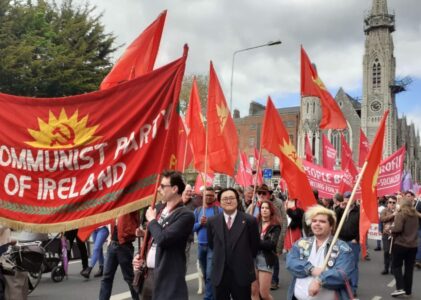
The Communist Split in Short
Alexander Homits
Introduction
The purpose of this text is to assess the shortcomings, failures and issues that surrounded the split of the communist movement in Ireland. The analysis is based on discussions with former and current members of the three different communist organizations in Ireland, but presented in a non-exhaustive and personalised way i.e through the prism of my personal experience, therefore parts of it are without a doubt specific to my own experience.
What has become clear since the split is that the issues Irish communists under the age of 30 face were not unique to them or to Ireland. In fact, splits based on younger more radical communists taking charge versus old geriatric comrades rooted in ritualistic schedules of meetings and paper sellings are taking place everywhere.
When I travelled to Russia in 2019, one of the first things the young Komsomol member who gave me a spin asked me was whether we were either a revolutionary party or a reformist party. I told him that this debate was taking place inside our movement, but that most young people leaned towards seeing themselves and their organisation as a revolutionary one. He said that this was the same in Russia, and that this great debate had already caused internal issues within the KPRF with some having went off and formed new communist organisations.
In Athens at Odigitis in 2018, at MECYO in 2019 in Vienna, these issues re-emerged among multiple youth organisations. Indeed, the Austrian youth organisation is affiliated to two communist parties on a case by case basis according to the districts and the specific conditions of each district.
In Australia, a split also took place and it too was characterized by a push from younger communists wanting to get stuck in, versus older communists who were described to me as “gatekeeping” and simply “not interested”. While these testimonies are personal and anecdotal, they, along with many others, show a pattern of events unfolding across the Western world in communist parties and communist groups.
To give the Irish communist split the assessment it deserves, I will break this contribution down into three separate sections, covering three separate ‘phases’ of the split. In the first phase I will talk about my introduction to the communist movement, its ‘status’, the goals that were being set and the work that was being carried out.
In the second phase, I will contrast the growing contradictions between the two organisations and the early attempts to split the two organisations by certain members of the CPI.
In the third phase I will comment on some of the post-split conclusions that I and my comrades have drawn and give suggestions on where we are going next in our ambition to build a militant communist movement in Ireland.
Phase I
Every step of real movement is more important than a dozen programmes. Karl Marx
While in Connolly Books an air of acute anti-electoralism always existed, in Cork, there was a tradition to run a candidate as a means of advertising the existence of the Communist Party of Ireland. Through the candidacy of Michael O’Donnell I found myself speaking to Noel Murphy, a long standing member, butcher, and the then General Secretary of the Independent Workers Union. I was given a general political history and introduction of Irish communism, the tradition from which it saw itself derive from and the contemporary struggle it found itself in today.
Despite the sheer impossibility of a revolution in Ireland, I found myself drawn both to Noel personally as a sound aul’ fella, but also the general principles he outlined the Communist Party to stand for. He also made the very obvious point that he was old, I was young, and that for the communist movement to live on, more young people would need to step into the ranks. The best way that could happen would be through the youth wing of the Party, the Connolly Youth Movement. The result of my conversation(s) with Noel resulted in my subsequent application to both the Communist Party of Ireland and to the Connolly Youth Movement.
After a short time I was accepted and connected to the only other CYM member in Cork who was living in Millstreet at the time. The two of us bounced some ideas around and with Noel’s guidance were able to put together the requisite amount of people needed for a Cork CYM branch.
I think that it should be noted here that besides “electing a chair and secretary” little guidance was given from the ‘center’ about structural matters i.e the running of a branch, procedures, fairness, natural justice etc or organisational matters i.e what should the CYM be doing on a day to day basis. Much of what we did was not too different from what other left wing parties got up to and still get up to – i.e protesting, having stalls, handing out flyers and the like.
This lack of guidance will resurface as a pressing contradiction between the two organisations in the near future. It spoke not only to our own difficult way of learning, but also to the lack of substantive knowledge within the CYM at the time.
Some of my earliest meetings in the CPI were badly chaired, went on for hours and had very few tangible and practical political conclusions on political work. In one way this was inherited into the CYM, in another way, it generated an organisational contradiction. It was fairly obvious that this wasn’t a model we wanted to replicate.
We attended the first ‘national’ meeting of the Connolly Youth Movement in January 2015 which comprised less than a dozen people. The meeting elected a chair and general secretary, had a brief political discussion and went separate ways. The meeting also had a Venezuelan comrade at it who talked about the political situation in Venezuela.
Over-all the meeting was fairly weird and gave no general direction or vision for the Connolly Youth besides how important it was for the paper, ‘Forward’ to be launched. To recall this in hindsight is relatively entertaining – the ambitions of a youth organisation being bound up in running a newspaper!
In trawling through my email correspondence between 2015-2017 I find a generally off-handed approach to provision of guidance for members of the CYM with basically emails that the now ex-general secretary Eugene McCartan was sending around being re-sent around to the CYM mailing list.
There existed no systematic or structured approach to education. No formal education on administration or officer roles and no real internal political discussions on the nature and purpose of the youth organisation and its relationship to the Party.
The same period generated the first campaign the CYM was involved in, Work Must Pay. WMP focused on businesses using the exploitative JobsBridge scheme and pressured businesses into withdrawing themselves from participating in it by protesting outside their doorstep. The scheme was being used up and down the country and as such, allowed the nascent Cork CYM to launch a number of protests in Cork. It was the first tangible piece of work CYM members could involve themselves in and it is fair to say that we jumped straight into it in Cork, forcing business after business to take down their advertisements and drawing in some interest from others. It is also fair to say that the drive for WMP in Cork came almost entirely from the CYM and as a result did lead to growth for the CYM.
Here too, the absence of explanation of the mechanics of WMP as a short term strategy for short term victories is felt. The question as to whether we are simply a glorified protest group arises in the CYM for the first but not last time.
In the background, questions about who is making decisions, where these discussions take place and why they are all in Dublin are bubbling away. It’s important to note that despite having a constitution, it was seldom referred to and regularly bent to fit the personal – political outlook of who controlled the CYM. When the constitution was invoked for eg. in sharing of information or holding of regular executive committee meetings, there was always pushback to stifle very basic democratic procedures.
Combined with lack of any structural or systemic education about the nature of a constitution and how it corresponds to the rights of members, this made for a deadly mixture.
To summarise, the condition of the CYM upon my entry into the organisation was that it was a small organisation, that received no specific guidance, education or instruction on the substantive aspects of organisation building but was more or less tightly controlled from Connolly Books.
Phase II
Is what you are doing good for your class, or your party? Bernadette Mcaliskey
When you are active in a number of projects, you begin to test your theoretical worldview with said practical experience. If you shy away or hide from practical work and experience, you will never test nor challenge your theoretical worldview and therefore may remain in an endless cyclical rut. This can most certainly be said for the Trotskyist parties and their off-shoots, who without much self-awareness continue to bandwagon off larger campaigns and have, despite having elected representatives and millions in state funding, not achieved very much at all.
Their presence in mass organisations is minimal and tends to be badly co-ordinated if co-ordinated at all. They exercise no real influence in working class communities, and their elected representatives are looking at total wipe-out from a center left party.
In the same breath I would criticize the lack of ‘testing’ the CPI has been involved in for decades. Internally, there are documents being distributed claiming that the party is leading the working class and is a vanguard party – in practice, CPI influence is negligible to non-existent in real and material terms.
This is the first and primary contradiction that emerged to us in the Connolly Youth Movement as we began to grow and engage with street activism of our own. “Who are the CPI” was not an uncommon question asked of members North or South.
I will elaborate on the contradictions within the CPI and how the CYM interacted with them below, referring to my personal political experience and the experience of other members past and present of the CYM.
Contradiction #1 – Tailism – Lobbying versus community work
The attitude in the CPI in Cork and Belfast was supportive of community work, while the attitude in Connolly Books was mostly derisive and condescending. Work conducted by CYM members was often called either adventurist, or “similar to the IRSP” (when commenting on a public clean up in Jobstown) and other bizarre comments that make you scratch your head.
It should be pointed out that despite all of these haphazard and petty comments made internally, the CYM continued to chug along, protest, disrupt, confront and make interventions in the way we thought possible – hugely drawing inspiration from the closest contemporary western communist street movement the Black Panther Party.
What all of this revealed however was not just a generally petty attitude to a more confrontational and militant activist milieu, but a convenient excuse to not go beyond the parameters of timid civility and newspaper article writing. Critics might say the CPI was avoiding bringing attention to itself from the state – but a closer reality is that the State has nothing to fear from the CPI and this is simply an excuse to avoid doing anything remotely uncomfortable.
There are theories as to why this took place. One theory is that the CPI is effectively involved in a form of lobbying-tailist strategy that separates it from the ‘street’ and ‘community’ and the working class while hyper-focusing on attempting to influence trade union officials or other people who might pass policy decisions. A quick examination of this strategy suggests that it has not yielded any tangible results and that motions that have been passed in conferences and events are simply buried by conservative union officials. In other instances, pointless bridge burning over wording of leaflets has also led to the CPI losing out on exercising ‘soft’ influence over other parties and influences.
This ‘lobbying-tailist’ approach is complemented by setting up front groups that are controlled by the CPI. While there is nothing inherently incorrect about setting up spaces to attract broader strata of our class, the net result has been similar to that of Maoist or Trotskyist ultra-leftism; nobody outside the same few people participate or involve themselves in these groups and if one examines the groups the CPI has set up this becomes clearly evident. In one sense we mimicked this approach in the CYM for some time, but I think over time it became obvious that this approach is incorrect and does not actually yield the desired result.
My own theory is that the average age demographic of the CPI was so heavily made up of older members, that over time, whether consciously or subconsciously, the strategy and overall aims of the CPI began to accommodate that. In one way, I can appreciate the practical reality of that, in another way – if the comrades in question have no self awareness of it, then it makes sense that their own self-imposed limitations became normal party policy and as a result the ‘direct’ line of work suffered.
Another issue that emerged was that the CPI strategy was closely cultivated around setting up pre-conditions such as the election of progressive governments north and south before any ‘real’ drive to socialism could take place.
In our eyes as young communists this was broadly perceived to be an outdated political analysis that disregarded the very standard Marxist Leninist world outlook on the necessity of revolution, the dictatorship of the proletariat and the necessity of socialism.
By reducing revolutionary struggle in Ireland to a number of convenient pre-conditions, the CPI had set itself up for permanent stasis and failure. This in of itself was completely unacceptable to the membership, passion and drive in the CYM.
As a by-product of all of the above, we understood in the CYM that the way to exercise influence was to develop a militant and independent communist organisation that placed the needs of young workers and students first and foremost and that carried the communist message to the youth proudly. With its strength, it could then exercise influence among other activists and bring them to more progressive and developed political positions that challenged monopoly capital. In my mind, that objective has not changed.
Contradiction #2 Trade Unionism
“It’s not our job to organise workers” from a CPI union meeting many moons ago.
Since as long as I can remember there existed no real strategy inside the CPI in terms of dealing with trade unions. The majority of those involved in the movement were not lay members who were shop stewards or representatives, but former or current trade union officials whose view and placement was entirely different to that of a lay member. Not only did this create an additional contradiction that was never addressed (the contrasting views of a TU official versus a young member of a TU that’s not in any way radical) but it also helped frame CPI policy towards trade unions as being little more than lobbying and newspaper selling.
The second and major contradiction focused on the role of the Independent Workers Union. On the one hand, the treatment of Cork CPI members who involved themselves in the IWU could be explicitly called victimisation and bullying, other people either adjacent to the CPI but in senior IWU roles got a free and uncritical pass for their membership of the IWU. This never received any explanation whatsoever – but neither did the fiery and very unfair sectarian hatred of the IWU.
Other examples of pointless anti-IWU sectarianism include deliberately avoiding anything IWU related or supporting anything IWU related. For example Gerry Corbett, a skilled and knowledgeable trade unionist from Galway would run educational courses in the 61 North Strand IWU office. It was suggested CYM members attend for the purpose of honing their knowledge and improving their skills; the suggestion was shot down on the basis that this might damage our standing with ICTU.
Not only was this strategy not something the CYM ever agreed on at a national level (policy), it was also pointedly incorrect.
Just because ICTU is bigger and has more workers, does not mean that a communist organisation in Ireland cannot take a twin-track approach incorporating ICTU and non-ICTU unions into its strategy.
If an ICTU union doesn’t want to take on workers for example (which happens more often than not), the CPI could have directed people to join the IWU and helped them organise for better terms and conditions.
Instead a nearly point blank approach was taken to pretending the IWU did not exist. This contradiction became more sharply felt as the membership of the CYM grew, and those that were in non-union industries were encouraged to sign up to the IWU as the only trade union that was interested in fighting and not having festivals and meetings talking about fighting.
A final comment I will make is on the entire campaign regarding the 1990 Industrial Relations Act. The CPI successfully managed to convince trade unions and other bodies to start campaigning for its abolition. However, a seasoned trade unionist in the CPI, who despite their rich experience was effectively kept on the shelf and for that reason did not contribute to the formulation of industrial strategy on the campaign around the 1990 Act.
The net result of this process was that the CPI managed to provide a convenient excuse for lazy trade union officials to refer everything to the WRC and hyper-focused everything into political lobbying for the removal of the Act instead of organising workers. This gross misunderstanding of the 1990 Act led to a near fatalistic attitude inside the CPI that framed the removal of the 1990 Act as a necessary precondition for any and all organising.
Unfortunately, being relatively unseasoned members of the movement, we did not at that time have the knowledge to identify this as being incorrect practice and went along with it. Thankfully, through practical experience surrounding this legislation and active organisation of industrial action, this illusion has been shattered and work has been put into demystifying the legislation.
There has been a shift in this contradiction, but it has not come from CPI members studying the 1990 Act or leading industrial disputes. It has come from non-CPI members who have studied Kevin Duffy’s Guide to the 1990 Act and started discussing it. This is very evident with the last few episodes of The Week at Work.
Contradiction #3 Republicanism
In my tenure as General Secretary of the Connolly Youth Movement, I endeavored to engage with other republican organisations in Ireland, arranging bilateral meetings and feeling out where common issues could be worked on (trade unions, housing, etc). For this I earned the ire of members of the CPI and post-split was defamation and labelled by Eugene McCartan as a member of the INLA.
Not only am I not a member of any military organisation, I have also never held membership of any other political organisations other than the Connolly Youth Movement and the Communist Party of Ireland.
Internally, the rationale for holding hostility to certain republican organisations was always ambiguous and unclear; even the prospect of having some sort of bilateral was scoffed at or shut down.
On the other hand however, a keen observer of CPI policy will note its attempts to court the friendship of other Republican organisations, groups and individuals. The basis of these interventions did not exist in policy or in writing and was never up for discussion e.g. why did the CPI engage with Group 1 and not Group 2?
Surely it is the job of communists to engage with all like minded organisations on issues of common work. This haphazard policy continues to this day. Some republican organisations are decried, while others are given red carpet treatment on the basis that they are friendlier to the CPI. This is not a real political strategy.
One point repeatedly made to me by members from outside the organisation is in relation to the pseudo-republicanism articulated by certain Southern members.
On the one hand, they criticized the CYM for engaging with Republican organisations, and on the other hand they postured themselves as being “more” republican than their northern counterparts.
A common criticism made of the southern CPI is that despite wrapping themselves in the tricolour to appear more Republican, most of whom lived through the armed struggle, never partook in any aspect of it and therefore speak from a place of convenient distance.
On the other hand, the criticisms made against Northern members focused on their ‘compromised’ politics while disregarding their rich experiences in the labour movement. Some members were shot, others scabbed against the loyalist strikes against peace and faced death threats while others earned the respect of the non-Republican communities in the 6 counties and even rose to prominent political roles – all while standing by the Party.
Contradiction #4 Democratic centralism and the rights of members
Given the consistently small size of the CPI and the tight control exercised by the former general secretary, it’s probably not surprising that there were few proper procedures that safeguarded the rights of members. This includes basic things like fair procedures and the right of appeal for disciplinary procedures but also the very fundamental nature of the culture associating democratic centralism.
It was the norm, rather than the exception, that members who disagreed with HQ were subject to character assassination that had nothing to do with their political analysis and any disagreements that emanated from it. In my first few trips to Connolly Books and Party events, it was both verbally communicated to me by a slightly more sympathetic member and fairly obvious upon walking through the door that there were things being said about me I was unaware of.
This culture within the CPI inevitably created a culture where members did not speak up at meetings as the contents of what they said would be reported back and it would be turned into an issue beyond the discussion. This happened frequently in the Cork branch of the CYM when one member took it upon himself to report everything that was being said back to Connolly Books and frustrated meetings in the Cork area.
Ironically – members in the Dublin area made the exact same argument about a very tone deaf document circulated by another long standing member about “reigning the CYM in” because we were adventurist costelloites.
The problem here is that the application of these principles was always one sided and fed into the broken nature of democratic centralism in the CPI. It was one rule for one set of members, and entirely another set of rules for other members and this is exemplified through numerous incidents relating to binge drinking facilitated by the CPI where long standing members would consume substantial amounts of alcohol and act in a way that would likely have seen us in the CYM expelled.
The contradiction here ultimately leads into dysfunctional democratic centralism that was characterised by personal allegiances rather than political clarity and discussion. If democratic centralism functioned in the CPI, then political disagreements around problems would have been discussed in a forum and setting provided for but this did not occur.
One ex-CYM member dubbed this practice as “ultra centralism” where while everything did go through the center, it lacked the democratic debate, dialogue and discussion that was supposed to accompany the decision making process.
The custom and practice was that if the NEC or the southern sub-structure came to a decision, it was on the members below these committees to carry out.. This in of itself is a gross bastardization of democratic centralism based on a short war period of the Bolshevik experience where they adopted this militarised structure until 1924 and then began to unravel it. An experience well documended in Stalin’s speeches on the opposition.
Of course these defects in democratic centralism and the accompanying culture set a certain tone for the CYM and in the earlier years preceding the split we behaved in a similar manner. Or simply put, monkey see, monkey do.
We did not understand nor were taught what fair procedures were and the rights of members – gossiping about each other was an unfortunate part of that culture, but it did begin to become an issue where it directly correlated into the life of the movement. Young members were not going to stay if there was a similar culture to that of the CPI, and while change takes time, we did start to work on making changes to this political culture; the introduction of focused schools for officers and all members to discuss matters, a promotion of self-criticism about political problems, surveying of members for feedback and so on. Imperfect attempts, guided by different experiences in other parties and groups, but attempts none the less at internal rectification of harmful and incorrect practises.
This lack of proper democratic centralism led us to a situation in the CPI where from the point of the investigation into those who were expelled and up until their attempts to exercise their right of appeal under the Constitution, all was denied or done in a way that created a clear conflict of interest. For example, the investigator for the complaints against me personally, was also on the NEC which is a clear conflict of interest. For another example, the right of appeal was denied to myself and other members under the Constitution by the NEC by a simple majority.
If procedures, rights and democratic centralism are dysfunctional and not adhered to, then the space for debates and discussions can never actually truly exist, which means, and like it meant in the CPI, the ‘real’ discussions happened over a pint in the pub. This is not adequate, professional or positive for any party and in my experience only damaged the ability of members (and myself) to be able to speak plainly, critically if necessary without the fear of potential reprisal or character assassination.
What really contrasted this experience for me was my time spent in Dunnes Stores and Mandate Trade Union, where against all odds, both institutions possessed more rigorous procedures for members and employees that had to take account of natural justice and fair procedures.
Contradiction #5 Relationship with the CYM
The CYM is mine – certain former general secretary of the CPI after shoving a CYM member in a fit of rage.
It was fairly clear and obvious that the CYM was the youth organ of the CPI. The dogs on the street know this and it was not questioned by CYM members who joined at the time. In a mechanical sense there was also a clear line of influence (at least before I became General Secretary) that the CPI gave instruction to the activities of the CYM. This was not an issue for those of us that joined the CYM, what was an issue was the attempt to consistently micro-manage, control and dominate the activities of the CYM.
So when we disaffiliated and the CPI effectively said “we were never affiliated” it was clearly a lazy way of avoiding addressing any of the criticisms raised in the disaffiliation statement: CYM Statement on Disaffiliation – Connolly Youth Movement
The two organisations worked in tandem on many projects and there was significant overlap between what they did. There were also differences between the two organisations that reflected contemporary struggles, cultures and the needs and demands of young people.
Given the severe lack of practical experience of industrial or military struggle among those giving lots of instructions in Connolly Books, it became very quickly clear that as mentioned above, there was going to be little real direction given to the CYM outside ritualistic newspaper selling/protesting and attending and organising meetings.
Organisations are run by people with competing and different interests, cultures, hobbies and opinions – organisations have to have the mechanisms that can facilitate these things and cement comrades together.
In the absence of this internally in the CPI, the relationship with the CYM was extremely turbulent and broadly guided by Eugene McCartan and those close to him. He concealed his conduct from the NEC as it was back then and pursued the line he and the “management committee” invented from one week to another. Given their collective lack of experience in any recent political struggles, this relationship manifested itself in a haphazard and adversarial way.
CYM successes were, as mentioned above, rigorously scrutinised and downplayed by Party members who’ve never done anything more radical than writing an article, while the failures were gloated over and hyper-analysed.
At one point in time, based on a series of fabricated charges, myself and another member were suspended without the right of appeal as per the minutes of that meeting. This was done shortly before my first and only Congress in 2017 and done to remove us from participating in the Congress and upsetting the carefully managed numbers game.
Fortunately we were successful in appealing to the NEC where members predominantly from the North understood the concept of an appeal and fair procedures. The charges were withdrawn and some apologies provided along with attempts to ‘reconcile’ internally.
In 2018 the CYM drafted its constitution as the basic legal document of the organisation and in one of the opening paragraphs we listed various Irish figures who we were inspired by. This included Larkin, Mellows, Michael O’Riordain, Lenin and Costello. While this was commeented, no formal political discussion took place outlining for example the grievances the CPI or its members might have with those figures or even inquiring as to why they were placed. Only on informal occasions was this matter discussed and the same explanation was given; we are proud of Irish working class history and some of the figures who have come through it, we celebrate them regardless if they were Marxist Leninists.
In the 2018, 2019 and 2020 period a lot of informal comments were made to me in Cork and Dublin about more involvement from the CYM. This culminated with a motion moved by me at the CYM Congress in 2020 instructing all members who fit the CPI criteria to apply to the CPI. No ‘entitlement’ was expected on the success or failure of these applications and indeed the CPI didn’t actually really comment on this resolution until there was a recognition that new members would mean there would be those who were beyond the control of the small clique in Connolly Books.
Shortly before the aforementioned Congress, I made the move to Dublin and also joined the Dublin CPI branch. It was an illuminating experience that re-confirmed a lot of the criticisms of the CPI. I made attempts, through party structures to put forward suggestions that would have taken us out of the bookshop and out into communities where I felt we should be organised eg. Tallaght, Clondalkin, Swords etc and joined the ‘outreach committee’ to achieve these ends.
Most of these attempts at initiative were “approved” but ultimately shut down in practice and as one can note, never came to fruition.
The year of 2020 was going to prove decisive in the break of the relationship.
I was made aware verbally that there was a plan to expel members of the Northern NEC, and in resistance to this and through the CYM, I ensured that we contacted the entire executive committee of the CPI to attempt to arrange a meeting where we could discuss extremely concerning matters.
One block of members boycotted the meeting under the auspices that they would not attend a meeting “set up by another organisation”, while another group of members attended to discuss the concerns around this open factionalism by the general secretary. At this meeting, we discovered that the bilateral meetings we were having between the CYM-CPI were actually not being fully reported on to the NEC and several NEC members were not aware of them.
This maneuvering was accompanied by a long winded rant sent to all Southern members accusing the CYM of various things and pointing out some of the potential political differences between the two organisations. In hindsight, it is easy to see that the statement was sent as a provocation to splinter the two organisations and provoke infighting – so in that sense the objective was achieved. Members who held dual membership and even CPI members who did not hold dual membership were alerted to this document. Members asked for a right of reply and were denied it. Members asked to discuss it in their local branch meeting and were denied that right. In effect, the dysfunctional nature of democratic centralism that gave way to the whims of one or two men once more played its role in damaging the relationship with the CYM.
Following an investigation about “leaks from the NEC” and “which democratic centralism placed higher, CPI or CYM”, expulsions were handed out to 3 dual members and a 4th shortly after on the grounds that we did not place CPI democratic centralism above CYM democratic centralism and therefore were in breach.
What is curious is that the members who were eventually expelled after this investigation were expelled for a totally different accusation than the one mandated for in the investigation. The investigation was on whether someone leaked something from the CPI NEC, while the ‘crime’ for the questions relating to democratic centralism was fixated on and ultimately used as the administrative reason for our expulsions.
There was no dialogue following my disclosure of the open factionalism within the CPI against one group of members and I think that’s when the split was ultimately complete in substance. The goal was to get rid of a block of members, one way or another, with or without us in the CYM.
The CPI may claim that we ‘split’ from them and lay the blame at my feet and the feet of those who agreed with the CYM position, but the practical reality is that you are talking about people with supposedly decades of experience who don’t have the know-how to navigate any form of mediation or discussion with younger comrades, who despite claiming “theoretical” superiority, were unable to agree to meet their comrades, debate the issues and find a solution outside of one that related to splitting the entire movement.
Given the extremely factional nature found within Connolly Books, it’s obvious that some things were predetermined objectives rather than byproducts of a series of circumstances. There was an aim of removing the northern members from the party and it was achieved. There was an aim in expelling some of us dating back to 2017, it was simply repeated in 2020 and ultimately achieved.
This is not meant to be an exhaustive list of the contradictions identified within the CPI but it does cover the primary issues. They can be summarised in short:
- Tailism and lobbying
- Democratic centralism
- Republicanism
- Trade unionism
- Relationship with the CYM
The substantive nature of each one overlapped heavily into the other contradictions and in some cases contributed to the growth of contradictions. I would say that at the root of these issues was the inadequacy of the institution to facilitate the resolution of these contradictions and the inability to enable strong democratic centralism that protected the rights of its members.
Phase III
More often than not now, former and current members of the CYM told me that we could have taken the CPI over if we were more subtle. We could have. We could have trickle-fed members into each branch and over the space of a few years influenced the following Congress to take a more radical path that would resolve some of the contradictions above.
There is no crystal ball for me to say one way or the other that this strategy could have been effective, but upon my insistence, we openly declared at our 2020 Ard Fheis that we would encourage membership of the CYM and upon my insistence and encouragement, CYM members started to apply to the CPI. This clearly set alarm bells off in Connolly Books and led to an immediate escalation in the campaign to split the two groups apart.
A more cynical thinker might suggest that the goal was to splinter the core dual membership and then reel the CYM back in. As one ex-CYM member recalled, he received a text a few months after the disaffiliation inviting him to meet for a coffee and how “Alex Homits was gone now and we could move on”.
The time apart and outside the CPI with experiences that were not found within the CPI as it was, and new experiences in the ICP have provided time to reflect on oneself and the political issues that served to drive a wedge between two totally different generations of communists.
As mentioned above, these social forces and contradictions are not necessarily unique in their own right and are taking place in other countries. The pace of these already existing contradictions is simply sped up, or slowed down, by the personalities that are politically involved.
In my personal case, it was a manner of saying things how they were and taking things on, that likely contributed to speeding up a process that may have happened anyway. In their case, the ossification of the CPI with a strategy formulated around older comrades contributed to their resistance to any substantive change that moved the Party away from what it was, into what it could be.
Another argument that has made more sense to me when speaking with ex-CPI members is the one surrounding revisionism and anti-revisionism. This process in some countries (Greece, Canada, etc) manifested in the early 1990s where the anti-revisionist and revisionist factions splintered and broke into new parties. It happened to some degree here in Ireland in the Workers’ Party when most of their TDs went on to end up in the Labour Party.
It never really happened in the CPI in the 1990s, with those that argued for de-registering the party and changing the name to appear more palatable remained within the Party. While the motion was defeated, many of said members are the same ones occupying the NEC for prolonged periods of time and ‘leading’ the party. In substance, their politics have amounted to reflecting their initial attempts to deregister the Party (something floated again in 2016). Reformist and tailist in substance, radical and revolutionary in word.
The road to Socialism in Ireland isn’t going to come through progressive governments in Dublin and Belfast. That is not the experience of the international working class or of communist parties in respect to social democratic parties. Our task is not to play mudguard to socially conservative institutions and tailing them because that’s where our class is organised; our task is to demonstrate leadership to our class through practical day to day struggle and through this leadership argue and fight for socialism in Ireland.
Conclusion
“Only the Irish working class remain as the incorruptible inheritors of the fight for freedom in Ireland” James Connolly
It would appear to me that that reconciliation is not on the agenda for the CPI in it’s current form. The recent fraternal greetings given at the Communist Party of Britain Congress by Jimmy Corcoran neatly compiled all the inadequacies of his leadership and his predecessors at various different groups and forces.
The truth is, the CPI in the South had an executive function to do whatever it pleased and it did so. It was not because of the “costelloite adventurists” in the CYM, nor the “King Billy socialists” in the North that it did not achieve its lofty aims, or recruit more members, or show any real activity outside of Dublin – but because of all the issues outlined above and more.
What is clear is that until there is a changing of the guard within the CPI and an equitable approach to members of the ICP, no reconciliation will be possible in the immediate future. However if members of the CPI believe that it’s fruitless to be splintered and believe in reconciliation on fair and equitable terms, the door of the ICP will remain open to that prospect.
Where does that leave the ICP? It leaves us in continued preparation for our Congress, our consolidation of our political line and the intensification of the work our members are doing in the trade and tenants unions they are represented in. Perhaps this has not been adequately reflected in the social media posts of the ICP, but that is fine. Social media has never been a real reflection of political life; the deep organising work of communists does not exclusively rely on being echoed out by social media, but on building power for our class. The process of discussing the issues of the CPI has already begun as one by-product of the split, the process of rectification of the issues, errors and problems will continue through programmatic documents, debate and discussions culminating in concrete policy papers at the 2024 Congress.
Where does this leave the CYM? It leaves it in the same position it has always been in. The development of young people as competent revolutionaries with a wide variety of practical and theoretical knowledge that will contribute to the strengthening of proletarian revolution and the struggle for the dictatorship of the proletariat. These skills range from practical organising, to marching, hiking and training. The CYM had, and continues to have to be a synthesis of unique Irish conditions that tie socialism and republicanism for the struggle of national liberation.
It is easy to say that matters may seem dire and insurmountable, comrades should remember that the struggle for the development of a cadre capable of inspiring our class to extraordinary feats may be difficult, it is not impossible. I challenge the cynical and even nihilistic assertion that revolution in Ireland is impossible.
The working class despise the establishment and are currently being successfully mobilised by elements of the far right in service of capital. Immigrants are a useful deflection for capital and in absence of a strong, militant and well organised left, that is where the frustrations of left behind communities will be sent to.
Other indicators that there is a repository of violent ruthlessness towards capitalists, exploiters and the bourgeoisie surface from time to time. They vary from private security companies being broken up physically or the capacity of inner city Dublin to throw the Garda into disarray. These indicators also exist in the form of opinion polls, for example in 2017 an opinion poll found that over half of young people in Ireland would join an anti-government uprising. These indicators are just that, snapshots into moments when people do take action.
Building the Communist movement and Communist institutions takes on a broader big picture that goes beyond instantaneous events and sometimes as a person on the younger end this is frustrating. It’s less frustrating if properly explained in the context of real Bolshevik strategy.
The Bolshevik strategy has to incorporate short, medium and long term objectives that can be flexible to account for spontaneous working class actions and divert them not away from revolution, but towards it, that don’t fizzle out, but that enlarge these actions far beyond their original size. Movements like Right2Water, which contained significant potential to challenge other aspects of austerity policies, or helped rejuvenate the labour movement and so on.
I am not saying that these are definitive representations of a ‘revolution ready’ country. I am simply saying that our class can exercise great power and militancy when mobilised but that we should be the ones to do the mobilising.
With a clear political line, backed up by strategic and effective organising, we can shift power away from monopoly-capitalism to our class just like our working class comrades have attempted to and done all over the world.
James Connolly, Vladimir Lenin, Ho Chi Minh, Kim Il Sung, Joseph Stalin, Huey P. Newton and many other individual working class leaders partook in a variety of different experiences for us to study and learn from. In some cases, lessons that are very similar to our own conditions and environment should be studied as closely as possible, as they might reflect some insight into potential problems we are facing, in other scenarios, they are not applicable. Regardless of that, we should as communists be open minded enough to study the experiences and apply or reject them accordingly. These lessons include party building, revolution, parliamentarianism, state management, confrontation with capital, armed struggle, civil rights struggle, trade union activity and more. These lessons are there to be learnt from and applied.
Cummanach Eastónach
This could have Been a group text.
I think a lot of it is survivership bias. Revolutionaries get locked up, burned out or otherwise Martyred for Their position. Reformists survive. Reformists organise organisations in the abscence of the revolutionaries & often revolutionaries who survive become reformist in their old age. Why the youth are more revolutionary is as simple as they havent been ground down or locked up yet. It is in the interest of the system to ensure young revolutionaries dont get old. The only way this is going To be solved is if the rest of us protect & support our young brave revolutionaries even if we arent in the position to fight a revolution ourselves.
I think a lot of it is survivership bias. Revolutionaries get locked up, burned out or otherwise Martyred for Their position. Reformists survive. Reformists organise organisations in the abscence of the revolutionaries & often revolutionaries who survive become reformist in their old age. Why the youth are more revolutionary is as simple as they havent been ground down or locked up yet. It is in the interest of the system to ensure young revolutionaries dont get old. The only way this is going To be solved is if the rest of us protect & support our young brave revolutionaries even if we arent in the position to fight a revolution ourselves.