Meet Máire, The 75-Year Old Anarchist Bringing Stormont To Its Knees
Aontacht Media sat down with Máire Mhic an Fhailí, a known legend in activist spaces up North, active in various social movements since her 20s. She is now 75 and shows no signs of slowing down.
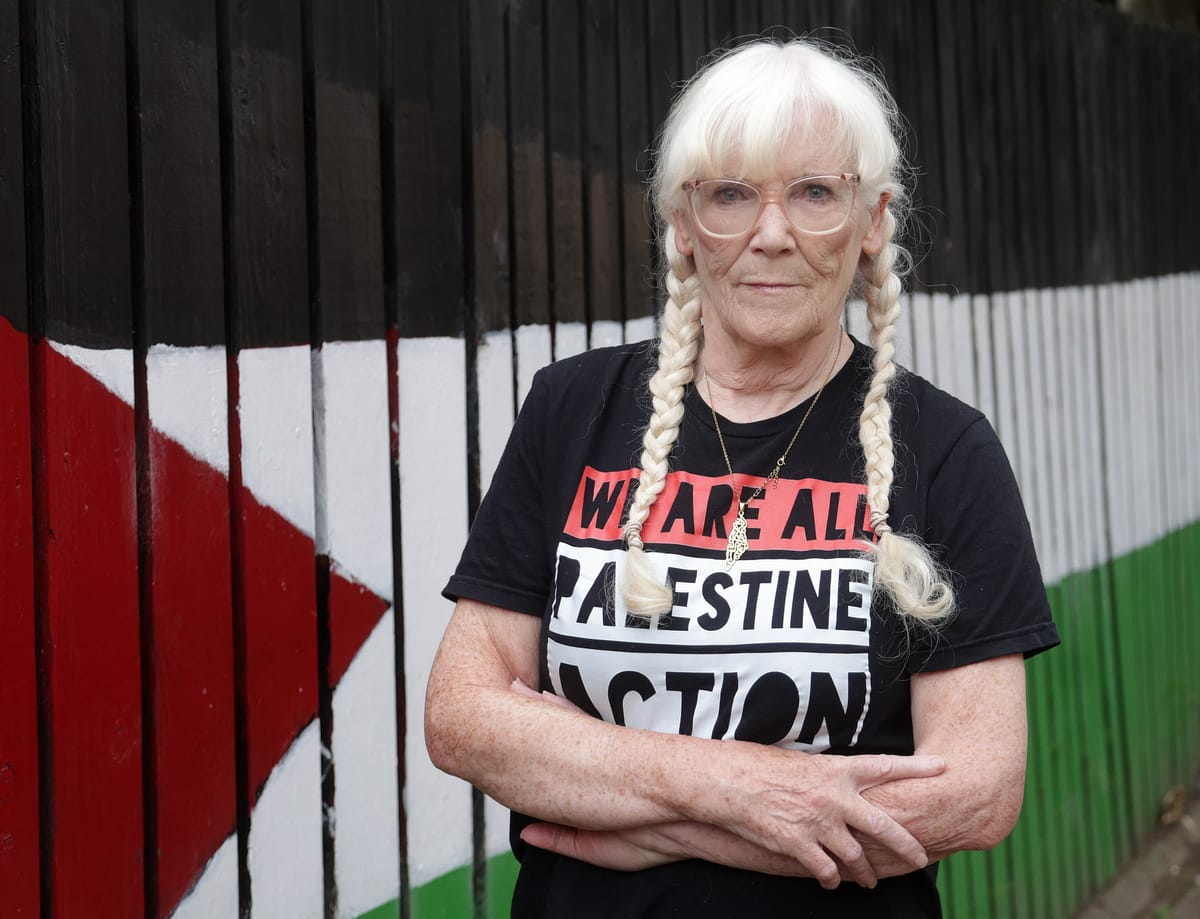
Aontacht Media sat down with Máire Mhic an Fhailí, a known legend in activist spaces up North, active in various social movements since her 20s. She is now 75 and shows no signs of slowing down. Recently, she made headlines for being the first person arrested in the occupied 6 counties under Section 12 and 13 of the Terrrorism Act (2000) for wearing a Palestine Action t-shirt, following which she brought a judicial review in defiance of Stormont.
You've been active in the Palestine movement for some time. When did you first get involved and why?
Well, I come from a very political family. My family history goes back generations, right through to the 1798 Rebellion, the Land Wars, the 1916 Rising, the Civil War.
My mother and father were in jail in the 1940s. My mother was on a hunger strike, and when my father was in jail, there were quite a lot of communists and socialists who were put in jail by the Irish government.
My father was in the Crumlin Road Gaol. He escaped from the Crumlin Road Gaol, was caught down in Dublin, and was sent to the Curragh.
In the Curragh, a lot of the men who came back from the Spanish Civil War were interned. There were also a lot of communists, socialists, and Irish Republicans interned there.
So my father, as a young 19-year-old, wanted to understand everything. He'd actually been brought up as a very strict Catholic, and said that when he was young, he'd actually thought of joining the fascists because he was told in the mass that the communists and Left were murdering priests and nuns.
So then he went to learn the Irish language, and he moved more towards Irish Republicanism. When he was in jail, he wanted to know about the communists and what was happening in the Spanish Civil War.
So it always made him very, very interested in different armed struggles around the world. I was brought up in a home where, when I was small, they were talking about the Mau Mau Uprising in Kenya, and what was happening in Kenya, and what was happening elsewhere.
My father was very interested in what had happened in Israel, and he had a friend who was Jewish. I remember him and my father having these big, big arguments about the kibbutz, about building kibbutzim.
So from the time I was very small, I had a kind of an understanding that something wasn't right about what was happening in Palestine and Israel.
But as a young girl, I was more interested in the civil rights movement. When you're in the civil rights movement, then you start, like my father did, asking questions about Vietnam, what was the cause of the Korean War, you know?
After that, I just started following what was happening in Israel, and what had happened to the Palestinians. It was just a natural progression from being in a political family and having a basic awareness that things were wrong.
While I'm very much an Irish Republican, I'm also very much aware of what's happening in other countries. Maybe that's because of where I came from and my own family rearing.
What was the first protest you attended and at what age did you first get involved?
I think my first protest was in the late '80s, early '90s. It would have been in my 20s. Something terrible had happened around then. As usual, something terrible had happened, and they'd gone after the Palestinians yet again.
Then I started buying books and reading. I started trying to get down to the library because we didn't have the internet at the time. I was trying to get to the roots of it because, when you're debating with people, you need to debate from a point of knowledge and understanding—not only of the history, but also of the modern influences on what's happening in the country.
So I think nearly every protest—if I read there was a protest for Palestine—I would have gone to it.
And then, yeah, from, since the '70s I've been wearing a keffiyeh. I've been wearing a keffiyeh since the 1970s because, during the Troubles, a lot of people came over. I had French journalists staying with me in the 1970s, and one of them was wearing a keffiyeh, and he gave it to me. So I always wore it, and I've been wearing a keffiyeh ever since.
You’ve been active for a very long time, it seems?
Yep. I've marched for civil rights, I marched against internment, I marched for the hunger strike, I've marched for the Irish Language Act, I've marched for the Palestinians. Yep. I have marched this road, protested, and carried banners all my life.
What advice do you have for younger activists who are getting started now, or who are interested?
I think I would say to young activists: first of all, know your subject. Know the history of your subject, know the politics of your subject, and follow the money. Look where the money is, because money is always the reason behind every conflict, or every escalation or de-escalation of conflict.
Follow the money, but always know what you're doing and why you're doing it. Keep true to yourself, and keep a level of integrity and principle at all times.
And what did you think of the '90s, with the collapse of the Soviet Union and Sinn Féin's betrayal of the revolutionary movement? I mean, you've seen all that and those difficult times for the Left. So how did you experience that decade?
Well, I never supported—I never voted. I didn't vote for the peace process.
And I think when it comes to politics and militancy,, and I would be more militant, it tends to be that the tail wags the dog, you know?
Having said that, Sinn Féin have gone down a route that I don't support, and I would make that very, very clear. However, I've always been of the opinion that, first of all, if I'm going to Donegal up the Glenshane Pass and you're going to Donegal up through Omagh and Strabane, if we're both going to Donegal, we'll meet. We might be travelling on different roads, taking different paths, but if we're going in the same direction, we'll always meet.
The other thing, too, is that a lot of Irish Republicans in Sinn Féin—the politicians and the ex-militants—were comrades-in-arms for 30 years against the British. So, as far as I'm concerned, the men who stood on the Bearna Baoil, we were under attack from the British Army, we were under attack from the UDI, the UVF, the UDA—we were under attack from everybody.
And the men who stood on the battlefront, the men who went to prison, the men who gave up their lives to protect our communities—they might have gone in a different direction that I don't agree with, but I won't speak out against them. I won't say a word against them or fall out with them.
I might disagree with them politically, but I still hold them in the highest respect because they defended our homes, they defended our people, to the very best of their ability.
There are prominent blanket men, prominent militants, who are now in Sinn Féin, and a lot of the things they come out with—I'm a bit horrified by them—but I still can't disrespect them because I know what they went through on the blanket. I know the horrendous torture they went through.
The other thing, too, is that I've known Gerry Adams. He's been a friend of my family for a long, long time. Again, there are a lot of things I don't agree with, but I do know that he went to every house of every volunteer who was killed, and that's the truth.
He went to every house. He saw mothers, daughters, children. He carried the coffin of every volunteer on his shoulder, and I don't know how many volunteers I could carry on my shoulder before I said, "Enough." I don't know.
And that's the gospel truth. Some dear friends of mine were killed in action, and a lot of people say, "Oh, it was for publicity." But I know, Gerry, it wasn't.
He went to houses where people did not want him there. He went to houses where he wasn't welcome because of the peace process, but he still appeared there, and he was still willing to carry the coffin of every volunteer on his shoulder.
How many could you carry? Could you carry hundreds of coffins on your shoulder? Young men, young women, old men, old women? How many of them could you carry before your heart screamed, "No more"?
So I can't agree with them, but I can't be as derogatory towards them as some Republicans are. To me, it would be an unprincipled thing to do, and it would lack integrity if I said that, because I do respect what they did, when they did it, and how they did it.
You saw the upsurge in energy after October 7th for the Palestine movement, and you've really focused on that over the last couple of years?
Yeah. Well, I know sometimes when we do a lot of the protests for Palestine, people say, "What about your own country? We have food banks."
People like myself have been active all our lives. We know what the problem is in this country. We know that there are serious problems in this country, and the rise of racism is very, very, very scary. But I think they're all interconnected.
At the end of the day, if our democratic governments in this country see a genocide and won't call it out, see a genocide and continue to finance it and morally support it, then nobody in this country is safe. No man, woman, or child in this country is safe if our own government will not call out a genocide and will not proactively fight for the Palestinian people.
If they won't do that for a blatant genocide, then what is the safety of every man, woman, and child?
Because they're talking about watering down, or doing away with, the Human Rights Act. We're part of Britain, so they want to do away with the Human Rights Act. The rights that we fought for—and I have a lot of criticism of the Human Rights Act—but it's there, and even that protection is now being taken away.
So I'm very, very aware. I just think the genocide—we're paying for it. We're paying for it not only because they're going to increase arms spending, but because they take it away from our education, they take it away from our benefits system, and people don't make those links.
There is a need to raise class consciousness and demonstrate anti-imperialist politics, right? You make those links and try to broaden it into a political struggle. I think, for many people, the Palestine movement might be a way into wider socialist and communist politics When we see the state clamping down and suppressing dissent—and you were one of the people arrested, actually the only person arrested, I believe, for wearing a Palestine Action T-shirt at a protest recently—can you tell us a bit about that, and why the State sees it as a priority to prevent the Palestine movement from gaining ground?
Well, first of all, the first time I was arrested, we were at a Palestine Action protest, and then we were told that there was a protest around at a hotel where immigrants were staying.
So we went round, and I was wearing the Palestine Action T-shirt. I was told that the police were stopping people from wearing the Palestine Action T-shirt.
Bill Shaw wore his T-shirt, and the police took his name and address, and that was it.
Then they went over to a man and his wife who were standing there. I knew them vaguely, so I went over and stood with them. The gentleman gave his name and address, and the officer said, "Okay, off you go." No comeback.
When he asked me, I gave my name and address in Irish. He told me to give it in English. I told him I wasn't going to because I could give it in Irish—I could give it in my own language.
He said, "If you don't speak English, we're going to arrest you."
Now, because I spoke the Irish language, the police officer cautioned me under Section 13 of the Terrorism Act relating to the proscription of Palestine Action.
The other people had been given a verbal warning about Palestine Action and were let go, but my case escalated immediately from what should have been a simple obstruction matter.
Immediately, the Irish language was linked to terrorism, and I was charged with that.
The second time, some of our BDS activists were in court for obstruction, and I was wearing my Palestine Action T-shirt in the courtroom.
This was the day that Palestine Action had actually won its first case, although it lost the second court case. The day I was stopped in the courtroom was the day that the proscription was declared unlawful.
A policewoman stopped me. I gave her my name and address in Irish. She insisted I speak English. I insisted I wouldn't, and then she cautioned me under Section 12.
Section 12 is the more serious offence. Section 13 carries a fine and a small sentence. Section 12 carries between 5 to 15 years in prison.
Because I spoke in Irish, she said to me, in front of witnesses, "We have translators for every language except Irish."
Now, I know other people have been cautioned for wearing the T-shirt, but I don't think anybody else has been cautioned under Section 13 or Section 12 of the Terrorism Act.
I think I'm the only one, and that gave me standing to go for a judicial review into the proscription of Palestine Action and also the difference in policing in this country because of proscribed organisations.
So there is obviously a criminalisation—a two-tier policing system—where Catholic nationalist areas and Republican activists are criminalised much more harshly than loyalists, loyalist paramilitaries, and loyalist politics. We've seen a bit of this with an arrest in Derry recently, where a young man was arrested for wearing a Patsy O'Hara T-shirt. Can you speak a bit about the continuing colonial presence in the occupied 6 counties?
Well, the reason that we're going for judicial review is that Palestine Action is now a proscribed organisation in England. In this country, there are a number of proscribed organisations, and terrorism legislation covers wearing T-shirts, flags, commemorations, and marches, which applies to both unionists and loyalists.
But the bigger issue is this: we know that if we're wearing our T-shirts, they need a two-tier solution here, the law simply can't be applied here in the same way.
Now, when we're going into the judicial review, you can go down a lot of legal rabbit holes. For instance, the Belfast Agreement promised there would be no derogation from human rights law. With Lord Bingham, there has now been a derogation from human rights law in 2006. In 1998, there was no derogation. Now there is.
So the Good Friday Agreement guaranteed our human rights. It is an international agreement. That is just one level of the complexity here.
The next level of complexity is that the law has to be applied equally. All people are equal before the law. That is a basic principle of the British constitution. All people are equal before the law.
The law has to be applied equally. If, over here, there's a derogation from that, whereas if you're a Palestinian activist wearing a Palestine Action T-shirt in London, the way the police treat you is going to be different from the way police treat you in the North of Ireland because, in order to keep the peace process in balance, they have to—every so often they took down a UDA flag. So they arrested that wee boy in Derry.
In that way, it's unconstitutional not to treat everybody equally. If we in the North of Ireland are going to be treated differently from people in England, then we're not all equal in the eyes of the law, and the law isn't being applied equally.
And the law hasn't been applied equally with regard to Palestine Action T-shirts, IRA T-shirts, UVF T-shirts, IRA flags, or UVF flags. The law has different levels of what they call "operational decisions," but all of these should fall into the category of terrorist legislation.
In England, those activists were charged with criminal damage and then given a terrorist sentence.
Over here, if people were sentenced for terrorism for wearing T-shirts—whether IRA or UVF—or displaying flags, that would create a prison situation. That would become a political situation if that law were going to be enforced.
So if that law is going to make sense, first of all it has to be applied equally to Catholics and Protestants. It has to be applied equally to nationalism, loyalism, and pro-Palestinian activists. But because it has to be applied differently here than in England, it's unconstitutional.
That equal policing obviously hasn't happened, as the PSNI have often been much more lenient—as we've seen during the Belfast riots as well—towards loyalist gangs and paramilitaries than nationalist areas. Would you agree with that?
I honestly think the police have stepped well back from anything now. They try not to get too involved because they don't want to fill the jails with loyalists and nationalists. They don't want to do it.
I think that they would like to be a lot worse than what they are, to be honest.
Now, I know there's always that discrepancy. You speak Irish, you're in trouble. If you're a Republican, you're more likely to be arrested.
But at the end of the day, I think because of the peace process, and the fact that Sinn Féin are on the Policing Board, they have to be very careful about how they implement the law.
But again, it's so unconstitutional within the British constitution because there's no equal application of the law, and people aren't equal in the eyes of the law.
Catholics and Protestants aren't equal. Unionists, loyalists, nationalists, and Republicans are not equal before the law. And Palestinian supporters are not equal before the law.
So there's a law there that simply cannot be applied in this country.
Recently we had a case in Dublin, actually, at the Pat McDonnell Paints store, where somebody was fired for wearing an Easter Lily badge. It just seems there is, nowadays, an increased fear from the State about Republicans and the Palestine movement. There also seems to be an increase in policing powers, and a persecution of activists, which is a dangerous trend.
Yeah, I would agree. As you say, the Palestinian and the Republican causes have always been linked. The Irish have always supported the Palestinians, and the Palestinians have always supported the Irish cause.
But the government is so corrupt, and so in hock to the USA and to Israeli interests that we are now a challenge to that government's corruption.
We are the only ones calling out that corruption. Therefore, we are the ones who are always going to be the target for oppression and suppression.
We'll be that target because linking Irish republicanism with Palestinian rights also exposes the corruption and the refusal to recognise the genocide while it's happening. And the State sees that.
What do you think of Sinn Fein?
Sinn Féin have been so weak and wishy-washy on this, and have made so many U-turns on everything they say.
What they say and what they do are two different things. So there's a really serious issue there. They really need to get on board far more with the Palestinian cause.
I think Sinn Féin's main purpose now is political power. And when you lose the moral high ground for political power, it's very hard to regain it.
And the IPSC?
I'm an anarchist. I don't believe in committees. I don't believe in having leaders.
As far as I'm concerned, a lot of Palestinian organisations get together, form a committee, and then the committee becomes a group of fascist dictators.
The bureaucracy comes in, and that's always a danger for any movement.
With BDS, we don't—we get together for a meeting, but really just a talk. We ask, "What do we do?" There's no leader, there's no secretary, there's no chairman, there's no authority within Belfast BDS.
We just get together and decide what we're going to do. Somebody puts forward an idea, it's discussed, and there's really no organisation behind it, just consensus.
I think when you have an organisation behind it, you've got a lot of personalities, you've got a lot of wannabes, you know. You have too many chiefs and not enough Indians.
And I think it undermines groups. It undermines some of the Palestinian groups, I think.
That doesn't denigrate from all the people involved.
I know that you go through town and I know hundreds of people. I don't know them personally—I know them because I see them on the bus, I see them going through CastleCourt, I see them at the marches, I see them at the functions.
I don't know their names, I don't know anything about them, but I know them because I've been marching in solidarity with them.
A lot of them are IPSC members, and they've been there and they do everything that they can.
So I have no problem with the membership. I have problems with the leadership of every organisation because I just don't like the structure of command.
I would say that, even if somebody came into Belfast BDS who was a spy, a police informer, or something like that, they can't do any harm.
People can get to the top of organisations and undermine them from within.
They can put somebody in there and destroy everything from the inside.
But if you don't have anybody who holds a position of power, and the power is within the consensus of everybody, then even if you had an informer in your ranks, they can't do any damage.
Do you think that you'll be continuing your activism? And what are your future plans?
Oh God, I never have future plans. I'm 75. I'm just living my best life as I can.
I don't know. I think I've just always spent my life trying to have the moral courage to stand up for what I believe in, call out injustice, and call out anything that's wrong.
With all these cautions for obstruction and these two terrorist charges hanging over my head, I don't know.
If we win this case, then the proscription of Palestine Action falls. If we lose it, then I go to prison because I've been so openly in support of Palestine Action. I've called on people to support it and called on people to engage in civil disobedience when I make speeches and things like that.
So the Public Prosecution Service has to charge me, but I don't think they want to charge me because I'm not scared.
I don't want to go to prison—obviously nobody wants to go to prison—but I'm prepared to.
But if they put a 75-year-old woman in prison, especially when the whole case came about because I spoke Irish and the Irish language was linked to a terrorist charge, putting me in jail would be a political nightmare for them.
So from now to Christmas, we're waiting on this judicial review. After Christmas, I could be a free woman, or I could be in jail for the next five years.
Well, it would certainly be a scandal and would be very politically uncomfortable, and I'm sure that would spark protests and further resistance. So either way, you win!
Yeah, I win. Because they know I'm not scared of them, and I have challenged them. I've thrown the gauntlet down to them. The gauntlet's down there. Put me in prison, or get rid of the law.
Do you have anything else you would like to add for our readership and for the people who'll watch this video or read the article?
Well, I would say to all Palestinian activists and all Irish Republican activists: first of all, follow your conscience. Know your history, know your politics. Always be in a position of knowledge.
First of all, keep your integrity, no matter what, and don't be afraid. Don't be afraid to do what you know is the right thing to do.
I would also always appeal for unity within Republicanism because there is so much dissent. So many people now, because of politics and because of the corruption within politics...
Respect another Republican, even if you don't agree with them.
If we can respect each other and believe that the other person is doing what they think is right, then that respect and honour will reunite us at some point in time.
That's my belief.