I Was Detained By UK Counter-Terrorism Police For My Anti-Imperialist Beliefs
I was detained by UK Counter-Terrorism police for my anti-imperialist beliefs.
There are moments in life when you have to stop and ask yourself a very simple question:
Is it worth it?
Is the activism worth it?
Is putting yourself out there worth it?
Is travelling to protests, speaking publicly, challenging governments and questioning the narratives we are presented with worth the personal cost?
And perhaps most importantly:
Where does all of this ultimately lead?
I have spent the past few weeks asking myself those questions.
I am Patrick Downey. Some people know me by my social-media moniker, Half Paddy, Half Vladdy. I am Secretary and Public Relations Officer of the Truth and Neutrality Alliance, a small grassroots organisation chaired by my comrade Bill O'Brien.
We are an anti-war organisation. We believe in Irish neutrality. We believe governments should be challenged when their policies contribute to war rather than peace. We believe people have a right to ask uncomfortable questions.
And we have never pretended that everyone will agree with us.
We were due to travel to London on 15 August to attend a No2NATO demonstration at Whitehall.
Bill and I were invited to speak.
We were excited.
We had prepared speeches. We had spoken with comrades across the water. We were looking forward to meeting people, networking, discussing future cooperation and, most importantly, making our case.
We expected a long day.
We expected arguments.
We expected disagreement.
We expected to be challenged.
What we didn't expect was what happened at Stansted Airport.
The day that didn't happen
I was awake at around 3 a.m.
I met Bill at Dublin Airport. We had something to eat, had a cup of tea and talked about the day ahead.
There was that familiar mixture of excitement and nerves that comes before giving a public speech.
Then, at departures, something happened that I didn't fully appreciate at the time.
My passport was scanned.
A red square with an X appeared on the screen, accompanied by what appeared to be an alarm.
I was nevertheless told I was fine to board.
So I boarded the plane.
Bill boarded too.
We flew to Stansted.
And that's where our day changed completely.
As we came off the aircraft, we were approached by men who identified themselves as counter-terrorism and border-security police.
They appeared to know exactly who we were.
We were taken aside.
Separated.
And detained.
"Hostile." "Threat." "Terrorist."
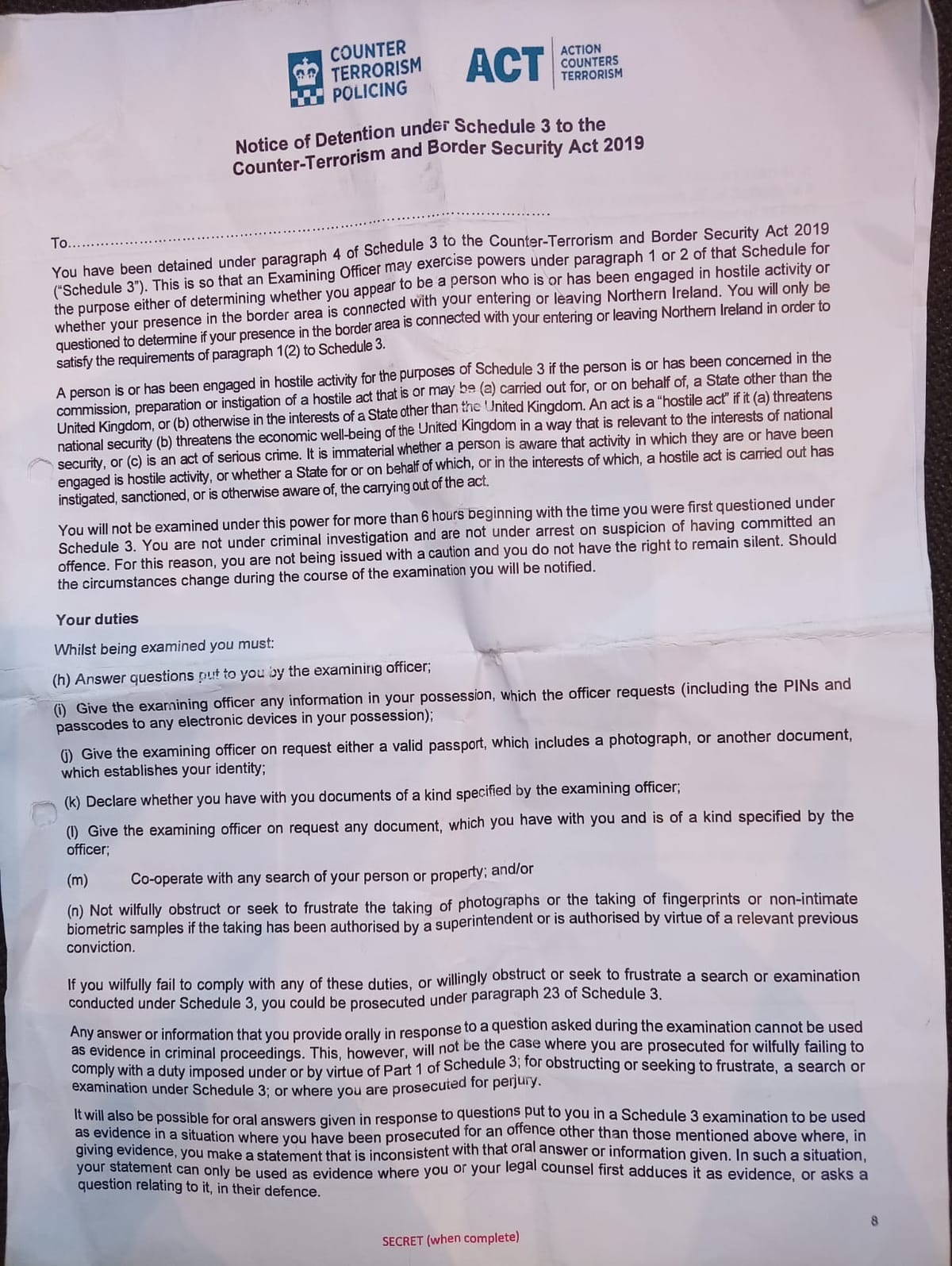
I was taken into a room and told that I was being detained under Schedule 3 of the Counter-Terrorism and Border Security Act 2019.
I was told the process could take up to six hours.
In the end, I spent almost five hours being questioned.
I was asked why I had come to London.
I explained that I was there to attend an alternative political demonstration and to speak.
I was asked about Bill.
I explained how we had met and the activism we had subsequently undertaken together.
Then the questions became much more personal.
My work.
My political beliefs.
My associations.
Whether I was a Republican.
Whether I had any connection to paramilitary organisations.
Whether I was a communist.
My views on communism.
My connections to Russia.
Whether I had ever received money from the Russian government.
Whether I had ever sought grants from the Russian government.
Whether I had ambitions to work for the Russian government.
The journalists I knew.
The people I associated with.
The podcasts I had appeared on.
The alternative media I followed.
And throughout this process, certain words kept appearing.
"Hostile."
"Threat."
"Terrorist."
I lost count of how many times I heard some of them.
And that's difficult to describe to somebody who has never experienced it.
Because I knew I wasn't a threat.
I knew I wasn't hostile.
I knew I hadn't committed a crime.
I was an activist travelling to a political demonstration.
I was going to give a speech.
That's it.
I have never been involved in paramilitary activity. I don't believe in violence against people. I don't believe in hurting people unnecessarily.
I believe in protest.
I believe in political debate.
I believe in free speech.
And I believe in peace.
The things that bothered me most
There were things about the detention that I found particularly disturbing.
My phones were taken.
I was asked for the relevant PINs and passwords, which I provided.
My work phone was retained even after I was released.
That created an immediate practical problem because I needed that phone for my job.
I was also concerned about being denied access to my medication during the detention.
My photographs and biometrics were taken.
My DNA was taken.
My photographs and biometrics then had to be repeated because, I was told, something had gone wrong with the first attempt.
Time passed.
More questions.
More procedures.
More uncertainty.
At one point, I was asked whether I wanted the Irish consulate informed.
I misunderstood the question and thought I was being asked whether I wanted legal assistance.
I said no.
Bill understood the question differently and requested consular assistance.
We subsequently learned that the Irish consulate had not been informed of our detention.
That is now one of the issues about which questions are being asked.
And perhaps those questions need to be answered.
Meanwhile, the rally was happening without us
While all of this was happening, the people we had travelled to meet were at Whitehall.
They were expecting us.
We had told them we were coming.
We were supposed to speak.
But we never arrived.
And this is where another question enters the story.
We have reason to believe that at least one person connected to one of the organisations involved was remarkably confident that Bill and I would not make it to the demonstration.
How could they have known?
I want to be very careful here.
I am not going to accuse somebody of something for which I don't have concrete evidence.
We have suspicions.
We know who the person is.
We know which organisation they are associated with.
But suspicion is not proof.
That distinction matters.
Nevertheless, the question remains:
How did somebody appear to know that two people who had boarded a plane in Dublin would not arrive at a demonstration in London?
That's a question I think deserves an answer.
The moment I thought about giving it all up
Eventually, Bill and I were released.
Our phones weren't.
We made our way towards Westminster.
By then, the rally was over.
The speeches had been made.
The opportunity we'd travelled hundreds of kilometres to take part in had disappeared.
We did eventually encounter one of our comrades, John, almost by chance.
He told us the demonstration had gone well.
He also helped us out when we found ourselves short of access to money because of the phones being retained.
It was a strange end to what had started as a day full of optimism.
And on the train towards Gatwick, I asked Bill a question.
I asked him what he thought about retirement.
Not retirement from work.
Retirement from activism.
Stepping back.
No more demonstrations.
No more rallies.
No more putting ourselves on the front line.
No more travelling to another country to exercise what we believe is our right to speak.
I was angry.
I was confused.
I was vexed.
I was upset.
I was, at times, nervous.
And, yes, I was questioning whether any of this was worth it.
I was thinking about my wife.
What must she have been thinking while I was detained?
How could I contact her without my phone?
What would happen if something had gone seriously wrong?
And then there was the simple question:
What am I actually achieving?
Bill's Answer
Bill didn't want to retire.
Quite the opposite.
He told me that what had happened had made him more determined.
I wasn't convinced at first.
But something happened to me too.
I began thinking about what we were actually doing.
We hadn't travelled to London to cause trouble.
We hadn't travelled there to hurt anybody.
We hadn't travelled there to threaten anybody.
We travelled there to speak.
People may disagree with what we planned to say.
That's perfectly legitimate.
They may think our analysis of NATO, Ukraine, Russia, Irish neutrality or Western foreign policy is completely wrong.
Fine.
Debate us.
Challenge us.
Write against us.
Stand on a platform and tell us we're wrong.
That's politics.
That's democracy.
That's what protest is supposed to be about.
What I don't accept is the idea that an activist should have to feel like a criminal simply because he crosses a border to attend a political demonstration.
And so I have decided
Despite everything, I have reached a conclusion.
I'm not giving up activism.
I came very close to considering it.
Perhaps that's the most honest thing I can say.
For a few hours, I wondered whether it was time to walk away.
But walking away would mean allowing an experience like this to define me.
And I don't want that.
I don't want to become bitter.
I don't want to spend my life holding grudges.
I don't even like holding grudges against people I know personally. Usually, if somebody treats me badly, I'm over it relatively quickly.
This is different.
Because this wasn't simply an argument between two people.
It was an experience that made me question whether exercising political beliefs and travelling to express them can somehow make an ordinary working person worthy of suspicion.
And that bothers me deeply.
I don't want fame. I don't want notoriety.
I have no desire to become famous because of this.
I don't want notoriety.
I don't want headlines.
I don't want political attention.
I don't want international incidents.
I don't want governments and embassies becoming involved in my life.
I certainly didn't travel to London looking for any of that.
I wanted to make a speech.
That's all.
I want to live a peaceful life.
I want to see a world where wars end rather than escalate.
A world where governments stop pouring fuel on conflicts.
A world where people aren't constantly being told who the good guys and bad guys are.
A world where ordinary people can question those in power without feeling that questioning them makes them suspicious.
That is what I want.
And perhaps that is why I have to continue.
So where do we go from here?
The events of 15 August have now gone considerably further than Bill and I ever wanted them to.
Our account has been published through our own channels.
It has been reported by The Ditch.
Questions have been raised with the Irish authorities.
Political representatives have become involved.
The Irish Embassy in London is seeking answers.
What began as two Irish activists travelling to London to speak at a demonstration has developed into something considerably bigger.
I never wanted that.
But perhaps there is a lesson in it.
If governments believe that activists are wrong, debate them.
If they believe our arguments are foolish, challenge them.
If they believe our politics are misguided, prove us wrong.
But don't make people feel that they are criminals simply because they are activists travelling to exercise their right to speak and protest.
And don't make peaceful people afraid to participate in political life.
Because if people become afraid to speak, afraid to protest, afraid to travel, afraid to question authority, then something has gone badly wrong.
I still have questions
I don't have all the answers.
In fact, I probably have more questions now than I had before I left Dublin that morning.
Why were we detained?
What exactly triggered the decision?
Why were our phones retained?
Why was the Irish consulate apparently not informed when consular assistance had been requested?
What exactly did the authorities believe we had done?
And perhaps the question that troubles me most:
Why did somebody apparently seem to know we weren't going to make it to that rally?
I don't know the answers yet.
Perhaps we will get them.
Perhaps we won't.
But I'm going to keep asking.
Because that's what activists do.
And after everything that happened, I have come to realise something.
I may be tired.
I may be angry.
I may still be carrying a grudge that I don't particularly want to carry.
I may still be questioning where this road leads.
But I'm not finished.
Not yet.
I went to London intending to speak about war, peace, neutrality and political accountability.
I never got the opportunity.
But perhaps, ironically, the events of that day have given me something else to talk about.
The right to ask questions.
And that's one right I'm not prepared to surrender.