From Armalites to Armani Suits: How Sinn Féin Betrayed the Revolution
Sinn Féin's story illustrates how a revolutionary movement abandoned its socialist ideals and the working class that built it.
Part 1: The Keeper of the Flame
They called him “The Dark.”
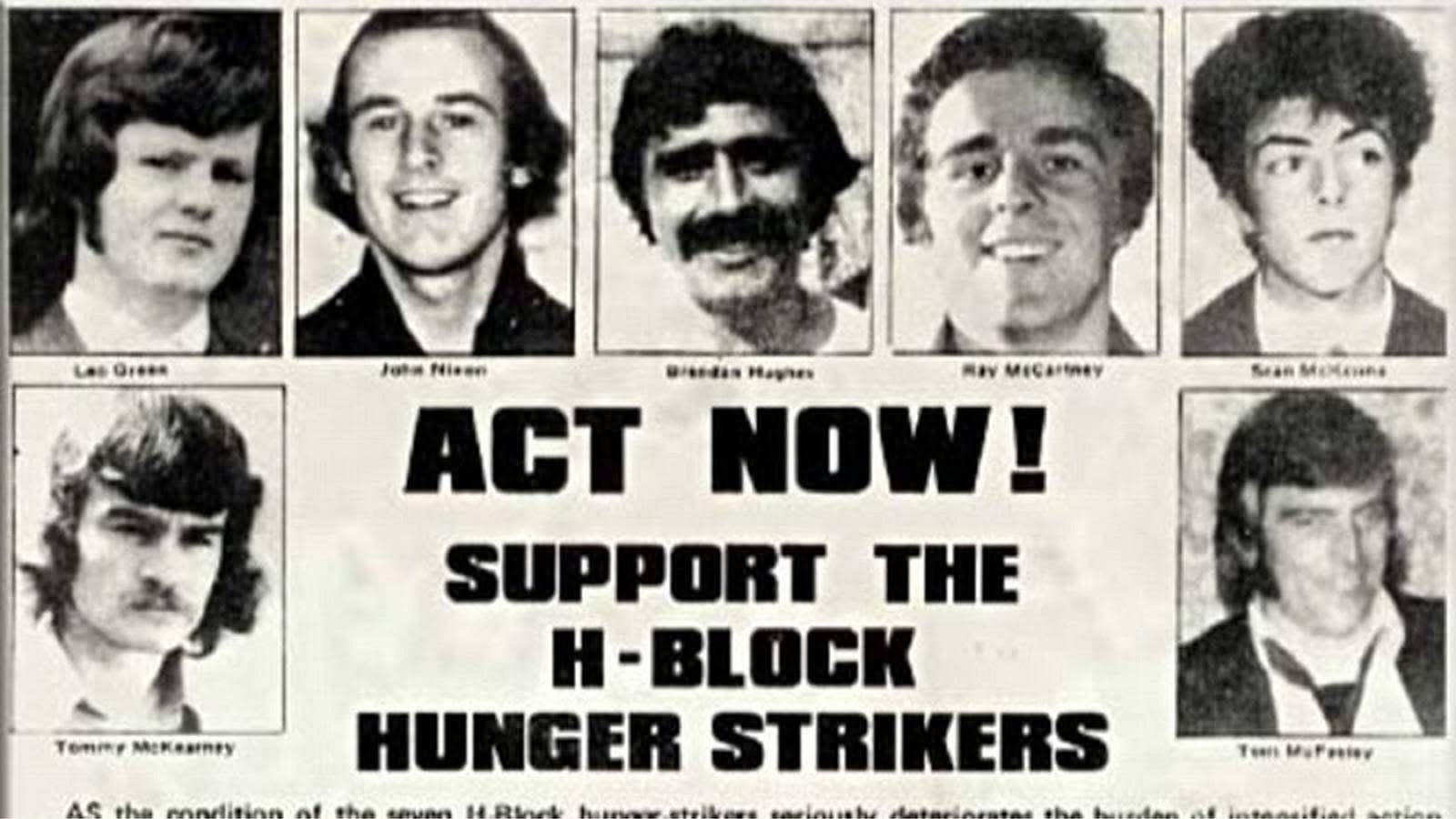
Brendan Hughes was not just a soldier, he was an architect of the Provisional IRA, a commander who escaped Long Kesh and returned to war, the leader who volunteered first for a hunger strike. His life was a testament to a sacred contract: unwavering loyalty and sacrifice in exchange for a 32-County Democratic Socialist Republic.
“For almost thirty years the Republican Movement fought a war against the British to remove them from Ireland and establish a thirty-two county democratic socialist republic. We wanted control of the wealth in this country to rest with those who created it – working men and women.” – Brendan Hughes
This was the promise. This was what men like Hughes, Bobby Sands, and Kieran Nugent were willing to die for. It was a revolution, not just a political campaign.
Yet, in his final years, Hughes waged his most difficult war. It was not fought on the streets of the Lower Falls, but from a flat in Divis Tower, against the betrayal of that very promise by the movement he built. He became the keeper of a flame that the Sinn Féin leadership had tried to extinguish.
Part 2: The Betrayal in Plain Sight
The Good Friday Agreement was hailed as a triumph. But for Brendan Hughes, it was the moment the revolution was surrendered.
“All of my life I spent attempting to bring down Stormont, attempting to remove the British from Ireland and all of a sudden, all of that language was gone… we were actually fighting to get down to the Stormont, that we just spent 30 years trying to bring down.” – Brendan Hughes
He watched as the “Armani Suit Brigade”, a new class within Sinn Féin he barely recognised, took over.
“What was developing here was a sort of a class thing within the Republican movement… their politics drifted away from me, their politics, I didn’t drift away from my politics, their politics drifted away from me to a stage where I believed I needed to say something, because these people are running away with my movement.” – Brendan Hughes
The leadership had broken the psychological contract. They had traded the revolutionary goal for a share of administrative power in a statelet they once vowed to destroy.
Part 3: The Proof of Failure: “The Working Class Got F – – All”
For Hughes, the betrayal wasn’t just rhetorical, it was measured in the cold, hard facts of continued working-class suffering. He saw the new Stormont for what it was: a manager of the old, oppressive system.
He pointed to the grim reality highlighted by unionist Fred Cobain:
“He claimed that 600 people would die over the course of the next year as a result of poor heating in their homes… We can rest assured that no one at Stormont will die due to a lack of heat. They might explode due to over eating.” – Brendan Hughes
Nothing had fundamentally changed. The “rogue employers and greedy financiers” were still protected. The system of economic injustice remained intact.
“Same old ship, just some different hands at the wheel. Now we are beginning to understand what the GFA really means. For working class Protestants and Catholics: – Got F – – All.” – Brendan Hughes
Sinn Féin had become part of the “middle class government for a middle class people,” administering British rule and implementing policies that left the poor to freeze.
Part 4: The Abandoned: From Heroes to “River Rats”
The ultimate moral failure of Sinn Féin’s project, in Hughes’s eyes, was the abandonment of the very people who built the movement.
He saw this in the tragic fate of Kieran Nugent, the first “blanket man” whose defiance sparked an entire protest.
“Kieran died in 2000. They called him a ‘river rat’ because he spent his last days drinking by the river in Poleglass. Why didn’t somebody in the movement not see he’d problems and help him? He was the bravest of the brave.” – Brendan Hughes
While the Sinn Féin leadership enjoyed ministerial cars and fine suits, the foot soldiers – the men and women whose sacrifice gave the movement its moral authority – were left with trauma, addiction, and poverty. They were the living, breathing evidence of a cause that had been sold out, and they were conveniently forgotten.
Part 5: “What Was It All For?” The Haunting Question
This is the question that Brendan Hughes forced a reluctant movement to confront. It is the cry of a man whose entire life’s purpose was rendered meaningless by the political success of his former comrades.
“If it is all over what was it for? Do we have freedom? Not the type I fought for. Did we get rid of oppression? Not the type I fought against. Did we change fundamental economic and social structures or did we change those who would run the same old ones?” – Brendan Hughes
He did not want to start a new movement. He wanted his movement back from those who had hijacked it.
“I believe it has been hijacked by a handful of people who have gone in a particular direction that I disagree with. But it is my movement. I don’t want to form another movement I want my movement back to what we fought for.” – Brendan Hughes
Conclusion: The Unhealed Wound
Brendan Hughes is a hero of the people. A man that knew, the people are the cause and the cause is the people. If you walk from the Twinbrook estate to the Falls road and beyond. Ask the people what they think of the Dark and Sinn Féin, the Dark wins everytime. – Séamus Mac Shíomóin
Brendan Hughes was the remnants of a revolution that lost it’s way. His loyalty was to the cause and the working class, and it remained absolute even as Sinn Féin’s leadership abandoned both.
Get Séamus Fitzsimons’s stories in your inbox
Sinn Féin may now be on the brink of political power, not only in Belfast, but in Dublin too. But in achieving it, they have become managers of the very system of inequality and partition they once fought to destroy. They dine in the halls of Stormont while the communities they represent are being crushed. The war Hughes fought has taken a new, more insidious form: a social and economic war against the poor.
The statistics are a damning indictment of their political project and these are but a few:
- The occupied Six Counties now have the highest suicide rate in Europe, a silent epidemic of despair.
- West Belfast remains one of the most deprived areas in Europe.
- Over 375,000 people live in poverty, including more than 100,000 children.
- The state Sinn Féin helps administer still functions with brutal sectarian bias: Catholics are charged and arrested at twice the rate of Protestants, while the RUC/PSNI commits countless sectarian crimes with impunity, just as British war criminals are granted amnesty.
And in a final, grotesque irony, Sinn Féin itself has become a landlord class, taking in £2000 a month in rent from houses on the Falls Road – from their own people, who cannot afford to heat them. Their pockets and bellies are full, while the working class is left to choose between food, heating, and electricity. Children miss meals, and food banks, the ultimate symbol of the failed peace, are constantly empty.
This state-sponsored violence is now meted out in evictions, as the PSNI/RUC forcefully removes people from their homes, stalking and intimidating young single mothers with children and grandchildren as young as two. On the streets, the human cost is palpable. People walk lost, self-medicating a deep-seated trauma, leading to the highest dependence on benzodiazepines in Europe. Apartments in working-class communities, once hubs of resistance, have been transformed into centres of mass drug production and trafficking. Anti-social behaviour, born from this cocktail of neglect and desperation, is worse than it has ever been.
Yet, Sinn Féin’s focus is elsewhere. They would rather champion cycle lanes and stage photo opportunities than confront the daily horror facing their people. They have become the smiling public face of a state machinery that is evicting, medicating, and imprisoning the very class they swore to liberate.
The war Brendan Hughes fought is not over. It has simply transformed and his former comrades have switched sides. They now command the forces of an economic oppression that is just as cruel and deadly as the conflict they left behind.
Sinn Féin’s journey is the ultimate lesson in betrayal to any revolution. It is a warning that the greatest threat to a radical cause is not always the enemy in front of you, but the allure of a seat at their table, and the willingness to sell your own people for a place in the ruling class.
- The Ulster Front.
This work is dedicated to the memory of Brendan Hughes and to his daughter, Josephine.
It is my sincere hope that the people will come to recognize that her father’s vision, the cause for which he sacrificed so much, is neither over nor lost. May his memory, his integrity, and his unwavering commitment to Ireland and her people’s freedom continue to inspire a new generation to fight on… Brendan Hughes: Fear Dorcha.
Ar dheis Dé go raibh a anam.



I now finish this, with a piece written by another Hero of the cause.
Dolours Price • 17 February 2008
Brendan Hughes -
Comrade and Friend.
Brendan Hughes was a man of principle, an idealist who devoted his life to the cause of removing all vestiges of the British presence in Ireland.
Those who would term Brendan a “No-Hoper” are wrong. Brendan was, as we are, full of hope that will will find and realise our hopes for a free and unfettered Ireland.
Those who lost hope have embraced Britishness with open arms and open hands.
Brendan could not be bought. He lived humbly in his last years; let those who have prospered from this war hang their heads in shame as they cruise between their various properties in their four wheelers.
Brendan was aware very early on that the “buy out” known as the “Peace Process” was directed at those who craved power and money. Now they run the British Administration in the six northern counties for the enemy. Treachery beyond all anticipation.
Brendan Hughes sought no personal gain. He was a giant of a man, a Republican leader who led from the front. He asked no volunteer to do what he would not do himself; he fought side by side with his volunteers.
If, as Martin McGuinness has described those of us opposed to the agreement with Britain, if Brendan was a “no hoper,” then he stands amongst a brave and valiant crew. Cathal Brugha, Harry Boland, Maud Gonne, Mary MacSwiney, all, and many more, castigated because they were uncompromising Republicans.
Those who once professed to be Republicans and now act as British Administrators in the six counties, let them hang their heads in shame at the way in which they treated Brendan in his last years. Let them look into their souls and ask, “Could I have been that brave?”
They rose to prosper on the back and bravery of Brendan; he had no time for personal gain or power. He served that old lady, “Republicanism” and served her well. Today we lost that great Republican.
I am proud to call him comrade and friend.