By The Numbers - Cork City’s Dereliction Crisis
The City of Cork remains scarred by vacant and derelict properties that sit idle, while thousands struggle to find housing. Notably, anti-dereliction campaigners documented approximately 450 derelict units within two kilometres of the city centre.
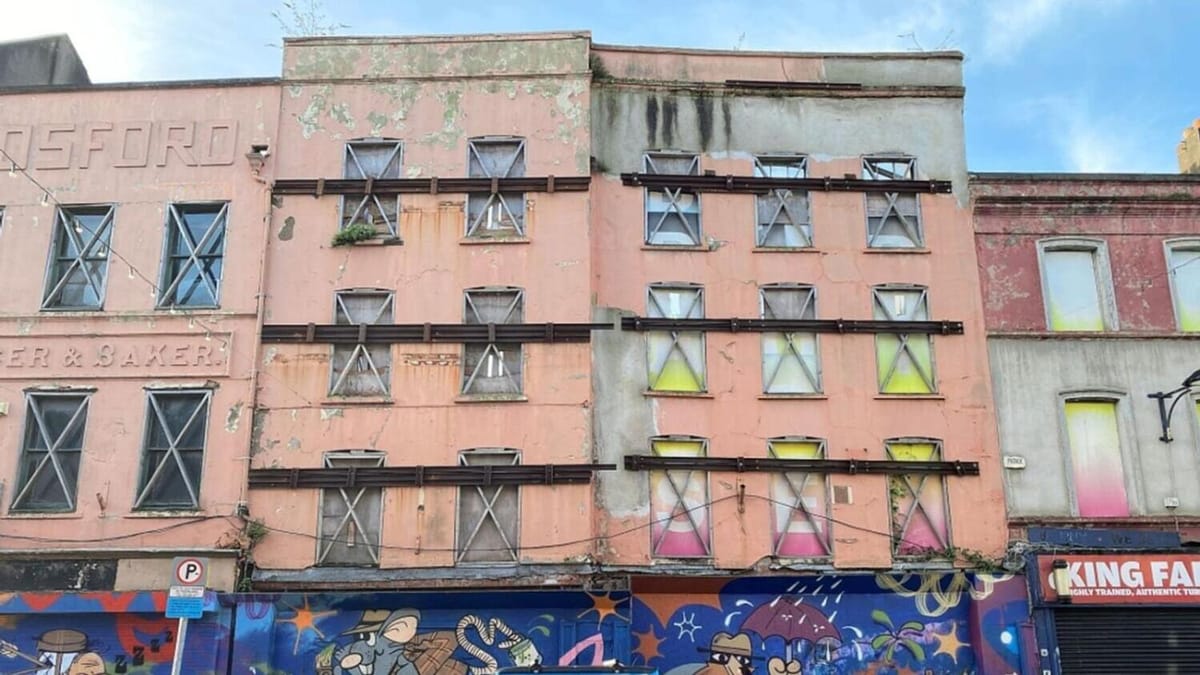
The City of Cork remains scarred by vacant and derelict properties that sit idle, while thousands struggle to find housing. Notably, anti-dereliction campaigners Frank O’Connor and Jude Sherry documented approximately 450 derelict units within two kilometres of the city centre. Official figures and independent analyses reveal a system that registers only a fraction of the problem, collects a minority of the levies it imposes, and moves at a glacial pace on compulsory acquisition. As a short study published by the University of Notre Dame asserts, the result in Ireland is a visible blight that undermines communities and represents a direct transfer of potential homes into prolonged disuse.
For example, by the end of 2024, Cork City Council’s Derelict Sites Register held 174 properties. Placement on the register was underway for a further 46, with additional investigations covering around 150 more sites, bringing the total under active review to over 400 at that time. By late 2025, the register stood at approximately 159 sites, with a report in early 2026 indicating around 200 registered properties. The number of sites on the register and under assessment has more than doubled since 2023.
The Derelict Sites Act 1990 requires local authorities to maintain a register of sites that detract from amenity due to ruinous or neglected conditions, or the presence of waste. Owners face an annual levy of 7% of market value while a site remains registered. Cork City Council has increased activity: 76 new files were opened in 2024 alone, with 33 added to the register and 18 removed. Across 2023 and 2024 combined, 196 properties entered the register, while 177 left it - higher volumes than the preceding two-year period.
The levy system designed to incentivise action has proved largely ineffective. Cork City Council collected around €150,000 in derelict site levies in 2023 and approximately €477,000 in 2024. Over five years to 2025, it issued more than €7.2 million in levies and collected less than €2.1 million - under 28%. Outstanding arrears exceeded €5 million by the end of 2025. Even the improved 2024 collection rate left the large majority of invoiced amounts unpaid. Automatic legal charges after six months of non-payment have helped recover some funds, yet the overall recovery rate exposes the weakness of the current regime. Property owners can effectively ignore the levy for years, with limited consequence.
Compulsory purchase, which can serve as the ultimate tool for council-led property regeneration, has been used sparingly. Since 2020, the city council has completed just 21 compulsory acquisitions at a cost of €1.6 million. The bulk of that spending occurred in a single year. The process is slow, often taking two to three years when appeals are lodged. Several acquired properties have been sold on with conditions attached; progress on actual redevelopment has been uneven. At the current rate of acquisition relative to the number of long-term derelict sites, resolution would take decades. Meanwhile, the council has spent heavily on managing the consequences of vacancy, rather than eliminating its causes. More than €1.1 million has gone on shuttering empty properties since 2020. Tens of millions (€) have been budgeted for the voids programme to refurbish social housing between tenancies. These expenditures treat symptoms, however, they don’t address the private derelict stock that continues to rot on main streets and in residential areas.
Grant schemes, such as the Vacant Property Refurbishment Grant, have supported some returns to use, with higher rates available for confirmed derelict properties. In the first half of 2026, uptake across Cork City and County was moderate, with €1.8 million paid out for 32 instances in the city, and €5.8 million paid out for a further 100 in the county. In August 2026, it was reported that Cork's county and city councils had collectively disbursed almost €40 million since 2022 to rehabilitate more than 800 abandoned houses, as part of the Government's Croí Cónaithe initiative. Yet, grants rely on voluntary owner action. They cannot compel the owners of the most neglected sites to act. For example, Cork City Council has written-off over €3.5 million in unpaid derelict site levies, which is more than it has received. The combination of limited compulsory powers (though, a notable set of units in the city centre, which partially collapsed in 2019, only saw refurbishment works commence in 2026 - a few years after they were acquired by the local authority), poor levy recovery, and incomplete registration leaves the most egregious cases largely untouched. Government plans to replace the local-authority levy with a Derelict Property Tax from 2027 onwards perhaps acknowledges the current system’s failure. The timeline is also slow. Questions remain over whether the proceeds will return to local authorities for enforcement and acquisition. Without that recycling of funds, councils risk losing even the limited income currently generated - while retaining the costs.
Widespread property dereliction is a negative consequence of a state that follows an inherently neoliberal idea. A significant contributor to neglect is the activity of “land flipping.” This involves acquiring real estate, allowing it to fall into disrepair, utilising this deterioration as a rationale for demolition, securing planning permission, and subsequently speculating until a maximum sale price is achieved. In Cork City, speculation and hoarding are among the main reasons for this pressing social problem.
The data presents a clear picture. It must be recognised that Cork City has increased activity on dereliction in recent years. Nonetheless, these incremental gains sit against a backdrop of thousands of vacant and derelict units, chronic under-registration, multi-million-euro levy arrears, and a compulsory purchase rate that is negligible relative to need. With a city and state facing acute housing shortages, the continued tolerance of long-term dereliction is a policy choice with direct human consequences. Stronger registration and a far higher rate of compulsory acquisition are required if empty buildings are to become homes, rather than remaining a permanent feature of the urban landscape.