

Why the Bourgeois Press Still Smears Us
Peter Irvine
From the birth of our Republican struggle, the pen of the oppressor has always sought to drown out the voice of the Republic. When Henry Joy McCracken wrote that the “rich always betray the poor”, he was not merely describing the parliaments and aristocrats of his day, but the entire structure of class power which endures through government, economy and media. Every generation of Irish men and women who dared to stand against imperialism or exploitation has found the newspapers and broadcasters aligned against them, sneering at their ideals and slandering their names.
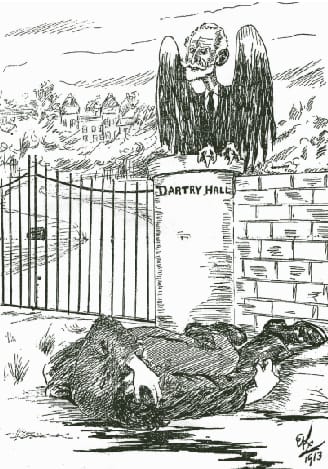
When the labour and Republican movements joined hands in 1916, the so-called respectable press called them madmen and criminals. When the locked-out workers of 1907 and 1913 fought for the right to live as human beings, the same papers called them mobs. In every decade since, the pattern has repeated. Whenever a movement arose that refused to bow to the authority of Westminster, Stormont or Leinster House, the establishment’s scribes re-appeared to remind us who owns the printing presses and whose interests they serve.
The bourgeois press does not defend democracy or the national interests, it defends property. Its moral outrage is selective. When power drops bombs, it calls it “defence”. When the powerless resist, it calls it “terrorism”. When elites break laws, it calls them “reforms”. When ordinary people rise up, it calls them “riots”. So it has been with every attempt to build a sovereign, socialist Ireland, every call for unity, equality and justice met with a chorus of misrepresentation and insult. The bourgeois Unionist and Free Staterite press slanders us for the same reason it always has, because a united, conscious working class and an underground Republic threaten the foundations of capitalism, privilege and imperial power.
Even today, the tactic is familiar. Individuals and organisations that stand outside the permitted bounds of politics are smeared not on the strength of their ideas, but often through allegations of criminality, racism, sectarianism or antisocial intent. The purpose is not to enlighten the public but to isolate dissenters, to make the words Republican or even socialist themselves sound suspect. Such narratives comfort those who profit from division, who would rather see the Irish working class at one another’s throats than united against the systems that impoverish us all.
Yet truth has a stubborn habit of surviving censorship. Every lie told about Irish Republicans, every caricature or misrepresentation printed of the militant worker or socialist idealist, is another reminder of why the struggle continues. The Republic proclaimed in 1916 was not a dream of vengeance but, rather, of human dignity “to cherish all the children of the nation equally”. That promise of true freedom remains unfulfilled and until it is realised, the guardians of privilege will always try to mock or silence those who fight to keep the flame alive.
Our task, then, is not to plead for fair coverage from the instruments of capital, but to build our own instruments of truth, that workers’ papers, people’s media and the word passed honestly from one comrade to another. We must write, speak and act in a way that exposes the hypocrisy of those who condemn us, while remaining true to the principles that make Republicanism more than ‘just’ nationalism, but a struggle for social justice, for unity across creed and class and for a free people in a free nation.
The slander of the successors to Cromwell and William Martin Murphy cannot bury the Republic, it only proves that the Republic still threatens them. Every generation must earn again the right to call itself Republican and to do so not by seeking approval from the privileged, but by standing firm for the poor, the dispossessed and the forgotten. Let the bourgeois press sneer. We know where we stand, with Tone, Connolly, Pearse and Mellows, with the working people of Ireland and with the unbroken cause of national liberation.
Our answer must be organisation and unity. These are means by which the next generation will fight for the Republic in its fullness.