

For a left populist, Socialist-Republican position on immigration
By Dylan Tchang
Recent years have seen the emergence of immigration as a major issue in Irish political discourse, coinciding with the rise of a serious right-wing populist movement in the country. The crash of 2008, combined with the economic uncertainty of the recovery that followed, have created fertile space for a politics that rejects the centre ground in favour of a more radical alternative. One would think, then, that the left would thrive in this environment. But it has not. Why is this? As has been discussed in other articles on Aontacht Media, the Irish left has largely abandoned the working class for the universities, moving to a middle class perspective that prioritizes gradual change and moralistic finger-wagging. This is, unsurprisingly, anathema to the white Irish working class communities which should form an important part of any proletarian movement’s base, who have started to look elsewhere. Into this gap has stepped a growing right-wing populist movement, which bases its appeal particularly around advocating for a significant reduction in the number of immigrants coming into the country. This, its leaders claim, will improve living conditions and services for the white Irish working class, while creating a sense of cultural cohesion based around the fact that there would be little to no non-white people in the country. While there have been multiple critiques of the liberal approach taken by the left in responding to this movement, as yet we have seen few major attempts to situate these developments in Ireland’s role in the imperialist system, or outline an immigration platform that could pose a real challenge to that of the reactionary right. This article will seek to do both.
Notable flashpoints have emerged around the placement of Direct Provision centres in working class communities. Asylum seekers are shoved into rough and substandard “accomodation” while local communities despair at the removal of vital services. With the government intent on continuing this policy regardless of local opposition, protests have spiraled into riots, making news in Ireland and around the world. The reaction of the left has, for the most part, taken one of two paths. One part emphasizes racism as a factor in driving these protests, while another stresses the structural issues underpinning IPAS dispossession of working class communities. Both approaches, I think, have captured something while failing to appreciate the whole picture. On the one hand, one cannot simply dismiss the role of racism in driving protests against asylum seeker accommodation. However, simply condemning protestors as racist while failing to develop a coherent alternative to Direct Provision is divisive and ultimately fuels the growth of organizations like the National Party. Furthermore, this liberal point of view often downplays the very real landlord profiteering and anti-social behaviour that develops around asylum centres – serious issues that will not go away no matter how much moralistic condemnation is issued. On the other hand, it is vital that an economic critique of IPAS profiteering be developed – that is being done at length by László Molnárfi and others – but a failure to see any significant role for racism in these scenarios runs the risk of kneecapping our strength. If we mistakenly assume “colourblind” attitudes in working class communities and across the country as a whole, we may miss key observations about our society that help us understand how to communicate with the average person. As Molnarfi and others have pointed out, it is certainly true that organizations like the one mentioned above intervened to take over the protests for their own gain, and largely succeeded. But we would do well to remember evidence also shows that racist, anti-immigrant ideas were a significant factor from the start, rather than simply being “imported” by “outside agitators.” This does not mean, of course, that it makes any sense to call people names or single out working class people as uniquely racist. A mature understanding of racism asserts it is a societal problem that is not simply the fault of one community or individual. But it does mean that we should understand the recent IPAS protests not as the result of any one cause, but a multitude of interlocking factors that have ultimately produced violent results. “Riots,” as Martin Luther King Jr. said, “are the language of the unheard.” But which group of people is being unheard in this case, and why? To understand this, we must trace the roots of increased immigration into Ireland.
One of the most frustrating unanswered questions confronting working class communities in Ireland is the “why” of mass migration: why are so many people migrating from the Global South to the Global North, and into Ireland? Once again, people are usually given one of two answers, both of which have some truth to them. The liberal left says that mass migration is natural, has always been happening and will continue. This is, in one sense, correct; one cannot expect a world in which people will simply stop moving across continents and borders. But it leaves serious questions: why the sheer volume of people? To this, liberal leftists typically assert that people are fleeing abstract “war and persecution,” seemingly out of Ireland’s control and not likely to end any time soon. In the context of a severe housing crisis, this gets people’s haunches up. After all, many reason, in the midst of a housing crisis in which Ireland seemingly “can’t even house its own,” how does it make sense to bring in more people? To this, folks are usually given yet more moral condemnation: you are being “distracted” and should focus your attention on “the real problem,” namely the rich. While some people will accept this framing, one does not have to look very far to see why many bristle at its suggestions. Given that years of ideological conditioning have already pushed most people to view the Global South as backwards, poor, and reliant on charity, we cannot expect that same majority to suddenly react positively about migration coming from the Global South. This is not to condone that conditioning, but to understand it. Simultaneously, the arguments used by the liberal left are abstract and more likely to alienate folks than bring them in. Telling people their concerns (whether or not they are based in fact) are distracting from the “real issues” creates bitterness and resentment at those purporting to lead the working class. If you tell someone they are being fooled and duped, they are likely to believe you are calling them a fool and a dupe. Here is where the populist right comes in. They offer their own, very simple story of why mass migration is occurring. According to their logic, this phenomenon is a deliberate conspiracy, engineered by elites in Ireland and the EU (with implications of “Jewish puppet masters”) to ruin Ireland economically, culturally, and politically. This often takes the form of racist tropes about an “invasion” that will wipe out the “native Irish” (read: white Irish people) in favour of “replacement” by Blacks and others. In this story, mass migration from the Global South is not merely an accident of history. It is the result of choices made by elites at home and abroad. Migration is conflated with colonization to create an impression of “invading hordes” that, simply by virtue of the colour of their skin, pose an existential threat to Ireland itself. As ridiculous as this may sound on the surface, it tells a powerful story with actionable responses. The person hearing this can connect the warnings of “invasion” with the very real Direct Provision centres in their own town. They hear racist ideas that, already felt, now have spokespeople who can confidently utter these thoughts out loud. And finally, there is something they can do: stop mass migration by any means necessary. Whatever one thinks of the values underpinning each argument, it is necessary to compare their effectiveness, respectively. The first explanation has reached some people, usually sections of the middle class. The second has sparked riots, protests, and public opinion firmly in line with the idea that Ireland’s immigration system should be very strict. It is clear by now who has won the battle of ideas. The challenge for the left then, is not to accept defeat or dig in our heels, but formulate a coherent alternative.
Answering the Question: Why is Mass Migration Happening?
I stated before that the populist right offers a glimmer of truth in their explanation: namely, that there are too many people coming from the Global South to Ireland. What do I mean by this? Namely, that the exploitation of Africa, Asia, and Latin America by the Global North (including Ireland) has forced huge numbers of people to leave their homes and seek jobs and shelter elsewhere. I find it interesting that, while the Irish left has plenty to say about US imperialism’s role in militarily destabilizing these countries, discussion of Ireland’s role in exploiting them is nearly nonexistent. As economic integration into the global capitalist system accelerated in the 1990s, Ireland enjoyed substantial foreign direct investment and preferential access to EU markets. This meant that valuable natural resources, like precious minerals from Africa – many of which go to power the same rapacious tech corporations that control the Irish economy – flooded in as part of finished goods purchased from the EU. According to CSO data taken over a fifty year period, “Imports of machinery and transport equipment grew from 25% of total imports in 1975 to 54% in 2000. In 2020, these imports accounted for €33.5 billion, or 39% of total imports.” These seemingly innocuous imports contain precious minerals like cobalt, mined using what is essentially child slave labour in places like the Congo. Mass exploitation by the Global North of natural resources like oil and minerals has meant impoverishment for their countries of origin. Why does this matter for the conversation on immigration? Namely, because it is this highly profitable exploitation, and not some grand conspiracy, that accounts for the increase in mass migration Ireland is seeing. This is not mere conjecture: until 1999, most asylum seekers came from three countries: Nigeria, Congo, and Algeria. And while the pool of arrivals has certainly expanded since then, it simply cannot be denied that the mass transfer of trillions of dollars in wealth annually from the Global South to the Global North – a process in which Ireland is very much complicit – is a significant driver of mass migration from there to here.
Their Subjugation, Ours Too
But so what? What does any of this have to do with people actually living here? Quite a lot, in fact. It is well known that multinational corporations exercise enormous power within this country. In effect, we have become a tax haven for some of the most powerful private entities in the world – organizations whose extreme wealth is only matched by their propensity for undermining national sovereignty. There is considerably less awareness, however, of the fact that the strength of our domestic colonizers is tied to the deals we have made with our masters in the US and EU regarding global exploitation. In this deeply entangled imperialist system, Ireland has sought to maintain a position below that of the most powerful countries, but above the Global South. In decisions taken over our heads and without any real democratic consent, successive governments have welcomed multinational corporations into this country. In return for our services in keeping taxes and regulations low, we are rewarded with cheap consumer goods – the fruits of exploitation of the Global South. Microwaves, iphones, PCs, fast fashion, big cars … the list goes on. This is our cut of imperialism, Ireland’s “reward” for helping to undermine the sovereignty of other nations, and therefore our own. These things have given us momentary relief while failing to satisfy our souls or provide the basics for a good life. Because for all the cheap products playing their game of imperialism may buy us, serving big powers like the US and EU is making life harder and harder for the majority. In this country, foreign corporations exert enormous power over the economy: keeping wages low, regulations lax, axing any hope of rent relief for the people. Price controls? Please. Basic social goods like housing, food, even healthcare, are luxuries whose availability is dictated to us by a handful of greedy multinationals. We have gleaming city skylines, but the people in those cities have to choose between eating and heating their homes. We get spanking new highways, as our railway infrastructure is dismantled. We own all kinds of consumer products, to distract us from the fact that local pubs and businesses are shutting down while multinationals have never had it better. But this isn’t some accident of history. The undermining of Irish national sovereignty is a direct consequence of the services we render on behalf of the imperialists. For instance, our tax haven economy relies on attracting big multinationals to station their headquarters and shift their profits here, sucking wealth away from where they actually do business and collect revenue (the Global South) at the same time as it gives them enormous power over our economy. By exploiting others, we are actually undermining our own national freedom and economic well being. For all the crumbs thrown our way, life is only getting worse for the vast majority as costs continue to skyrocket. We have a choice: cringing humiliation, helping to exploit other colonized nations for powers that don’t care about us. Or national liberation: breaking the connection with imperialism to build our own sovereign, socialist economy. An economy reliant not on helping foreign plunderers for a small piece of their pie, but seizing their wealth and building an economy we control to meet the needs of the people of Ireland.
But Back to Immigration …
Now that we have located one of the chief proximate causes of mass migration from the Global South to Ireland, let us discuss how we might approach the situation armed with this knowledge. Having established these facts, many people are still reluctant to reject an approach that calls for a significant reduction in the amount of immigrants coming into Ireland. Some assert that all immigration must be ended, in order to deal with the crises in housing and healthcare. And while most do not take the latter view, I can see the logic inherent in both: how can we take in more people when our public services are crumbling? The assumption here is fairly straightforward: increased immigration is putting pressure on services, so while it may not be the cause of the crises we face, it is certainly a significant contributing factor. Now, I am not one to dismiss out of hand the relationship of increased immigration to our public services. Everyone knows that an increased population using the same (woefully underfunded) social services will increase pressure on those services. It is then pretty easy from there, to reason that a significant decrease in the amount of immigrants, if not a complete halt, would do a good deal towards solving the problem. Or, if it would not solve the issue in and of itself, the rate of attrition might slow, or at least stay the same. The last thing it would do is make the problem worse. Right? This is where theory meets reality. According to a comprehensive study across 15 European countries including Ireland, not only do migrants contribute more to public services than people already living in Ireland, but they also contribute more than they take out. What does this mean? Put simply: migrants are, overall, not a burden on public services, but contributors! These are shocking facts when one examines the terms of public debate in Ireland, which often considers migrants as taking more than they give in benefits. This becomes even more startling when we consider the consequences of significantly reducing immigration. Studies indicate that mass deportations tend to decrease job security across the board, push down wages, and worsen the housing crisis. This is because deporting many immigrants loses companies money, and how do they respond? By cutting costs. Wages down, prices up, more people fired (who are not immigrants), and a fall in the rate of house building as the construction industry is particularly affected. Therefore, we must ask ourselves the question: If significantly decreasing the number of immigrants will not only not solve the crises we face, but actually make them worse, then how can mass migration be a significant cause of these crises? It just doesn’t make sense. Cause and effect simply do not add up here. Again, this is not to say that having an increased number of immigrants is not a factor in putting pressure on social services; rather, that it is not a significant factor. And there is nothing to say that we cannot address these factors as well. Ending Ireland’s exploitation of the Global South would bring migration numbers down, with less people migrating here out of desperation as conditions in their home countries improve. Instead of triggering job losses across the board through mass deportations, we could end the policy by which many migrants are tied to just one employer – a key cause of their low wage employment which can push down wages for those already living here. Instead of shoving immigrants into Direct Provision while draining services from working class communities, we can make use of the over 166,000 vacant properties across Ireland to end homelessness (estimated 16,000 people) plus house and integrate those living in Direct Provision (estimated 30,000 people). We must stand up to misleaders who call for significant cuts to immigration in the name of sovereignty, when in fact doing so would deeply harm the social safety net, opening it up to yet further privatization by multinationals. There are solutions, and they are ready to go. They are just not widely known – yet.
The Class Interests Behind Irish Immigration Policy
Now that we have established that significantly decreasing or stopping immigration will only make our problems worse, it is important to understand the class forces at play behind the Irish immigration policy of the last 30 years, and indeed the present. Contrary to the narrative of “open borders” so commonly heard in discourse surrounding this issue, the past 50 years have seen greater and greater militarization of national borders, especially in the Global North. Through Frontex, the European Border Security Agency which Ireland is a contributor to, the EU has pushed back hundreds of thousands of people from entering EU countries, with thousands drowning in the Mediterranean as a result. Both individual countries and the European Union as a whole, including Ireland, have prioritized restricting safe, legal migration routes, leading to a significant increase in undocumented migration. They respond to this, by, unsurprisingly, “cracking down” even harder, further pushing immigration underground and targeting people for making difficult decisions based on the very immigration policies they claimed would reduce undocumented migration. This has created a sort of feedback loop, where politicians call for greater and greater restrictions on immigration, and, seeing that their policies only fuel illegal immigration, take this as an excuse to frame the only choice as more restrictions. Nothing could be further from the truth; prioritizing safe, legal migration routes is a real alternative that addresses community concerns about undocumented migration while simultaneously resisting the “race to the bottom” on restricting immigration that so many political parties and organizations are currently engaged in. So, the question must be asked: if the definition of insanity is doing the same thing over and over again, and expecting different results, why do our politicians continue to make such insane choices? It’s because they aren’t insane – in fact, their decisions are rational from the perspective of capitalism. Here’s why. When people migrate en masse from the Global South as a result of the neocolonial exploitation of their countries, our government usually chooses one of 4 options: 1) ensure they never make it here in the first place, 2) deport them for being undocumented, 3) grant them permission to stay and be exploited for low wages by rapacious companies, and 4) “house” them (specifically asylum seekers) in miserable Direct Provision, failing to integrate them and taking away services from local communities. From the perspective of corporations, numbers 3 and 4 are obvious – big companies make huge profits off immigrant labour and Direct Provision. Our economy is very dependent on exploiting immigrants, but as discussed earlier, mass migration is not a major factor in pushing down wages. We are not “letting in the world” so much as we are exploiting the majority world, which then allows corporations to exploit immigrants further when they arrive where their nations’ wealth has been funneled to. One of the things we often miss, however, is how 1) and 2) feed into 3) and 4) by design. By constraining safe, legal migration, the state ensures that capital is given a highly exploitable army of immigrant labour. This is because, excluding high earners like the Indian diaspora, many people that do get through are often living in a precarious status. After all, under conditions of imperialist economic exploitation, restricting legal pathways does not stop people migrating; it only increases the number of people who do so outside the system.
When they do manage to get here, they are ripe for exploitation by employers, which, apart from making their lives hell, can also use their precarity to exert downward pressure on wages across the board. Direct Provision centres also take advantage of their situation, calculating that migrants’ vulnerability makes it that much easier to profit off them. Deportations function similarly: the more the threat of deportation increases, the easier it is for companies to extract profit out of migrant workers, knowing they must either shut up or risk being sent back. But what about the act of deportation itself? Sometimes people wonder why deportations make sense from the perspective of capital. After all, wouldn’t corporations want as many potential workers as possible? Not exactly. Capitalism is a transnational system, and there is a great benefit to “returning” a poor, traumatized population to their countries of origin, in that it makes them more pliable and easily exploitable on arrival. In this sense, pushbacks and deportations have a short of “shock effect,” in which, by crushing the spirit of migrants, they in turn crush any potential worker militancy among the most oppressed of our class. Part of this, too, is about undermining class solidarity – the harder it is for people from different countries to organize together and realize their common interests, the easier it is for corporations to push them apart. This is especially true for a country like Ireland, where a shared experience of colonization (albeit with clear differences) could help workers organize across racial and national barriers. Better, then, to maintain a permanent underclass of immigrants who can be scapegoated for the problems caused by imperialism, while both the private sector and the government happily further the same policies that created this underclass in the first place. This creates a race to the bottom, in which successive governments are knowingly squeezing safe, legal migration, increasing undocumented migration that is then used to shape public opinion into backing further and further crackdowns, which, unbeknownst to the public, actually just incentivize more undocumented migration. The populist right understands this: it knows that, by framing restrictionist policies as supposedly not going far enough to tackle undocumented migration, rather than in themselves increasing the latter, it can frame the only solution as total or almost-total cessation of all immigration. Recent reports confirm this strategy by the government, which has Ireland’s immigration system set to be one of the most restrictive in Europe. We must do everything we can to expose this coordinated, 30-year deception by the people in power as the fraud it is. Making it harder and harder for people to come here the legal way will only increase a class of vulnerable immigrant labourers – ballooning corporate profits while furthering undocumented migration. The alternative is clear – we must prioritize safe, legal migration routes, a real solution to undocumented migration that makes the working class stronger while undermining corporate profiteering.
Historical Context of the Irish Right-Wing Populist Movement and its Relevance to the Present
With the rise of right-wing populism in Ireland over the last few years, I figured it would be pertinent to examine its historical roots, in order to understand it better. Of course, this article already situates its growth as, in part, a consequence of ramped-up Irish exploitation of the Global South from the 1990s onwards, but it is necessary to go further back than that. Significant work is now being done in tracing historical right wing populist movements in Ireland, by historians like Pádraig Óg Ó Ruairc. Here, I would direct readers to works like his Burn Them Out! A History of Fascism and the Far Right in Ireland to learn more about that. For it is indeed necessary to go back further still. Many discussions of the populist right center on the question of to what extent racism is a factor in its emergence and goals. While I have already cited work that indicates racism and xenophobia were indeed significant elements from the very beginning, I think it is necessary to attempt a definition of what racism is. Too often, debates in Ireland assume a shared understanding of racism, when in fact different people have wildly different definitions. Often the debate goes something like this: one side defines racism as white supremacist prejudice against people of colour, stemming from historical injustices like Atlantic slavery. The other side sees racism as prejudice based on colour of skin, which can happen to anyone and is not, on the whole, all that common. Once again, both sides possess a kernel of truth. The first explanation is correct that racism has roots in historical crimes like slavery. The latter is right that racism often manifests as judging someone based on the colour of their skin, not the content of their character. But for all their disagreements, both are missing something crucially important: the role of class. In this essay, we have already discussed the role of global neocolonial exploitation in driving mass migration. But it should be noted that these actions by the Global North also drive prejudice towards people from poorer countries. To many people living in the Global North today, it seems the Third World is poor due to some inherent backwardness or need for charity. After all, independence has been achieved, for the most part, and we are not told about neocolonial exploitation at all. As a result, most people assume the South is poor on its own faults, as the North is rich by its own merits. Naturally, whether consciously or not, this lends itself to assumptions of superiority. Just as the middle class man looks down on the poor man for his destitution, so too does the Global Northerner look down upon the Southerner for his economic circumstances. In doing so, each one identifies more with the rich than with his fellow worker at the bottom of the totem pole. Of course, this is not to say that everyone in the Global South is poor – but associations once formed tend to be quite strong. So when people come here from Africa or West Asia, we assume they are almost naturally lazy or backwards. This, and not some irrational skin-based prejudice, is where racism ultimately comes from. Ideas of Black people as being unproductive or violent, notions of Muslims as rough or uncouth … these are stereotypes commonly associated with the poor. Racism, then, is above all else a class phenomenon, that expresses itself through the language of skin colour. After all, it is easy for elites in the North to latch on to a noticeable difference between the North and South – skin colour – to promote the idea that imperialism is natural and desirable. This is class inequality, laundered and justified through the language of race. But even given this, one might struggle to understand how this explains the rise of right-wing populism in Ireland. After all, Ireland is relatively unique in Western Europe (alongside Malta and Cyprus) as a country that has suffered colonization from another European country. So how then did this phenomena make its way to Ireland?
This is where things get interesting. Many accounts detailing the history of British colonialism in Ireland focus on how the Irish were taught to feel ashamed of their language and culture in favour of supposedly “superior” British norms. But there is considerably less exploration of how the Irish were taught to hate other colonized people, those hailing from the Global South. Here, we must look at the Irish role in colonialism. Before I continue, it is necessary to preface this with one clear point. It is nominally true that Ireland as a country did not colonize anyone, in the sense that the nation-state of Ireland itself has never conquered another country and exploited its resources. But to look at colonization solely through the lens of nation-states ignores a more pernicious underlying phenomenon: that of Irish soldiers in the British Army. According to the National Army Museum, Irish soldiers made up 40% of the entire British Army during the 19th century, a very notable amount. Importantly, Irish, Scottish, and Welsh people were the only colonized subjects who could serve in the British Army – a factor justified using standard British claims of racial superiority. While there were colonial regiments drawn from the Global South, these recruits mostly served in their home countries or regions (with the exception of India), and faced significant differences in pay, treatment, and prospects for advancement compared to their Celtic counterparts. Irish soldiers (mostly rank and file Catholics) participated in British colonial conquests from India to Egypt and many places in between. Irish soldiers were heavily involved in putting down the 1857 Sepoy Rebellion in India, for example. Their actions were, of course, not uniquely brutal by the standards of European colonialism. But all the atrocities we associate with European colonialism – mass executions, gunning down of innocent civillians, sexual assault, and more – were taken part in by Irish soldiers. As Dr. Hiram Morgan notes in his essay “Empire Building – An Uncomfortable Irish Heritage,” “The Irish, whatever their experience at home, were as brutal as any other white colonizers.” It was this lived experience of carrying out violent conquest, and not some inherent irrational prejudice, that ultimately drove the emergence of racism in Irish society. After all, the ancient Celts, whatever their faults, cannot be accused of harbouring racial prejudice in the modern sense of the term. Racism came to Ireland as a British-imported tactic of colonial control, eventually accepted by most of the Irish population as a way to advance in a system where they were very much oppressed, but perceived as white when compared to their fellow colonized people from the Global South. This in turn reinforced British colonialism at home, as Irish subjects now had a reason to assist their colonizers in conquering the Third World, in hopes of receiving crumbs from the very same people oppressing them. It made it much easier for England to control Ireland through colonial crumbs and accompanying ideological propaganda. This is borne out by historical and primary sources. Limerick historian Liam Hogan discusses Montseratt, a British colony in the Caribbean where many Irish were sent as indentured servants. Though their experiences there were horrific, compared to the enslaved Black indigenous population they could eventually work off their sentence and themselves become slave owners. This many did, to the point where Irish Catholics made up over two-thirds of the island’s plantation owners by the mid-1600s, with Montseratt eventually earning the title “The Emerald Isle of the Carribean.” While this kind of rapid advancement to the slaveowning class was not as common in other Caribbean colonies, Irish indentured servants still played an important role serving in colonial militias, putting down slave rebellions and policing the Black population. In return, they could receive land and wages. In all these cases, the basic pattern was the same: give the oppressed Irish a higher position than their brethren of colour, and they could be used to prop up the colonial system rather than rebel against it. Through this, they would learn to hate them and identify more with their colonizers. Primary sources demonstrate that support within Ireland for Irish participation in colonialism was by no means confined to a small minority. Staunch Irish republican Liam de Roiste had this to say regarding in 1904 a “courtesy visit” by the Lord Mayor of Cork to commander of the Channel Squadron of the British Navy, Augustine Roche: “Many nice things are said on both sides! Irish youths will be welcomed into the British Navy… There must be some insincerity in this ‘courtesy’. Can one honestly welcome here representatives of England’s imperial power and, at the same time, truly desire Irish freedom from English rule? There is no doubt, however, but the great majority of Irishmen regard such actions as this of lord Mayor Roche as ‘the right thing’ to do. Such actions are popular.” This statement is all the more noteworthy given that de Roiste was not just any Irish republican, but an ultranationalist who supported the fascist Ailtirí na hAiséirghe (Architects of the Resurrection) party in the 1940s. As such, he had every reason to downplay or minimize Irish involvement in, or support for, the British Army. It is a testament to the extent of both that he did not. Rather than muddling our understanding of Irish history, adding this piece of the puzzle actually helps us better contextualize the titanic events of the early 20th century. John Redmond’s call to fight for the British Empire in WWI was answered large in part because British ideological conditioning around serving imperialism had already been at work for years. This was an important part of what made constitutional nationalism so popular, even on the eve of the First World War: it was an Erin’s flag-waving endeavor that took no shame in upholding the British Empire and supporting racist, colonialist imperatives. All this while proudly displaying Irish symbols in the pursuit of broader imperialist goals. The green flag, it turned out, was only a threat so long as it stood for a clean break with empire – and that was, for a while, only the province of a small minority of committed republicans.

The green flag flying in the service of imperialism
In this context, it is worth it to note that many republicans were deeply opposed to Irish involvement in the British Army, which they viewed as not only traitorous but morally wrong as well. This stands in stark contrast to much of today’s Irish left, which is far less willing to critique that significant Irish involvement in imperial crimes than their forebears of a hundred years ago. Take, for instance, A Letter to the People of Ireland on the Present Situation of The Country (1796). This was a powerful statement by Thomas Russell, one of the founders of the Society of United Irishmen, on Irish involvement in the war against Revolutionary France:
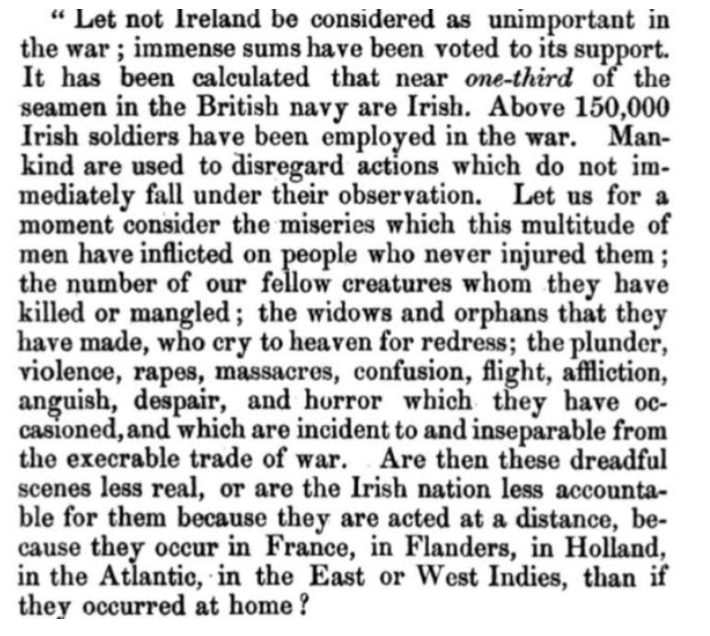
He does not mince words
Or remarks from future Free State President Sean T. O’Kelly in 1924 (then a republican), who, in a speech to the Friends of the Freedom of India, “apologized to Indians and Egyptians for those of Irish background who had assisted in their oppression and ‘formed the backbone of the invading and destroying armies.’” Of course, many will correctly point out that it was poverty resulting from the colonization of Ireland itself that motivated many Irishmen to fight in the British Army. This is indeed true. James Connolly himself acknowledged this, and to this end fought for a socialist republican movement against both Army service and economic exploitation. He did not use the very real fact of Ireland’s exploitation to justify or excuse away Irish participation in the subjugation of other nations. Rather, he sought to organize workers to fight for their class while strongly rejecting the premise that conquering other peoples was a choice justified by its desperation. In Connolly’s view, all the energy being wasted fighting colonial wars in Africa, Asia, and the Middle East could have been spent organizing a socialist workers’ movement in Ireland. The Irish Citizen Army stood as a testament to the potential strength of such a movement, even with its relatively modest numbers. Unfortunately, until shortly before the Irish Revolution, significant numbers of working class Irish chose to serve the British Empire abroad for a leg up rather than organize against it at home to improve their conditions, something Connolly called out in his time. This of course does not erase significant anti-imperialist struggles like the Land War, but it helps us understand that they existed alongside extensive Irish participation in colonial violence. In Connolly’s oft-forgotten 1898 essay “A Fighting Race,” he proclaims: “We gather from the American newspapers that our countrymen in the United States army and navy have been highly distinguishing themselves in the cause of the war with Spain. This is as it should be and in consonance with all our Irish traditions. We are a fighting race, we are told, and every Irishman is always proud to hear our politicians and journalists tell of our exploits in the fighting line – in other countries, in other climes and in other times. Yes, we are a fighting race. Whether it is under the Stars and Stripes or under the Union Jack; planting the flag of America over the walls of Santiago or helping our own oppressors to extend their hated rule over other unfortunate nations our brave Irish boys are ever to the front. When … the Egyptian has to be hurled back under the heel of his taskmaster, the Zulu to be dynamited in his caves, the Matabele slaughtered beside the ruins of his smoking village or Afridi to be hunted from his desolated homestead, wheresoever, in short, the bloody standard of the oppressors of Ireland is to be found over some unusually atrocious piece of scoundrelism, look then for the sons of our Emerald Isle, and under the red coats of the hired assassin army you will find them. Yes, we are a fighting race. In Africa, India or America, wherever blood is to be spilt, there you will find Irishmen, eager and anxious for a fight, under any flag, in anybody’s quarrel, in any cause – except their own.”
This quote, perhaps more than any other, draws home the connection between our past and present. Then as now, we are engaged in the service of hostile foreign powers, looting other countries for a slice of that imperial pie as our sovereignty slips further and further away. Then as now, pro-imperialist movements use the Irish flag to great effect. They promise national sovereignty while standing for the opposite, rallying ordinary people against a false foreign enemy, a stand-in for the real foreign oppressor these misleaders in fact serve. Yesterday, that false enemy was Africans in Africa. Today, it is Africans in Ireland. Yesterday, that real foe was the British Empire. Today, it is multinational corporations. In that sense, there is no contradiction in a group which flies the tricolour while calling for attacks against migrants. The right wing populist movement today recruits from the desperate Irish working class, just as the British Army did a hundred years ago. It uses the Irish flag and patriotic symbols to rally ordinary Irish people in the service of their imperialist oppressors, just like Redmond and his British overlords on the eve of the First World War. It channels their real economic grievances, this time linked to IPAS centres, to convince them to beat down other colonized peoples in the hopes of improving those conditions. It is this hope, this real chance that things could get better, however immaterial when trumpeted by pro-imperialist forces, that we must speak to. We must rally our class as James Connolly did, illuminating the real foreign enemy while pointing out the emotional parallels and material divergence between what many people assume is true (Irish national sovereignty as anti-immigration) and what in fact is true (Irish national sovereignty as anti-imperialism). As is so often the case on the left, we have been once again humbled by those we so often talk down to. In its own way, the great majority of the country’s working class is shining a light on a core part of Ireland’s history and present we have not been attuned to: Éire’s colonial servitude to empire. As with Redmond’s men, we have been told that subjugating those below us will somehow grant us freedom and prosperity from our imperial masters. But look around us, and we see it only makes us poorer and less free with each passing day. It is a vicious and abusive lie, told by vicious and abusive imperialists. But we will not be content to serve a wicked master, not in 1916 and not now. If the Men of 1916 could convince the great majority of their countrymen to turn against the British Empire, then we can do the same in our fight against multinational corporations and their Irish comprador lackeys. But we must recenter our conflicted role in the imperialist system, past and present: at once colonized, and part of it too.
In the interests of clarity, I want to say that internalizing important home truths is not the same as engaging in pitched historical debates with the average person. The aim should be not to force conversations about the Irish role in colonialism, nor to take the moralizing path if and when the subject should come up. For instance, it is not uncommon for folks to justify support for mass deportations through the adage that “The Irish never colonized anyone.” It is in fact both principled and strategic to point out that Connolly, Russell, O’Kelly, and others directly refuted this in their time, and were passionate opponents of Irish participation in colonialism, which they understood to be more than the work of “a few bad apples.” Furthermore, they did not use the fact that Ireland did not grow rich off widespread Irish participation in colonialism to excuse away or justify that violence. Connolly in particular understood that the key question was not whether the Irish benefited from their participation in colonialism vis a vis the British; it was that they did so vis a vis their fellow colonized people in the Global South. Under this state of affairs, it was perfectly consistent for large parts of the country to be dying from British-engineered starvation, at the same time as huge numbers of their fellow Irishmen were settling and occupying other countries, benefiting socially and economically as a result. The two weren’t contradictory — in fact, they were linked. One fed into the other. Irish participation in colonialism abroad fueled Irish oppression under colonialism at home. We see this continue today as our exploitative relationship with the Global South incentivizes corporate multinationals controlling our economy. Historical republican freedom fighters, especially 1916 martyrs like Connolly, are still highly regarded among working class communities and across the country. Indeed, anti-recruitment songs like the moving “Arthur McBride,” which dates back to the 1800s, are in the collective memory and can sometimes even be heard in pubs and at folk festivals. So it need not be preachy or moralistic to relight this flickering candle. Far from seeing it as repugnant to their nationalism, men like Russell and O’Kelly understood it as crucial to republicanism itself.
Ideological Consequences of Imperialism Today
It is, I think, crucially important to understand the impacts of what we have discussed on ideology in Ireland today. Much ink has been spilled, and rightly so, over the insidious and multifaceted impacts of continued colonization on the island of Ireland; shame around the Irish language and culture, psychological ties to the American commercial colossus, etc. Much less has been said, however, about how Ireland’s extractive role in the world system impacts us psychologically here at home. I have already proffered the theory of racism as ultimately a class phenomenon rooted in the exploitation of the Global South by the Global North, and I would like to expound on that further. We can look, in the first instance, at the significant body of evidence that attests to racism in Ireland historically not as an afterthought, but a central part of manufacturing consent for imperialist domination of Ireland through demonizing other colonies. Indeed, the 1907 International Exhibition in Dublin featured a “human zoo” purporting to show what life was like in British Somaliland, complete with Black villagers and all; far from controversial, it was the most popular exhibit at the entire event. It would probably not surprise readers to hear that Irish soldiers played a significant role in conquering that very same region. Blackface performances too were also very popular. Limerick historian Liam Hogan describes other “human zoos” in Ireland here:

Contrary to popular mythology, Ireland did have human zoos, and plenty at that
But surely that was ages ago. What are the ideological consequences of Irish participation in imperialism today? It is worth taking a look at what studies about racism in Ireland actually tell us. It may be argued, however, that some of the more recent studies have been coloured by shifts in political attitudes towards immigration, and therefore are not as stable barometers. One of the most comprehensive studies was taken back in 2016, a good deal before the right wing populist movement emerged on the scene. The results are sobering: the study found that Ireland ranked one of the worst countries in the EU regarding racism, with the highest rate of racial harassment among the 12 countries surveyed. It ranked the second highest for racially motivated violence, with racism being particularly bad in the workplace. Now, one could say that was ten years ago, surely the situation must have improved since then. But in fact it has only gotten worse; a newer, even more comprehensive edition in 2023 ranked Ireland even higher than it was years earlier, now having the unfortunate distinction of the highest rates in the EU for racist harassment at school. These studies, while deeply disturbing, must be taken seriously. Particularly as the first one was taken a good deal before the right wing populist movement gathered strength in this country, they demonstrate that racism in Ireland is not merely the consequence of some imported US/UK culture war. Rather, it has far deeper roots in this country’s history. For instance, although it is certainly true that US-origin accounts claiming to be Irish have played a significant role in spreading Irish anti-immigrant narratives, similar things can be said about American MAGA social media accounts recently revealed to be based abroad. But surely no one would say this proves racism is mostly an imported phenomenon in America. Let us not make that mistake here in Ireland. In one sense, however, the “foreign importation” theory is partially correct – the racism we see today is the result of imperial servitude imported by the British Empire and largely accepted in Ireland, hundreds of years ago. That it is so high can be explained in part, of course, by the simple fact that Ireland has not had any significant immigration for as long as many other European countries. But social phenomena are by their nature multi-causal; if that is one half of the puzzle, the other half is drawn from the role of Ireland in serving the imperial system, which has only deepened in the thirty years since the Celtic Tiger began. People often wonder why a nation that has been colonized should have higher levels of racism than many countries which have not experienced colonization. In fact, it is rather intuitive; if some colonized people are given a position in the imperial system below that of the people at the top, but above that of those at the bottom, they will likely seek to prove their “worth” to the former by brutalizing the latter as much as possible. The more they do so, the more they might be considered eligible for certain crumbs from the master’s table. This, in essence, is the age old tale of the Master, the Servant, and the Slave. As sobering as that is, it should be said that there are many proud examples in Ireland’s history where its people have rebelled against this status quo. People do not consent to being oppressed, and challenge their subordination at crucial points of historical development. The 1798 Rising, the Land War of the late 1800s, the 1916 Rising, the War of Independence, the Anti-Treaty IRA in the Civil War, and finally the thirty year long war against British imperialism in the north of Ireland … All these are heroic examples of the Irish people refusing to accept their subordination to powerful imperialists who use them as pawns in conquest of other nations. And today, there are still bright lights to be found. A recent example was the massive show of solidarity for the Oyekanmi family in South Dublin, who were tragically deported to South Africa on February 28, 2026. They were beloved in the local community, and strong local opposition to their deportation shows standing up to our entrenched imperial servitude is doable. We must take inspiration from the best parts of our history, and learn from the worst, if we are to make real change in Ireland today.
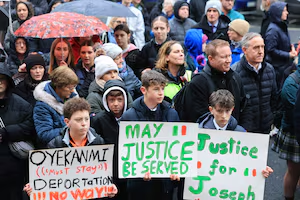
Hundreds, including schoolmates, protest in support of the Oyekanmi family in South Dublin
Understanding the end goal: from a class perspective, what do right-wing populist leaders want?
It probably does not surprise readers that I would locate today’s right wing populist movement as in part the consequence of continued dependence on American and EU multinationals, due to its insistence on strengthening the alliance with empire and cracking down on immigrants. But I figured I would share my thoughts on the class interests that lie behind its emergence; i.e., why from the perspective of capitalism organizations like the National Party are being brought in to prop up the system. I think it is pretty clear to many on the left that such parties have no interest in actually overturning the system of capitalism and replacing it with a socialist society. After all, no one can seriously believe as such, from a group that has as one of its core principles the “right” to private property. But at this point, it is necessary to move beyond the mere “immigration is a distraction” thesis towards understanding what the end goal of right wing populist immigration policy might be. Of late, Trump ally, alleged pedophile and Jeffrey Epstein associate Steve Bannon’s attempts to intervene in Irish politics have made big headlines. It is clear that U.S. imperialism is targeting this island for yet further subjugation. But how might this be accomplished? As yet, we are dealing somewhat in speculation, although anyone with an eye to historical materialism can notice a certain pattern. Nearly all of the right wing populist groups active on this island call for an end to all non-white immigration into this country, combined with the mass deportations of all non-white people, to create a supposedly “pure Irish” society. When not this extreme, such groups may call for the replication of Donald Trump’s policies regarding “illegal immigration,” or, in the most extreme cases, even the deportation and banning of all non-Irish people (whatever their skin colour) from the island. No matter which model you choose, it is clear from statistics I provided earlier that the economic consequences would be enormous. The impact on wages, jobs, social services, and general economic stability would be earth-shattering, and not in a good way. Several right wing populist actors have attempted to justify this recently, by claiming they are the only ones who can be trusted to kick the corporate multinationals out of the country. In a sense they are correct; although certainly not the only political faction whose policies would effect such a change, it is almost certainly the case that the economic disruption caused by mass deportations would cause many giant multinationals to lose confidence in their investments and leave the country. The question is, however, what comes after that? Because we know these political formations have no interest in uprooting capitalism, which Connolly noted was key to creating a sovereign Irish economy and nation. We have seen time and time again how our weak domestic capitalist class, incapable of generating high enough rates of profit on its own, relies on malicious foreign powers to get the job done. England, the U.S., the EU … we have switched masters while keeping the underlying system intact. And this is where the really important part comes in. An Ireland modeled on, say, National Party ideas, would be in need of economic support as consequence of mass deportations. After all, initial euphoria at the departure of immigrants and MNCs from the country would soon be met by panic, as layoffs and prices soar and wages drop. And out of all the most powerful countries in the world, who would be the most likely to offer assistance? The United States of America – in return for a price of course. This price would be an even greater usurpation of sovereignty by the United States, and probably a Farage-led Britain as well. Powerful countries in continental Europe, many of which look set to be run by Trump equivalents themselves in the near future, would be smelling blood too. Trump has already proven useful at striking deeply unequal trade deals with countries he is targeting through tariffs. Ireland, its economy heaving from mass deportations, would be the prime candidate to be “saved” by crusaders in red white and blue. Expect DOGE-style policies dictated almost word for word by the American elite, with business regulations and public services becoming practically nonexistent in Ireland. It’s easier to justify handing healthcare over to American companies when you’ve deported all the immigrants who contribute so much to the public system. Cheap, low quality imported food and other products, subject to the “oversight” of nut RFK Jr.’s FDA, would poison our bodies, hurt our quality of life, and destroy any hope of indigenous industry. It would, in short, be even more humiliating than the indirectly controlled, multinational-run economy we already have. It would be the biggest attack on Irish sovereignty in a century. Certainly not the “Irish Ireland” promoted by its exponents at home. Furthermore, the whipping up of ultranationalist militarism by right wing populist groups would ultimately serve a U.S. imperialist agenda. War with China, justified by virulent racial imperialism, would be sold under the banner of destroying the “inferior races” while offering “opportunities” for young Irish people to fight and die on the battlefield. We cannot trust to safeguard our sovereignty forces that align so closely with the United States and its vassals like the AfD in Europe.
Tackling Cultural Questions: Where to for the left?
When it comes to the topic of immigration, we are often faced with a cultural dimension as well as an economic one. Concerns around “cultural erasure,” while often not as prominent as economic concerns, are still significant. Leftists are often wont to respond to this by shutting down these arguments, calling them racist. This may feel good but in fact accomplishes nothing; the other person does not feel heard and is driven even further from the left. Rather than seeing them as stupid, we must attempt to understand where these arguments come from. While I certainly do not condone such attitudes, it is actually rather easy to understand their logic when you see them from the perspective of the person expressing them. It is a very hegemonic perception in this country that in order to be Irish, one has to be white. Due to the profound historical developments outlined earlier, Irishness has come to be seen as inextricable from race. In this reality, significant numbers of people who were born here, grew up here, have Irish accents, and are immersed in the culture, are not considered Irish due to their skin colour. Meanwhile, say, Irish Americans with no real connection to this country and its culture are considered Irish shortly after landing. Now, one could say the difference is Irish Americans do at least have Irish ancestry. But this argument falls apart when we consider that it is fairly easy for someone from Germany with no Irish ancestry, for instance, to come here as an adult and within a few years be considered Irish in a national sense, citizen or not. Not so for Black people who have lived here their entire lives. Of course, this is not to say ethnic Irishness is merely an invention. One can of course understand the fellow-feeling experienced by people who have shared ancestry going back hundreds of years. But it is to say that there is a real case for the idea that one can be not just ethnically Irish but nationally Irish. That is, one may for instance have two African parents but has grown up here and is part of the country. In that sense, they are Irish. Not ethnically Irish, nationally Irish: but Irish all the same. There is a significant case to be made that rather than simply dismissing cultural arguments around immigration as ridiculous, the left should put forward a vision of Irish nationalism that addresses common fears without leaning into ethnonationalism. That is, we should express our sympathy with the very real emotions around immigration people are feeling, without necessarily condoning or agreeing with everything they say. We can and should point out the ridiculous double standards mentioned earlier, and push for an understanding of Irishness that, rather than simply calling for a more “inclusive” definition of the term, takes as its first principle the idea that Irish culture and identity are a good thing that should be strengthened. Accordingly, we should seek to better social cohesion by promoting a shared Irish culture centered around national identity (language, dancing, games, songs, etc.) rather than race. Think of it like a quilt that, rather than being a simple patchwork of identities, is a mixture of threads that ultimately combines into one green, white, and gold design. In this understanding, Irish and say, Indian identity can coexist equally for a person who has Indian heritage, but everyone has a shared Irish identity that ultimately unites us as a nation across differences. This model of social integration addresses fears around difference without accepting overt racism (i.e., that the colour of one’s skin determines what nation one is allowed to be a part of).
On the topic of culture, what about the question of immigration and crime? On this issue, many leftists will start by pointing out that there is no causal link between immigration and crime, as this excellent study taken across 30 OECD countries demonstrates. While that is absolutely true, it may be better to start by validating some of the concerns people have. This does not mean leaning into racist tropes, which have been spreading on social media like wildfire in the form of spurious allegations against people of colour. Rather, we can, as others on Aontacht have already done, point out the very real trend of anti-social behaviour in and around Direct Provision centres. This will help us to elucidate the problems inherent in Direct Provision; namely, that it allows a tiny minority to profit while putting vulnerable people in substandard “accomodation” and depriving services from local communities. One symptom of this is the terrible mental health impacts this can have on residents, which can spiral into criminal behaviour. We should stress that this is not an inherent result of the fact that they are immigrants, and has more to do with their conditions. The solution being to use our vacant housing supply and make housing a public good, to house those in Direct Provision along with the homeless population, while revitalizing hotels and the like which were once used for Direct Provision. One recent example of the left getting it wrong on the crime issue was the CityWest riots. While these have been discussed at length elsewhere, I think it would be pertinent to propose a potential solution that appeals to working class communities without prioritizing deportations. Obviously, the man who committed that horrific crime against the young girl was a deeply disturbed individual, his condition made worse by the fact that he was in Direct Provision. And yes, obviously the fact that he was an immigrant does not mean that immigrants are, proportionally speaking, more likely to commit such crimes than the general population. And yet, the left really dropped the ball here. By trying to dunk on the protestors through highlighting the fact that there are plenty of white men who commit such crimes who are not the cause of violent riots, leftists created the perception we are “whataboutists” who seek to distract from immigration at every turn. This contradicts the oft-repeated left-wing assertion that immigration is itself a distraction from the “real issues,” making our position seem even more removed and elitist. Furthermore, it increases the suspicion that immigration is going unaddressed as part of an elite conspiracy to cover up the fact that it is supposedly the cause of all our problems. Surely there is a better way to go about things. We should, as always, start by empathizing with communities, stressing the impact of such a horrific crime. From there, we deal with a very powerful argument put forward by right-wing populists. It goes something like this: “that man was given a deportation order before he harmed the girl. If he was deported, that would never have happened to her. So he (and by extension everyone issued a deportation order) should be deported, right?” This argument is effective because it gets to the heart of a sexual crime against children, foregrounding the attacker’s racial identity and legal status as the supposed predominating factor. As I have pointed out earlier in this essay, attitudes like this were firmly embedded before organizations like the National Party arrived on the scene, becoming more open and vocal after the shift occurred. However, this does not mean that people’s concerns around this issue were ever inherently racist. On the contrary; they repeatedly pointed to anti-social incidents around the Direct Provision centre, but nothing was done. So we definitely have a responsibility here to amplify these concerns and push for the solution mentioned earlier, in order to prevent such incidents from happening again. But what to do once they happen? This is where things get interesting. Arguments for deportation are often framed around a discourse of justice: a crime has been committed and so it must be punished. And why ought we disagree with that? Crimes like this are terrible. However, we also understand that the push to enforce deportation orders using cases like this, is directed against the vast majority of immigrants who have deportation orders given for nonviolent “offences” like being undocumented or overstaying their visa. Deportations by their nature reinforce the existence of a low-wage, highly exploitable class of immigrants, who fear to organize or risk expulsion by the state via outing by their employers. So, how to resolve the problem? Simple: take the demand for justice to its logical conclusion. Deportations may sound like justice, but in fact, when a person is deported right away, they do not serve time for a serious offence like this, and are potentially free to re-offend. In a sense, this is actually a dilution of sovereignty; crimes committed on Irish soil should be tried on Irish soil rather than outsourced to other countries. Justice means prosecuting them here, not flying them off consequence-free. Now, some will say that Ireland already prosecutes and imprisons here for the most part, before deporting the convicted person. This is true. But with very serious crimes such as murder or abuse of children, there is a real case to be made that the person should be imprisoned for life so they cannot re-offend. This would mean Ireland taking control of the situation, without reinforcing a deportation system that punishes exploited peoples for coming here without papers. Furthermore, the offender would not be free upon landing to commit crimes in their home country, as is usually the case when people are deported after serving their sentence in Ireland. With this solution, the offender would be treated in such a way that they could never commit such crimes again. Now that sounds like justice to me.
There is another aspect of the crime issue I would like to address, and that is the matter of undocumented immigration. Often known as “illegal immigration” in popular discourse, this is a hot-button issue that brings out strong emotions on both sides. The right wing populist argument goes like this: a crime has been committed by someone being undocumented, and so the law must be enforced. The left usually responds by saying that there is no such thing as illegal immigration, because of the UN Convention on Refugees, the arbitrariness of borders, or both. Therefore, the person should be allowed to stay. These arguments tend to fail miserably, as one side has the perceived moral high ground from a “justice” perspective. Here I think we should start by affirming something often deemed anathema on the left: the amount of undocumented immigrants is too high, and it should be brought down. Not in the sense that undocumented immigrants are criminals in need of punishment, but in the sense that undocumented immigration at the levels we are seeing is a sign that our immigration system is not working properly. After all, if it was, why would you have people burning their passports, coming in without papers, etc? Clearly something has gone wrong. From here, we ought to emphasize Ireland’s role in exploiting the Global South as a key cause of why so many people are migrating undocumented (and in general) in the first place. The more desperate their situation, the less likely it is they will arrive with papers, and the more likely they rely on smugglers who instruct them to burn their passports. Furthermore, decades of immigration policies aimed at closing off and restricting safe, legal immigration pathways have actually led to an increase in illegal immigration, as people switch to illegal routes with no other choice available. Many people are not aware of this, given the media narrative that paints undocumented immigration as a necessary consequence of “lax” border measures. In fact, the opposite is true. Besides, deportations are costly, and we could use that money to provide for public services. Maybe instead of closing off legal routes, we should prioritize safe, legal immigration, so people who migrate here arrive safely and with their documents. Combined with a policy that ends our exploitation of the Global South, this would mean that when people immigrate to Ireland, they do so safely, legally, and because they want to, not because they are doing so out of desperation. The path to solving undocumented immigration runs through safe, legal routes, not closed borders and millions spent on immigration enforcement.
The final cultural question that comes to mind is that of fascism. Many on the left have observed that the rising right-wing populist movement in Ireland is fascist, but the word has become such a term of abuse in recent times, that it has lost almost all meaning in general parlance. “Fascist” is often used to connote someone who simply uses the power of the government to shut down opinions they don’t like, rather than an organized political movement, led by capital, that seeks to mobilize large sections of the Global North’s working class against its own interests when the system is in crisis. Aware of this, many leftists have sought to prove the right wing populist movement is fascist by highlighting its racism. But as mentioned previously, this often fails; people do not like being called racist, and being called fascist is, if anything, even worse. Given these facts, I think we would do well to return to understanding the logic of fascism itself, in our efforts to warn those it seeks to mobilize. Benito Mussolini, the ideological godfather of fascism and leader of Fascist Italy, once said that “Fascism can more appropriately be called corporatism, because it is the merger of state and corporate power.” This, straight from the dictator’s mouth, is the essence of fascism. In this light, it should not be difficult to elucidate to our class the bourgeois nature of fascism, using the words of the man who literally invented the word itself. The right wing populist movement in Ireland, whatever its exact ideological perspective, is led by people who, as discussed previously, seek to affect the merger of corporate and state power through mass deportations which will open Ireland up to an even more direct form of American colonial control. In this vision, in which the American state and Irish state collaborate to ensure American corporate interests take precedence over every sovereign need of the people of Ireland, fascism as Mussolini defined it takes full form at last. Fascism in Ireland is fundamentally about colonial control, epitomized through corporate-state collusion – brought about by the same demonization of the Global South that has sustained colonial structures in Ireland for hundreds of years. Let us not hesitate to call out the deep-rooted ties of today’s Irish right wing populist leaders to America’s MAGA political and economic elite – reflective of their own desire to turn Ireland into a country where the fusion of state and corporate power is absolute, dictatorial, and fascist to the core.
Conclusion: Compassion is Common Sense
I hope the positions I have laid out in this document have been of use to you. Throughout, I have tried to demonstrate that it is possible, doable, and indeed necessary, to articulate a socialist republican vision on immigration that addresses concerns regarding the issue, while avoiding a restrictionist position that ultimately plays into the hands of the populist right. Ultimately, mass migration is not a distraction – it is a horrific consequence of imperialism that we must address head on in order to wage the fight against capitalism and unite the working class. We should respond to it by recentering Ireland’s role in exploiting the Global South, explaining the causes of mass migration and offering real solutions that deal with the root issues rather than simply punishing those we have played a significant part in victimizing. A socialist republican position on migration would entail:
- Rejection of moralistic arguments that talk down to the white working class in Ireland. Shaming people for expressing racism, however real it might be, will not win them over
- Highlight Ireland’s role in the imperialist system, the “why” of mass migration, and the necessity of breaking the connection with imperialism. Stop serving the imperialists, and we will free our country as well!
- Challenge the stranglehold of foreign corporations over our economy, one of the biggest causes of the housing and cost of living crises devastating our country
- Remind ourselves and others that while it may have been our government that implemented these policies, they were successfully sold to the Irish people with promises of consumerist “prosperity.” We must remember that the Celtic Tiger was a popular neoliberal program, enthusiastically received by the vast majority of people.We must recognize we bought into the lie, and take responsibility for it
- Agitate around Direct Provision, opposing IPAS profiteering while working to shut down the system as a whole and replace it with dignified housing for homeless and DP residents. Respond to “house the Irish first” arguments by pointing out the 166,000 vacant properties available, far outstripping the numbers in homelessness and Direct Provision
- Foreground awareness that racism in Ireland is not a recent phenomenon, or something imported in recent years, but a long-standing result of Ireland’s servitude/subjugation to imperialist powers. Move away from binary ideas about “racist” and “not racist” – we live in a racist society and should treat racism as a societal issue, not a matter of individual moral failing or the province of a “few bad apples”
- Push for an understanding of Ireland’s past and present role in colonialism, moving away from binary ideas of “national innocence” to a more nuanced understanding grounded in the necessity of consistent anti-imperialism. We cannot liberate this country unless we challenge our own role in historical and neo- colonial exploitation.
- Smash the myths of the taking migrants – go to the studies, which prove the opposite is true. Facts are paramount, especially in this time
- Again on studies, illustrate the disastrous consequences of right wing populist immigration policies on prices, wages, public services, etc, and how this demonstrates that mass migration is in fact not a significant driver of the economic crises in society
- On emigration and Irish healthcare workers for example being “replaced” by immigrants, point out that both forms of emigration are driven by our exploitation of the Global South. This transfers huge amounts of wealth here, in the process drawing healthcare professionals from the Global South. It also gives corporations so much power that they can annihilate living standards and working conditions for professionals here, causing many to emigrate. We must tackle this if we are to stop the brain drain on both ends.
- Fight red-brown arguments with facts – how can we build a sovereign socialist republic by alienating vital allies like Burkina Faso, Mali, Niger, through deporting and excluding their people? Alliances with the Global South are key and they cannot be threatened for the sake of racial prejudice
- On undocumented immigration, rather than dodging the issue, point out that attempts to “get tough” on migration have largely incentivized it by criminalizing people fleeing imperialist exploitation. Expand on this by exposing deportations, restrictionist policies, etc, as corporate stooges that create and expand a highly exploitable class of immigrant labourers, lining corporate profits while exploiting immigrants and pushing down wages. Counterpose to this the real alternative of a post-exploitation global economy based on safe, legal immigration routes, with common-sense reforms like immigrants no longer having to be tied to just one employer
- Stress the historical significance of prominent republicans in opposing the Irish role in colonialism. They did not make any excuses for what they understood was profound Irish complicity in colonial violence, and neither should we. Let us not tarnish their memory by justifying the Irish role in colonial violence simply because those who were participating in it were oppressed themselves. Stress as Connolly, Russell, and O’Kelly did, that there was/is always an alternative to this kind of service to one’s oppressors – fighting the real enemy by organizing our class against capitalism and imperialism at home
- Point out the contradiction between right wing populist leaders who say they are about national sovereignty, but in fact have deep ties to the American MAGA elites. Demonstrate the logical outcomes of their immigration policies – economic collapse, followed by a form of even more total American imperialist control
- On culture, sympathize with common fears around immigration but do not feed into them. Point out the role of not recognizing huge numbers of Irish-born people as Irish because of their colour, as an important factor in undermining social cohesion. Challenge the hegemonic notion that “in order to be Irish, you have to be white.” Promote a sense of Irish nationality based on – you guessed it– national characteristics – music, dance, language, sport – instead of race
- On crime, speak to local concerns about anti-social behaviour and Direct Provision while stressing these are the result of Direct Provision itself, not someone’s immigration status. On serious crimes like the one in CityWest, counter the deportation narrative with a call for “justice on Irish soil” – life sentences for such crimes here in Ireland, not deportation somewhere else where such crimes could be committed again
- If/when choosing to introduce the idea of fascism, frame it as the fusion of corporate and state power, and illustrate how right wing populist immigration policies are used to accomplish those goals. Using Mussolini’s direct words is simpler than giving people an ideological definition of fascism from the left wing. Stress that fascism in Ireland seeks a complete consolidation of corporate and state power through subordinating our economy completely to the US, to be accomplished by wounding it through mass deportations
- Above all, stress that the things we all want in life – affordable, decent housing, good quality food and water, jobs that actually sustain us, an economy based around our needs as working people – are not only possible without punishing immigrants. In order to accomplish them, we must free ourselves from the colonial servitude of oppressing the Global South. That is where real Irish freedom begins.
Break the connection with imperialism! Let us free Ireland from colonial servitude and oppression!
– D. Tchang