

Corporate Power in Ireland Under Scrutiny at Maynooth University Report Launch
A new report examining the extent of corporate influence over Irish public policy and everyday life was launched at an event in Dublin this week, drawing activists, researchers and independent media to discuss what authors describe as a growing democratic deficit in Ireland.
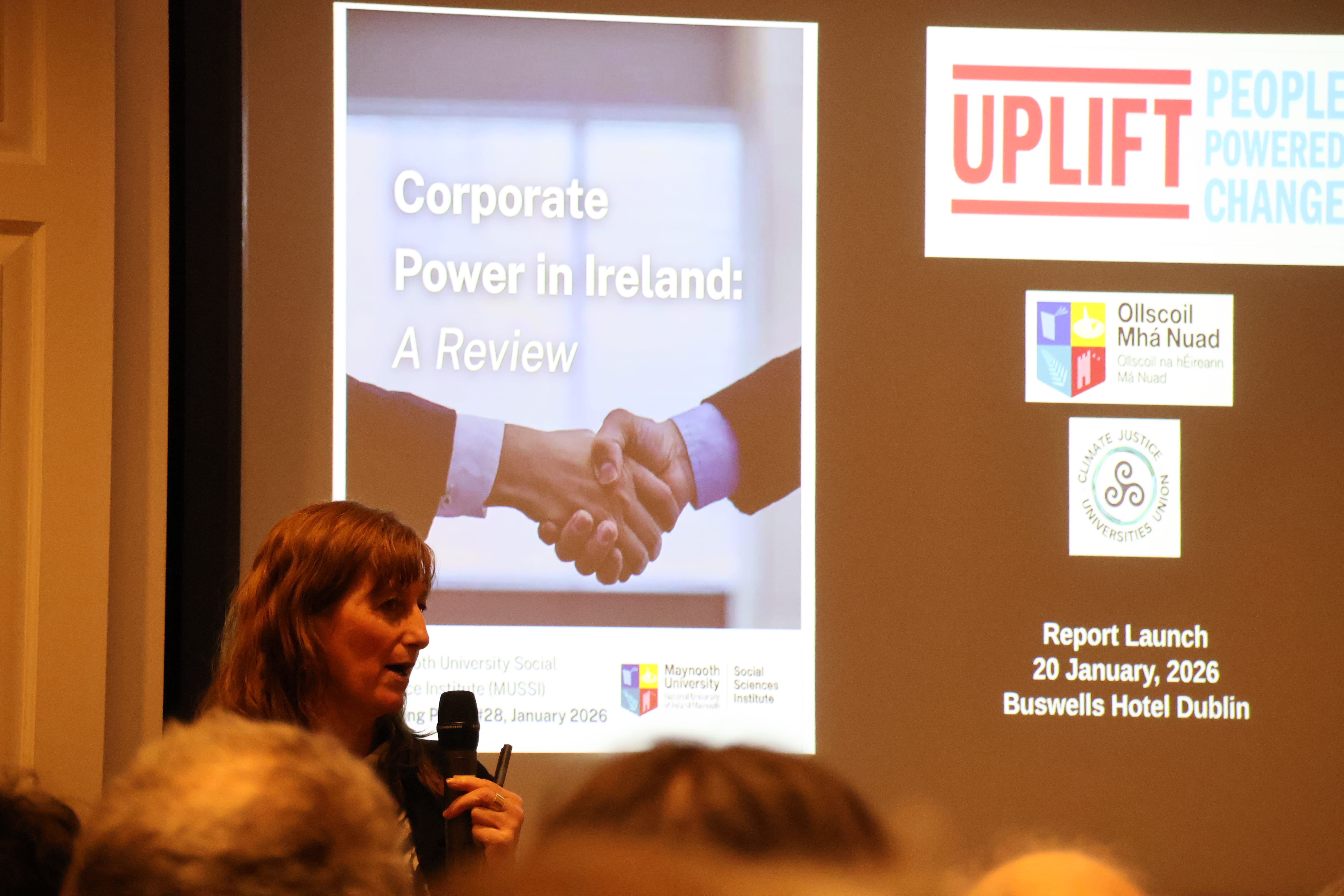
The report, Corporate Power in Ireland: A Review, was launched on Tuesday afternoon in the Georgian Room of Buswells Hotel. It has been co-authored by members of the Transformative Climate Justice Research Team at Maynooth University, including Professor Jennie Stephens, Caoimhe McSharry Daly, Laurie Reilly and Conchur Ó Maonaigh. According to the authors, it is the first research project to systematically examine corporate power across multiple sectors in Ireland, including big tech, agriculture, housing, pharmaceuticals, health, energy and education.
The research argues that large corporations wield outsized influence over government decision-making, often shaping policy in ways that prioritise private profit over public interest. The authors say this influence has profound consequences for housing, climate action, public services and democratic participation.
During the question-and-answer session, independent outlet Aontacht Media raised concerns about what it described as an underexamined example of corporate power in Ireland: the International Protection Accommodation Services (IPAS) system. The outlet highlighted the role of private companies in profiting from asylum accommodation while asylum seekers are left in degrading conditions and local communities experience the loss of essential services.
Referencing the Citywest Hotel deal, Aontacht Media pointed to the removal of one of the area’s only major amenities under a reported €150 million arrangement, arguing that such deals prioritise corporate interests while bypassing meaningful community consultation. The intervention questioned why mainstream political parties have largely avoided the issue, despite rising community tensions and public concern.
Responding to the discussion, Professor Jennie Stephens placed these concerns within a broader social and political context, warning that concentrated corporate power erodes trust in democratic institutions. She argued that when people feel excluded from decision-making processes, mistrust and polarisation grow, weakening democratic engagement and social cohesion.
Stephens linked local experiences of corporate influence in Ireland to global trends, including the concentration of wealth and the rise of authoritarian politics. She said these dynamics are interconnected and reflect a broader crisis in democratic governance driven by excessive corporate power.
She also addressed Ireland’s role on the international stage, noting that decades of tax and economic policy have helped multinational corporations, particularly in the technology sector, to consolidate power. According to Stephens, Ireland must openly acknowledge how its economic model has contributed to strengthening corporate power globally.
The report’s authors stressed the importance of situating Ireland’s experience within a wider European and international framework. Discussion at the event touched on trade agreements, regulatory structures and the need for stronger coordination between local activism and European-level political engagement to counterbalance corporate lobbying.
Attendees at the launch included campaigners, researchers and media representatives, reflecting growing concern about how corporate interests shape housing policy, climate action, migration systems and public services. Organisers described the report as a resource for journalists, community groups and policymakers seeking to challenge corporate dominance and advocate for greater democratic accountability.
Corporate Power in Ireland: A Review is intended to support efforts to constrain corporate power and encourage public debate on the future of democracy, governance and social justice in Ireland.