Workers Left Hanging As Solicitors Strike Over FFG Austerity Attack
Defendants with additional challenges – including mental health issues, addiction, and homelessness – require the most time and effort, and will be the most affected by Jim O'Callaghan's austerity reforms.
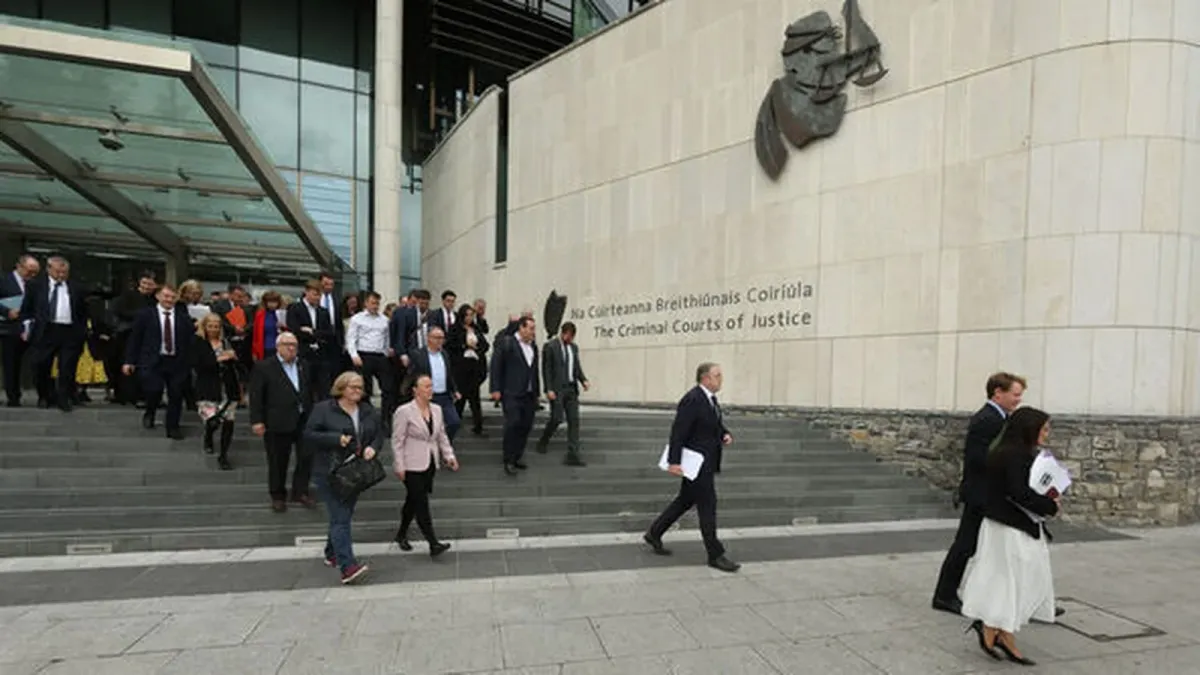
Hundreds of criminal defence solicitors across the country withdrew their legal aid services after the Minister for Justice Jim O’Callaghan’s ‘one-accused, one fee’ reform came into effect on Wednesday 1 July.
The reform, publicly announced in February, means that the Department of Justice will pay each solicitor voluntarily taking on criminal legal aid work a flat fee of €520 per client, no matter how complex or simple, long or short the case may end up being.
Barristers working with these criminal legal aid solicitors, who for years have relied on solicitors’ willingness to share a portion of their pay with them, will face even more financial strain if this reform is not reconsidered.
Impact on workers
It is Irish workers that are suffering the most as a result of this disruption, and it is the most vulnerable workers who will shoulder the long-term consequences of O’Callaghan’s reform.
In Westmeath, Judge Cephas Power has postponed the trial of a man who allegedly assaulted a younger woman at an Athlone church to October. The accused, Sean Bailey, has been allowed to remain free until then, risking the immediate safety of his local community.
Civil society organisations like the Irish Council for Civil Liberties (ICCL) have warned that such a reform will result in solicitors pressuring their clients into pleading guilty to resolve cases faster, a practice normalised as ‘plea bargaining’ in the United States. Defendants with additional challenges – including mental health issues, addiction, and homelessness – require the most time and effort, and will be the most affected.
Efficiency theatre
This wildly unpopular decision of O’Callaghan’s can be thought of as the Government reasserting its authority over the legal profession and emphasising its commitment to austerity after a track record of concessions and failures.
In 2024 and 2025, lawyers successfully pressured the Department of Justice into increasing the budget for criminal legal aid. These demands, pushed into being by an ever-growing army of legal professionals, came after the Government failed to commit to a comprehensive reform strategy after two of its proposals fell flat.
In 2021, the Government examined the possibility of a public defender system for criminal law, which would see legal practitioners employed directly by the State to represent poorer defendants. Critics worried that this would increase costs, create more bureaucracy, and trigger a decline in quality, causing the idea to be dropped in 2024.
In 2023, the Government published a blueprint for its proposed Criminal Justice (Legal Aid) Bill 2023. The Bill, as sketched, would create a means-tested application process, automate payments, and offload much responsibility for criminal legal aid from the Department of Justice onto the Legal Aid Board.
However, Fianna Fáil and Fine Gael’s lack of political capital meant that the the development of such legislation would have required the cooperation of civil society bodies like Rape Crisis Network Ireland (RCNI), which instead of expressing support, publicly opposed the expansion of means-testing.
Taking Jim to court
Dublin solicitor John Quinn, allegedly the biggest single beneficiary of criminal legal aid money, is seeking a court order that will temporarily prevent the reform from being enforced. The case is set to resume at the Four Courts on Tuesday 7 July.
As for pushing back against this reform at Strasbourg’s European Court of Human Rights (ECtHR), it will likely be difficult for an Irish citizen to challenge this flat-fee reform due to the Irish State having a ‘reservation’ in place for Article 6(3) of the European Convention on Human Rights (ECHR).
This ‘reservation’, in force since 1953, effectively frees the State from the ECHR obligation to overhaul the criminal legal aid system in order to ensure that criminal defendants get legal assistance when they cannot afford it.
(1) Anna Barlow, “The Machinery of Legal Aid,” (Doctoral thesis, Åbo Akademi University, 2019), 40–41.