The Slievenamon Fires: Burning Through Our Own Ignorance
The Slievenamon fires are a serious education in what happens when you refuse to understand your own environment and refuse to decolonise.
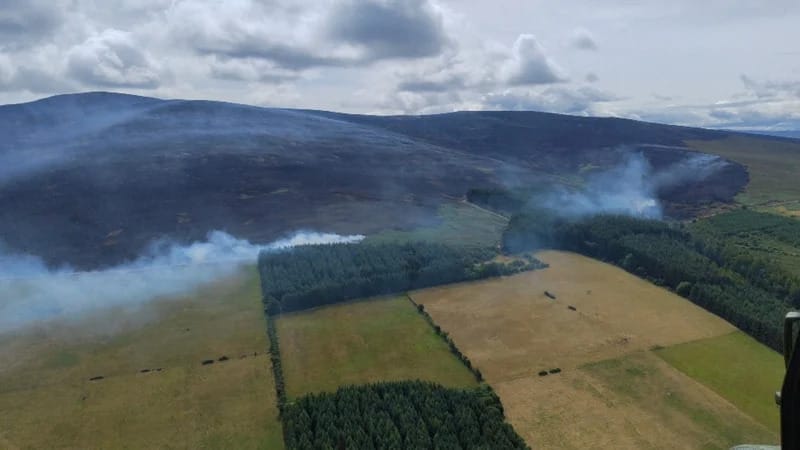
The Slievenamon fires are a serious education in what happens when you refuse understand your own environment and refuse to decolonise.
They are not an accident; they are the inevitable result of a government that refuses to understand its own landscape, it's people and it's history, where the only opposition is a left that doesn’t know what to do other than parroting imported eco-ideologies without interrogating their colonial roots. To decolonise the Irish environment, and I use that word with surgical precision, is to reject the globalised templates that treat our bogs, hillsides, and river catchments as blank canvases for ideologies that didn’t work 200 years ago and do not work now. It means accepting a radical, inconvenient truth: Ireland's ecosystem was never a pristine, virgin wilderness, but a living, breathing symphony co-authored by human hands and animal hooves over millennia. The moment we forget that, we are not repairing the land; we are setting fire to our own history, literally.
Ireland possesses one of the youngest landscapes in Europe. Twelve thousand years ago, the island lay entombed under a sheet of ice kilometres thick. As the glaciers reluctantly retreated, flora and fauna scrambled to establish a foothold, but humanity was hot on their heels. Our ancestors didn't passively observe this ecological succession from a safe distance; they waded into it, axe and herd in tow. Within a few thousand years, a stable ecosystem emerged, but it was never a "natural" one in the Romantic Victorian sense. We were a heavily forested island, up to 80% tree cover, yet there is no historical record of major, landscape-devouring forest fires. Not one. Why? Because we didn't need to burn brush to clear land; we had teeth, dung, and feet. Our ancestors practiced extensive, rotational, seasonal grazing: The ancient booleying system, moving livestock between upland summer pastures and lowland winterage. This rhythmic pulse of transhumance prevented scrub encroachment, maintained species-rich grasslands, and built the very organic soils we are now desperately trying to preserve. The imported concept of "controlled burns," introduced by settlers in the 17th century, was a solution looking for a problem—an alien technology grafted onto an ecosystem that had functioned perfectly well without it for thousands of years. More than that, it was a stolen American indigenous technology that was inverted and used to clear “The wild Irish” off of unenclosed land. This is the ancestor to both gorse burning as carried out by farmers and the controlled burns of firebreaks carried out by Coillte and the fire brigades every so often to seem like they are doing something in the aftermath of fires like these.
So, why are we now watching our hills smoulder in 2026? Because we have broken that ancient contract. There are three interlocking, systemic obstacles to land decolonisation and ecological repair in Ireland today. They are not separate enemies so much as three heads of the same hydra: the economic driver, the institutional enforcer, and the ideological confusion.
This is to say, 3 primary enemies in the modern day post independence, all of which have their roots in the old enemy - colonialism.
The primary, overarching, modern enemy is capitalism, specifically the post-WWII intensification doctrine that, until recent decades, went virtually unchecked. This doctrine viewed the Irish landscape not as a fragile, living matrix but as an inert factory floor for food production. It demanded drainage, chemical fertilisers, silage monocultures, and the eradication of hedgerows. It broke the rotational rhythm of our grazing systems, replacing them with year-round, heavy stocking densities that compact our fragile peaty soils. It turned our natural carbon sinks into net emitters. Capitalism does not see a blanket bog; it sees a field of grass or, worse, a carbon credit to be traded. It has no memory of the seasonal movements of cattle, horses, sheep and goats; it only sees the quarterly balance sheet.
Hand-in-glove with this economic driver is the bureaucratic machinery of the European environmental directives. They were actually originally what led to the aforementioned intensification via farm improvement schemes from the 70s to the 90s. Now they are trying to put that genie back in the bottle. Our government, eager to sign up for green credibility, signed up to frameworks like the Habitats Directive and the Water Framework Directive without any forensic understanding of Ireland's unique pedology or hydrology. These directives were drafted in boardrooms in Brussels and Strasbourg, based largely on studies of continental ecosystems - the alpine meadows, the Mediterranean scrub, the sandy heathlands of northern Germany. They impose rigid, binary categorisations of "good ecological status" that have zero bearing on the wet, acidic, oceanic reality of a western Irish bog. The same curse applies to commercial forestry and the financialisation of carbon storage. Planting Sitka spruce on a deep peatland is not climate action; it is carbon arbitrage dressed in green. It is a financial instrument, a tax-break vehicle for pension funds, that drains the water table, acidifies the soil, and creates a dark, biologically sterile mono-crop. It’s not that the government doesn’t know, Teagasc warned them that Sitka spruce wasn’t viable and recommend native Scot’s pine instead, way back in the 1950s. When these plantations inevitably fail or catch fire, the state is left holding the ash. There are few in the country who understand the perverse incentives of this carbon-trading racket as intimately as I do—the first policy of the Roots Party - Our agricultural and environmental policy - was built precisely on exposing this architectural flaw.
But it is the third enemy that stings the most, because it comes from our own side. The well-meaning, passionate left has been seduced by the glitz and moral authority of the international Anglo-American NGO industrial complex. They listen too hard to the sufficiently alt and trendy eco influencers and the glossy fundraising brochures as well as the YouTube “documentaries” with fund raising links in the description, and not nearly enough to the actual experiences of indigenous peoples around the world. "Rewilding" is a scam -I will not soften that word - and it will not repair the damage already inflicted on the ecosystems of the world, least of all in Ireland. Why? Because rewilding presupposes a "natural" baseline, a pristine state of nature before human interference, that exists only in the imagination of Victorian era naturalist proto - fascism. In Ireland, that baseline does not exist. It has never existed. Our original ecosystem was shaped by ancient human activity. We are not separate from nature; we are a constituent part of it. To "rewild" an Irish hillside in practice usually means fencing it off, excluding livestock, and walking away. But without that rotational grazing pressure, what actually happens? Rapid scrub invasion. Hazel, gorse, and bracken take over, drying out the soil, increasing the fuel load, and raising the ambient temperature of the landscape. This is precisely the conditions in the unmaintained firebreaks that turned the Slievenamon fires from a manageable gorse flare-up into a peat-consuming inferno. Rewilding is that but on a larger scale. Rewilding, in an Irish context, is not healing; it is arson by neglect.
Furthermore, this fetish for the "wild" has its ideological roots in the 19th and early 20th-century Romantic movement, which carried a deeply unsettling, often eugenic undercurrent—a theme I explored months ago in They Are Killing The Dogs They Are Killing The Cats - The Calculating Cruelty of Colonial Deflection, Which can be read here. It was actually the forerunner to eco-fascism and fascism itself, particularly the “blood and soil” movement.
In the Americas, the creation of national parks like Yellowstone and Yosemite involved the violent removal of indigenous peoples who had managed those landscapes with fire for millennia. The colonists needed to manufacture a myth of a "virgin" wilderness to justify dispossession. They blamed native groups for causing forest fires, evicted them, and history has since vindicated the indigenous methods entirely. Those prescribed fire techniques have had to be re-deployed up and down the Pacific coast to prevent the catastrophic megafires we now see annually. But here is the crucial distinction that the lazy, one-size-fits-all modern environmentalism refuses to acknowledge.
Prescribed fire was introduced to Ireland by those very same colonial settlers, so we know full well that the banning of it in the US was a political ploy to get natives off their ancestral lands, a bitter irony that it was deployed here to help get us off of ours. The difference is that the ecological application is wholly unsuitable to the Irish environment. There is a hell of a lot of difference between using prescribed fire on a sandy or mineral soil - where the fire runs hot and fast across the surface, consuming duff without damaging the substrate - versus using it on a peat or other high-organic-matter soil.
Which brings us to the smoldering heart of the matter.
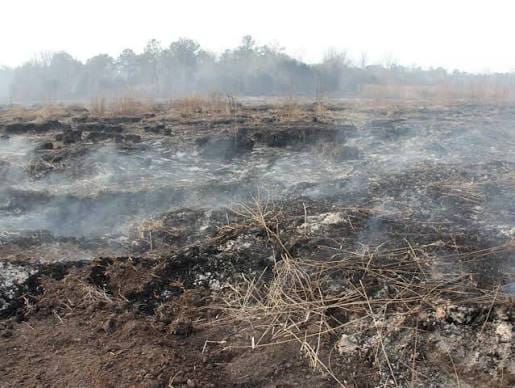
A prescribed burn on a mineral soil in California is a surface event; it cleanses. A prescribed burn on an Irish blanket bog is a hidden underground catastrophe. Peat is organic matter - compressed, partially decayed vegetation built up over thousands of years. Set it alight, and it does not just burn the grass on top; it smolders downward. It oxidises the very foundation of the soil. It releases hundreds if not thousands of years of stored carbon back into the atmosphere in a matter of days, not decades. It destroys the hydrological structure, rupturing the delicate capillaries of the bog, turning a sponge into a cracked, hydrophobic moonscape that will take centuries to recover. This highlights the terminal danger of fetishising indigenous practices from entirely different biomes. To copy the fire-stick farming of Australia or the cultural burning of California onto the wet, peaty hills of Tipperary is not solidarity; it is intellectual laziness and the results of colonialism.
An interesting pattern I would like you to observe however:
Even with gorse burning, forest fires of this scale were more or less unheard of, up until the forced settlement of travellers - our own indigenous people, and before the eu subsidies schemes demanded that what wasn’t fully enclosed or fenced off be fenced off or you got no subsidies. There is an area I am familiar with because I have grazing there for my few nags, in upland county Limerick that the old folks will tell you had never been fenced until the EU forced it to be and until the 1980s forestry boom. I’m nervous watching Slievenamon, because if this was to take off it would be worse than the Killarney national park fires some years ago. Because there are thousands of acres of tightly packed commercial forestry under varied ownership with firebreaks chock full of gorse, dry sedge, and other out of control brush, as well as multiple overlapping wind farms. On an EU spread sheet this is the ideal forestry, rewilding and renewables combo. But the same time as Killarney burned the hills at the other side of the river valley did too and they burned to a crisp but the news was overshadowed by Killarney. The hills at this side of the valley are worse regarding the expansiveness of peat and out of control combustible material.
But back to the travellers and the enclosure. You see, before we tried to cosplay as a strange Scandinavian-British hybrid, before we joined the EU, before we tried by pen rather than sword to eradicate both our own indigenous travellers and the traditional farming practices that kept us safe but were marked as “backwards” - this vegetation was managed by a combination of the seasonal movement of traveller families managing areas of “no man’s land” abandoned land whose ownership could not be easily established or which the land commission had not allotted yet depending on the time period. They were considered a well known “nuisance” during the 1980s forestry boom letting their horses graze the firebreaks. Little did we know or want to acknowledge that they were likely saving us all back then.
The remainder was made up by the local landless peasant labourer with a few goats or a house cow which persisted well into the 1970s in many areas as well as farmers short of grazing in dry weather letting animals into these areas in addition to the board of works in some areas.
This is another case of what the British couldn’t kill in 800 years- Fianna Fáil, Fine Gael and the EU killed in 50.
I’m not just talking out my rear end here, the science is proving me right every day - it just doesn’t want to acknowledge the class and ethnic issue.
If you follow ecology, everyone knows that now again the humble goat is trendy. No longer derogatorily “The Tinkers Cow” or besides that the preserve of the strange spinster, the widow woman, the hippy or the cracked mountainy man - and a much persecuted animal she always was, shot regularly by coillte and persecuted by landowners as well as the state until all that remains of our native goat is a couple of hundred;,The goat is now the frontline troop in the battle against climate change, but stripped of her history, separated from her people, and the preserve of the environmental NGOs. This is not to detract from the great work of the Irish Goat Society and their conservation grazing project on Howth Head, but if it wasn’t for the history and the injustices against man and beast therein there would be no need for them.
Post Killarney National Park fire, there have been multiple trials of upland native cattle, native horse and goat grazing as suppression of forest fires and in the maintenance of scrubland. All have been a resounding success.
Notably the Hen Harrier Project's gorse management trial, which used mob grazing with horses and goats as a sustainable alternative to burning or mechanical removal. The horses break down branches and strip bark, while goats follow to finish off the remaining gorse.
While the project spanned multiple counties, one specific part of the trial was conducted in the Mullaghanish-Musheramore Special Protection Area (SPA), which is near the Cork-Kerry border.
Their findings were:
- Grazing is most beneficial from January to March, when grass has low nutritional value, encouraging horses to eat the gorse stems. (Traditionally when travellers would be in the upland land vacated by those cattle booleying, who would have returned to the lowlands in late October or early November)
- The trial helped contribute to a recovery in the hen harrier population, with breeding pairs in the Mullaghanish-Musheramore SPA increasing from one pair in 2015 to five pairs by 2020.
Notably missing from this is the travellers, who are still locked down into alien urban environments with their horses being regularly taken from them and destroyed by the state, why can we not recognise them as the ecological asset they are, and provide them the resources, contracts and grazing to utilise their horses to save us from the effects of climate change while alleviating their social strife?
It’s not that difficult to provide them with mobile electric fencing, a mobile horse shelter and a water tanker trailer. The whole set up would cost about 2-3k and one equipped traveller family with a contract and permission could manage the firebreaks of multiple forestry plantations and save the state millions. As is historically any shortfall can be made up by the local landless. All the rural peasants like myself and our friends the travellers require is the permission to do so.
What a climate proof Ireland requires is native trees and animals to graze under them, managed by the people.
The Slievenamon fire isn't just burning gorse; it is burning the credibility of a movement that refuses to look its own history in the eye. Decolonising the Irish environment means tearing up the EU directives and the rewilding leaflets. It means investing in agroecology, in the return of rotational grazing, in the restoration of our natural water tables, and in treating our peatlands not as potential carbon credits, timber plantations, or rewilding experiments, but as the living, wet lungs of the island that require active, knowledgeable human stewardship. The left has a choice: continue to chase jobs in the globalised Anglo-American NGO sector, or root itself in the actual ground beneath its feet. Because if we don't understand the soil, we will keep burning it. And the smoke will choke us all.