The Rise And Fall Of Irish Sugar Beet
For eight decades, the sugar beet industry was an integral and constant component of the functioning of rural Ireland. It employed farmers, machine operatives, maintenance, factory workers. What followed was EU membership, sovereignty lost and a colossal mess.

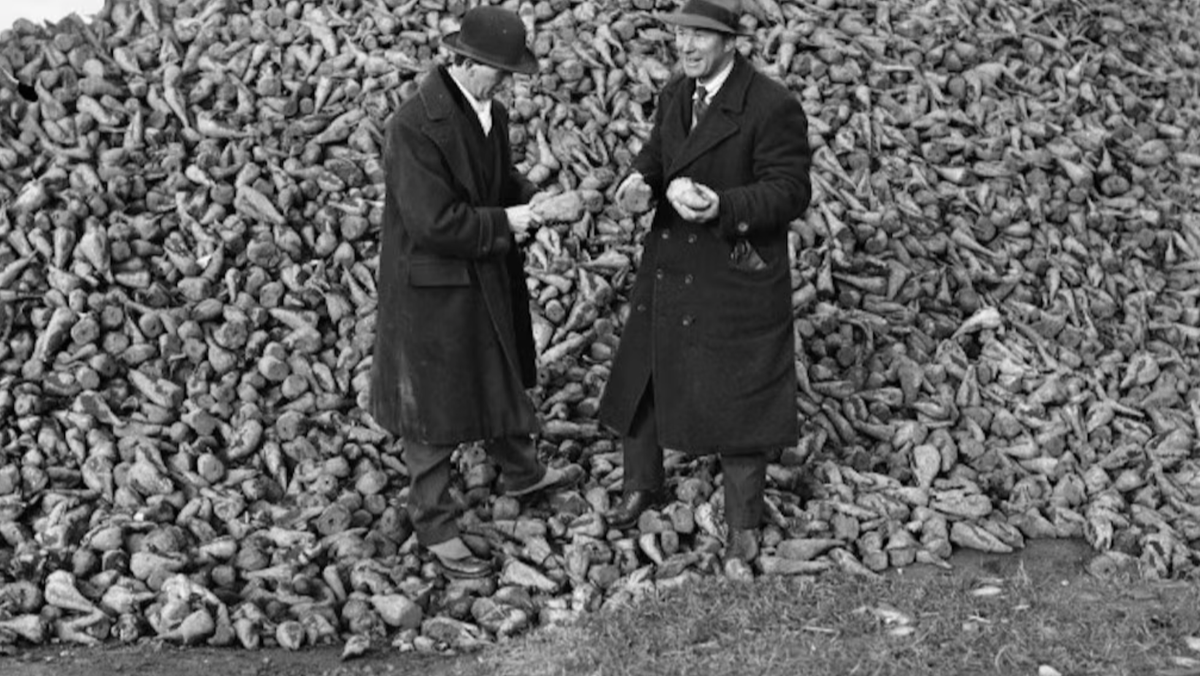
“Chris, why in the living fuck are you writing about sugar beet production in rural Ireland?” I hear you say. Well, the answer is, of course, the Houthis.
For folk who grew up in rural Ireland in areas like Tipperary, Carlow or Wexford, you might be familiar with the story of the sugar beet. For anyone on the island who's spooned some Siúcra into their tea and wondered why it no longer said “Irish sugar” on it this might help you understand.
Firstly, why is this important? Well, Ireland and Britain (where I live) have both been hit by pretty substantial food price increases over the last few years. Most recently with the ongoing illegal and terroristic American-Israeli wars on Iran and the Houthi resistance in Yemen. This has put huge pressure on global supply chains that run through many such choke points.
To put it in perspective, a cargo ship took a corner poorly in North Africa in 2021 and then it was harder to get insulin.
Anyway, sugar beet.
For eight decades, the sugar beet industry was an integral and constant component of the functioning of rural Ireland. It employed farmers, machine operatives, maintenance, factory workers, seasonal harvesters, it kept rail lines humming, it provided industrial scale employment, it kept secondary and tertiary businesses afloat and it offered food sovereignty for a staple ingredient. What followed was EU membership, sovereignty lost and a colossal mess.
The industry was born out of the new Irish Free State’s drive for self-sufficiency. In the 1920s and 1930s the government built factories in Mallow, Thurles, Tuam, and later Carlow, under the State-owned Comhlucht Siúicre Éireann. The factories were deliberately located in poorer regions to provide a bit of a social and economic ballast. The context for this is that the vast majority of the 26 counties was an open air museum of the Iron Age. It had been utterly and forcibly mal-developed by the crown. Belfast was the seat of industrial power on the island. So the Free State government had a lot of catching up to do.
For towns like Tuam, the impact was huge. At its peak the Tuam factory employed 700 people, offering seasonal work to local small farmers and keeping money circulating in the local economy. The wider ecosystem was way bigger. Beyond the permanent factory staff, there were the beet growers, the hauliers who moved the crop, the contractors who maintained the machinery, and the railway networks that transported the beet to the factories. Sugar beet was the fuel that could power social change in a new Ireland, sustaining industrial and social development in regions that had little else going on.
The first major issue came in 1991. The government moved to privatise the State company, as was the style at the time, which was taken over by Greencore. At the time, the company was profitable, employing over 1,700 people and reporting strong finances. However, the true existential threat came from Brussels.
In 2005, Greencore announced the closure of the Carlow factory, followed shortly after by the shuttering of the remaining plants. This was driven by the EU’s 2006 sugar regime reform, which sought to cut overproduction and comply with WTO obligations. The EU introduced a voluntary restructuring scheme, offering compensation to processors who renounced their sugar quota and dismantled their plants. They essentially bribe you to not produce sugar anymore so as not to be competing with other larger EU states. Basically sugar production was measured in terms of the continent and not the country. When it should really have been measured by its impact on the communities.
Greencore, the sole quota holder, took the deal. The last factory in Mallow was dismantled in 2006, ending an 80-year industry that linked Irish agriculture and indigenous manufacturing. The government secured a compensation package worth roughly €353 million. That was €220 million for beet growers, €127 million for Greencore, and a tiny wee €6 million for machinery contractors. A 2011 report by the EU Court of Auditors later suggested the closure may have been based on “out-of-date figures” and might have been unnecessary, a finding the Department of Agriculture rejected. I’m sure there were many a fat back pocket bulging with manilla envelopes. Cunts in the Department sitting in italics.
The human and economic toll on the towns was severe. When the Tuam factory closed, a member of the Seanad lamented that "nothing has replaced it… Not one extra job has been created in that area since". The same story played out in Thurles and Carlow. The closure of the Carlow plant in 2005 was met with plenty anger, as it was still a profitable business and its ecosystem spread wide into the hinterlands and into a lot of Wexford. And to top it off this closure came ahead of the final EU negotiations, arguably weakening the government's hand in Brussels. Intentionally or otherwise.
The promises of diversification and replacement industry failed to materialise. The compensation money went to farmers and the company (and to fat back pockets), but the industrial heartbeat of these towns stopped. The loss was not just economic, the whole social cohesion of communities built around the harvest campaign was smashed.
Today, Ireland produces absolutely no sugar from beet. Even the Siúcra brand is owned by a German company, and the sugar on supermarket shelves is entirely imported, thus completing the legislative national infrastructural cuckoldry. The raw cane sugar comes from a mixum-gatherum of various countries, reflecting a globalised supply chain rather than a functional local one.
In 2024, Ireland’s top sources for raw cane sugar included the Czech Republic, El Salvador, Mauritius, and Ukraine, with smaller volumes from the UK, Colombia, and France. For refined or industrial sugar, we rely on France, Germany, the UK, and the Netherlands. This means Ireland is fully exposed to global market prices, shipping costs, and the geopolitical whims of distant regions.
The bludgeoning of the Irish sugar industry is a case study in the loss of food sovereignty. The concept refers to a nation's ability to control its own food supply and production. As former French Agriculture Minister Annie Genevard noted, "Anything that makes us dependent on others is maximum fragility". Such a good point and we’re such nice fellas that we decided to bolster French sovereignty with our dependency.
We have felt this fragility a few times now. The war in Iran and disruptions in the Middle East highlight how quickly global supply chains can seize up. The Strait of Hormuz, for instance, is a chokepoint not just for oil, but for fertiliser. Roughly 29% of global urea trade and 47% of sulfur trade (critical for phosphate fertilisers) pass through here. When conflict threatens shipping, fertiliser prices spike, which in turn drives up the cost of food production everywhere. If only there was a way in which we could grow food organically without an over reliance on artificial fertilisers essentially made of petrol, if only there was the capacity to grow food locally in our cool temperate oceanic climate with plentiful rainfall that was once known as the bread basket of the British Empire. Such a shame. Anyway, better keep getting asparagus from Azerbaijan.
Ireland’s main export is “blood products” (don’t ask) and the biggest earner for our GDP is “intellectual property”, or to put it more simply: money laundering and tax avoidance. Meaning that we are over a barrel when it comes to fluctuating prices for essentials. Ireland imports a massive proportion of its food, including vegetables, fruit, and grains that could be, and traditionally have been, grown domestically. While Irish food (beef and dairy) exports are booming, the domestic reliance on imports for basic staples like sugar, flour, and certain vegetables leaves the nation utterly exposed.
The current government has acknowledged the loss. Agriculture Minister Martin Heydon recently called the closure of the sugar beet industry a "mistake" but noted that rebuilding it is unlikely due to the massive capital costs (estimated at €250-€400 million) and the lack of processing infrastructure. Best to not bother then. Instead, the focus has shifted to smaller-scale import substitution, such as a new scheme for flour mills. Hooray.
The story of Irish sugar beet is like a Greek tragedy. It tells the story of a nation throwing off the yoke of oppression, to try and stand on its own, only to willingly and gleefully throw back on the yoke of oppression like a traumatised Sisyphus. There must be a particle of Diarmait Mac Murchada in every Agriculture Minister inviting in the foreign corporate or crown despoilers and extractors for short term personal gain at the expense of generations of Irish people. The compensation money is long spent, but the towns of Tuam, Thurles, Carlow, and Mallow still bear the scars of lost industrial identity.
In a time of near constant and ever increasing global instability, whether from war, pandemics, or climate crisis, the value of a local beet field and a working factory becomes clearer. Food sovereignty is the strategy of resilience. And also of combatting climate change. Ireland is in a terrible position when it comes to its ability to stand on its own two feet. Fixing this would require not just investment, but the political will to prioritise security, sovereignty and even patriotism over the efficiencies (and threats) of the global market.
Socialism is often seen as crude centralisation but look at capitalism. Sovereign nations are reduced to narrow use value for empire like a McDonalds worker being the gherkin guy as opposed to being a well rounded worker capable of fully integrating with and understanding the whole of the catering trade in its totality. It makes you intentionally unskilled and infinitely replaceable. For nations it makes you utterly devoted to maintaining the geopolitical status quo so that you can eat. This is the logic of monopoly finance capitalism. We have been infantilised, our industries destroyed and we’ve been clamped onto the teat of the EU, the UK and the USA. Good wee Paddy will give us the beef and the butter and take our pittance corporation tax rate. No wonder the triple lock is under attack. No wonder we are still the second largest export market for Israel. Our lack of infrastructural capacity has us complicit in genocide. In the Soviet Union they recognised that some areas were more industrial, some were more agricultural, and they recognised that that was an issue. They actively encouraged regional sovereignty to not be overly reliant on whole nation supply chains. This is true also for China. Whereas it does use the economy of scale to produce commodities at extraordinarily low costs the CPC still actively encourage and materially support the development of smaller and more regional industries as they recognise that the knock on effects far outway any capital expenditure or profit loss from moving away from monopoly production. They even twin developing poorer areas with prosperous and productive areas and share personnel, training, favourable trade and support in governance. A system that is proven to work extremely well. Head onto RedNote and see regional villages selling agricultural produce on the equivalent of Tiktok Shop. Or be happy enough that Siúcra is German owned and doesn’t contain one gram of Irish sugar.
Do yous know the theory about the Bronze Age collapse? That it was actually the collapse of the supply chain that killed off loads of civilisations because they had become far too reliant on international trade for meeting their essential needs. Bronze itself requires commerce as copper and tin deposits tend to not be found together and so this alloy needs trade to occur to even be made. Then iron comes around, which is a superior metal but, most crucially, can be found in the ditch. Suddenly folk didn’t need to deal with these civilisations’ monopolies and super-profits to be able to get in on the game. The moral of this story is: you can either grow and produce what you need domestically and somewhat contribute to the fall of the ruling empire or be a passive participant in said empire and gleefully fall with it when this house of cards inevitably comes tumbling down.