The Revolutionary Legacy of Karl Kautsky
Many on the left know of Karl Kautsky, but few understand him. He is denounced as a reformist and his politics as anathema, but the reality of the fact is that he is one architect of the European revolution of 1917.

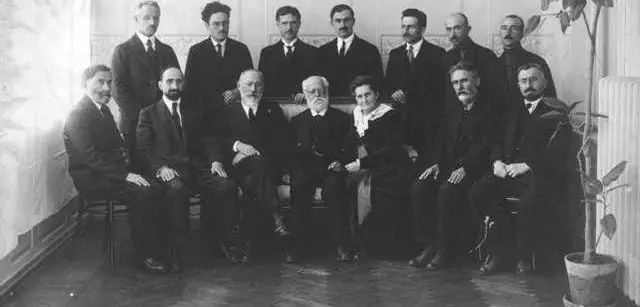
Many on the left know of Karl Kautsky, but few understand him. He is denounced as a reformist and his politics as anathema, but the reality of the fact is that he is one architect of the European revolution of 1917.
The abandonment of Karl Kautsky and the reimagining of Lenin as a great man leading a vanguard against the Tsarist regime has led to all sorts of simplistic distortions of history and the nature of the state. Today Irish Marxists frequently speak of the “landlord” class that governs. While such a term has propagandistic use, it has become to some almost a simple statement of fact. But on the contrary we know that it is a simplification as “the capitalist class rules but does not govern. It contents itself with ruling the government”[1]. The fact that we have so many landlords sitting in government is not the cause of our problems, but the effect.
So many marxists today read all the works of Lenin, but they neglect the seminal works: ‘The Social Revolution’ and ‘The Road To Power’ by Kautsky. So they read only the sequel, but not the source. Without this context they conceive of the vanguard party as a party of revolutionary elites. This lie has been repeated so many times by the Bolsheviks that it has become to many an unknowing assumption. This is not the case, Lenin was a proud follower of Kautsky when he wrote ‘What Is To Be Done’. Since the collapse of the Soviet Union the real history has been unearthed again. ‘What Is To Be Done’ argued only against an economistic trend within the RSDLP that repeatedly pushed for strikes without ideological development. Lenin made this clear so many times himself[2].
Thus even today socialists continue to call for a ready made “Vanguard Party”. But a party is not made in a day. The struggle for ideological development must happen within the worker’s organisations. Similarly, some socialists call for a general strike just as Luxemburg did in her day arguing against Kautsky. But as we saw yesterday, even the far right can call for a general strike[3]. As laid out in ‘The Social Revolution’:
“The strike as a political method of warfare will scarcely ever, certainly not within any time we can foresee, assume the form of a strike of all the workers of a country; nor can it be expected to replace the ordinary weapons of political warfare of the pro letariat. ’ It can only complement and strengthen them.”[4]
The Kapp Putsch was not merely defeated by a worker’s strike, it was the threat of an armed uprising that led to its defeat. The strike defeated the Putsch but without ideological development and a victory on the political or military field it ultimately led to the rise of the DNVP and the bourgeois bloc. The task of organising is hard and slow and it is best that the “professional revolutionaries” of today heed that fact.
[1] Kautsky, Karl. “The Social Revolution”. https://www.marxists.org/archive/kautsky/1903/xx/socrev2.pdf
[2] Draper, Hal. The Myth of Lenin’s “Concept of The Party” https://www.marxists.org/archive/draper/1990/myth/myth.htm
[3] Murphy, Ann and Sherlock, Cillian ”They went too far': Fuel price protesters call for national strike” https://www.irishexaminer.com/news/arid-41826308.html
[4] Kautsky, Karl. “The Social Revolution”