Kinisla: A Rebrand Will Not Fix What Is Wrong With Kerry
This could have been a beautiful story of farmers and workers taking back the power from a PLC, but instead due to the issuing of transferable shares, this is a disaster in the making.
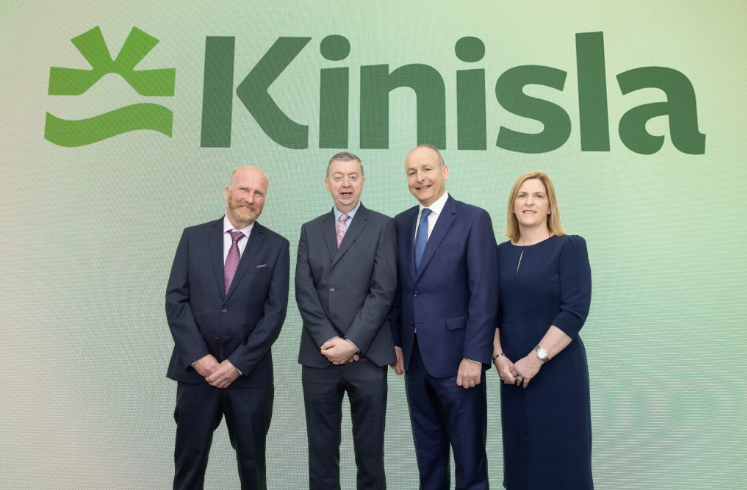
Photo credit to The Irish Co-Operative Association
In May 2026, a carefully orchestrated corporate unveiling took place in Kerry with the Taoiseach and others from the FFG political class in attendance. The dairy processing arm of Kerry Group, one of Ireland’s largest historical indigenous food businesses, was re-christened “Kinisla.” The name, drawn from a local river, was meant to evoke heritage, rootedness, and a clean break from the past. A €300 million investment plan was announced, promising growth, innovation, and a bright future. To the outside, and to those not in the know, it looked like a triumphant homecoming: after decades as part of a publicly listed multinational, the dairy business was back in the hands of its farmer-owners through Kerry Co-operative Creameries.
Behind all this lies a far messier story. The rebrand to Kinisla is not a return to co-operative principles. It is the culmination of a decades-long counter-revolution in Irish dairy, one that has hollowed any semblance of mutual ownership and replaced it with a system of tiered, tradable wealth that serves a minority of shareholder-farmers while leaving workers, and even many farmer members, out in the cold. For a socialist analysis, the Kinisla launch is a near-perfect case study in how the language of co-operation can be mobilised to entrench and protect a new class of rural capital.
The deal that created Kinisla was staggering in scale. In a €500 million transaction finalised in early 2025, Kerry Co-op bought a 70 percent stake in Kerry Group’s dairy business, with a path to full ownership by 2035. To fund it, the co-op sold off a slice of its shares in Kerry Group PLC, raising roughly €250 million, and took on substantial debt. The headline for many members, however, was a windfall. The co-op redistributed 85 percent of its remaining PLC shares directly to members as individually owned, tradable stock, unlocking an estimated €1.4 billion in personal wealth. The average “A” shareholder—an active milk supplier—received around €188,600; even “C” shareholders, who have no voting rights, averaged nearly €89,000. This is the usual story of a short-term windfall to the detriment of stability and legacy.
For some long-standing farming families, this was undeniably life-changing money. But framing it as a victory for the co-operative movement requires ignoring who won, who lost, and what was lost along the way. The Kinisla rebrand is best understood not as a revival of the old co-operative spirit but as the logical endpoint of a long process of “PLC-isation,” demutualisation, and financial engineering that has transformed relationships between farmers, workers, and capital.
To grasp what has been abandoned, we must go back to the worker-shareholder model that briefly flourished in mid-20th century Ireland. Family members of mine worked for Golden Vale from the 1970s, supplied Dairygold and were involved in other cooperatives in Limerick & Cork including a goats cooperative in the 1980s-early 90s so there is very little I do not have a horse’s mouth history of regarding the co-op movement in Munster from the 1970s to the 2000s. At Golden Vale in Charleville in the 1970s, employees could become members and receive shares. Annual bonuses were paid as dividends on those shares, meaning workers had a direct, material stake in the success of the enterprise. More than that, any of them who had good exams in school were put on to further education part-time, at a time when no working class person could aspire to such. This is how relatives of mine ended up becoming UCC qualified agricultural and dairy scientists and engineers. Via the Golden Vale Laboratory Department and Stainless Steel Department. This was never pure socialism—the co-ops were still controlled by boards of directors and a management class—but it represented a meaningful alignment of labour and capital, a recognition that those who worked in the plants were co-creators of value, not just costs to be managed.
That world was dismantled step by step. Co-ops converted to public limited companies to access capital markets, because of neoliberal ideology, pie in the sky promises from big foreign investors who had been visiting and promising trade since my mother’s time, as well as the government and EU pushes for more production capacity and demand to fill bigger and bigger contracts, meaning debt was taken on and outside investment being accepted. Separating the co-operative society from the operating business. Golden Vale became a PLC in 1990. Kerry Group had pioneered the hybrid PLC model four years earlier. Once shares could be traded on the open market, the link between supplier and shareholder eroded. Hostile takeovers followed: Kerry swallowed Golden Vale in 2001 for €245 million, promising anxious suppliers, many of whom tried to fight it, that Charleville would not become a “ghost town.” However, in reality, almost immediately after, most of the ancillary industry like the engineering and stainless steel was contracted out and shut down. The worker-shareholder model vanished, replaced by standard employment contracts and an even worse managerial class whose first loyalty was to the bottom line.
The Kinisla deal is widely celebrated as a reversal of this trend—a “re-cooperativisation.” But what has actually been re-cooperativised? Not the inclusive, multi-stakeholder co-op of old. Instead, we have a legal entity controlled by a specific class of shareholders who have just received a massive, personalised payout in tradable shares. Those shares are not held collectively for the benefit of future generations of farmers or workers; they are private financial assets that can be sold to anyone, including outside investors. This is precisely the “back door to investors” that many feared and many smaller farmers fought during negotiations. Once patronage shares are tradable, the co-op’s capital base can slowly leak into non-farmer hands, undermining member control and inviting the same market logic that gutted the earlier generation of co-ops.
The democratic deficit within Kerry Co-op is stark. Voting power is concentrated in the hands of “A” and “B” shareholders—active and former milk suppliers—who number around 5,500. The 6,329 “C” shareholders, many of whom are descendants of earlier members or have a more distant connection to dairying, hold 36.9 percent of the co-op but have no vote. They also have no incentive to hold on to those shares, so much of that 36.9% will be immediately on the open market and will likely be bought by the likes of Vanguard who own some of Glanbia already. This is a classic tyranny of the minority, and it was exercised ruthlessly to push through the €500 million deal. Director Seamus Crawford resigned in opposition, arguing the business was “overvalued” and that the co-op was effectively negotiating against itself, being the sole buyer. His warnings were drowned out by the promise of a windfall, albeit badly needed by some who are financially struggling.
The rebrand event itself was pure corporate theatre. “Kinisla” was unveiled with a glossy video and language about “nourishing communities” and “building a better future.” But a brand cannot paper over the contradictions that erupted within months of the acquisition. The newly independent dairy business, now ostensibly owned by farmers, immediately moved to impose a new milk supply contract on those same farmers. The Munster Dairy Producers Organisation branded the contract “one-sided,” noting that it offered suppliers nothing beyond a promise that their milk would be collected. The Kinisla CEO ignored two formal letters requesting negotiations. A co-op board member defended the top-down process, revealing the deep separation between the managerial class and the owner-suppliers. The co-op had become its own members’ adversary.
And what of the workers? The Kinisla rebrand made no mention of them as stakeholders. There are no worker shares, no profit-sharing schemes, no seats at the board table. This is a co-op that employs around 1,600 people, but the prevailing attitude among some on the gain out of it is that even this is too many: one shareholder publicly complained that “all other efficient dairy businesses are managed on half that amount of labour.” The memory of the 2017 Cheestrings strike, where SIPTU members walked out over unilateral changes to work practices and management’s withdrawal from agreed procedures, shows that labour relations under this model are fundamentally adversarial. The co-op structure does not soften the capital-labour divide; it simply replaces a distant shareholder class with a local one, equally determined to extract maximum value from the workforce.
In a bitterly ironic twist, the newly enriched farmer-shareholders are unlikely to spend their windfall on propping up the co-op’s struggling rural communities. Most of it is likely to be either swallowed up by existing debt to the banks following the post-quota abolishment big bank farm expansion giveaway or retirement. The €1.4 billion payout will not rebuild the social fabric that decades of consolidation and centralisation have frayed. It will, however, cement a new class of propertied rural shareholders whose interests are increasingly divorced from both their non-voting neighbours and the workers who process the milk.
The Kinisla rebrand is a masterclass in the appropriation of co-operative aesthetics to legitimise a fundamentally inegalitarian structure. It borrows the language of mutualism while practising a form of shareholder primacy that would make any corporation proud. For socialists, the lesson is clear: a co-operative is defined not by its legal form or its branding, but by who holds power, who reaps the surplus, and who is excluded. By that measure, Kinisla is not a return to the co-operative ideal. It is a monument to its defeat. It also is a masterclass in divide and conquer. You now have A shareholders who, while getting the bigger payout in the short term, now long term have much worse contracts versus the B and C shareholders who have nothing to lose by eroding the A shareholders’ milk prices and workers’ wages, but everything to gain, and all the above versus the workers who have no say.
You also have the issue of taking on debt to then pay out what was gained by it (classic privatise the gains, socialise the losses neoliberalism) which will leave the whole lot vulnerable to hostile takeover in the future. It is either intentional or flagrant stupidity because this is how Kerry acquired Golden Vale in the first place, so it is not like they do not know.
Much of this has been gone over in less socialistic language already by those within Kerry who opposed the deal, primarily smaller farmers dependent on a good milk price and the longevity of the cooperative as well as the workers and some dissenting management. This could have been a beautiful story of farmers and workers taking back the power from a PLC, but instead due to the issuing of transferable shares, this is a disaster in the making.
Let this be a lesson to all setting up the co-ops of today, bar the creation of transferable shares in your constitution and make suppliers and workers equal shareholders. Do not listen to soft-soaping from suits and politicians. Mind your own and the people beside you.