Socialist Republicans Take Over Vacant Property And Call For Liberties Community To Participate
Socialist Republicans from the Revolutionary Housing League have taken a locked up, vacant building in the Liberties from the hands of capitalist speculators and are now turning it, via the kind of direct action they have become known for, into a community center.
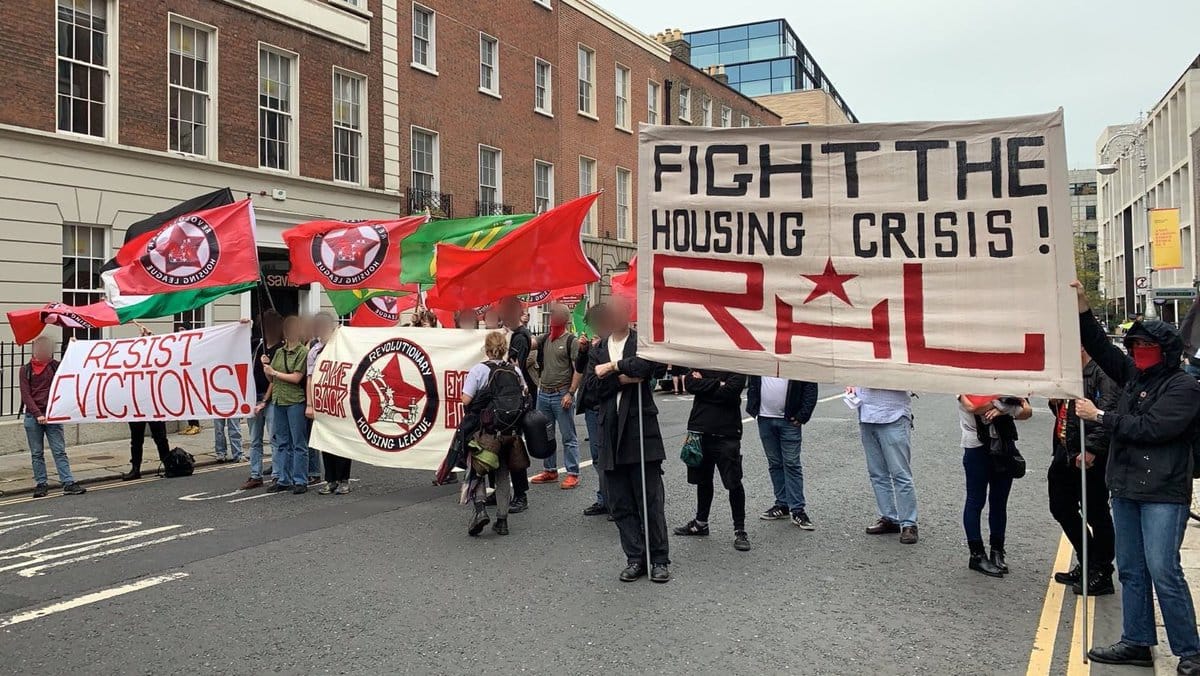
Socialist Republicans from the Revolutionary Housing League (RHL) have taken a locked up, vacant building from the hands of capitalist speculators and are now turning it, via the kind of direct action they have become known for, into a much needed community space, in one of the most deprived urban areas in the country, the Liberties.
The RHL, through a statement issued on their social media, have called on locals from the area to engage with the Anne Devlin Community Center, which will soon be furnished with a café, meeting rooms, a space for events as well as a library. Anne Devlin, whom the center is named after, was an Irish Republican and freedom fighter. Together with Robert Emmet, she was a key organiser of the 1803 United Irish Uprising. After her release from prison, she lived, worked and raised her family in the Liberties, earning her the name Liberty Belle.
“The Anne Devlin Community Centre is an acquisition aimed at empowering the local community, demonstrating that the working class do not need to wait for crumbs from politicians and can organise and find solutions ourselves, “ the statement read, adding that “we encourage local residents to get involved in this working class-led project and to reach out and give us your ideas about how the community centre can be used to best serve our community”. Those interested can message the Instagram account of RHL or use the email isrmedia@protonmail.com to get involved.
The presence of working-class politics in the Liberties is undeniable, and has historical origins. For over eight centuries, the Liberties has been a distinctive and fiercely independent working-class quarter of Dublin. Its name springs from the “liberties” which were manorial jurisdictions established after the Anglo-Norman invasion of the 12th century that lay outside the jurisdiction of the city corporation. From the 16th century much of the area was controlled by the Brabazon family (later Earls of Meath), whose influence is still visible in street‑names such as Meath Street and Brabazon Street. By the 17th and 18th centuries the Liberties had become Dublin’s industrial engine-room: a centre of brewing, distilling, tanning, silk‑weaving and silverwork, powered by Huguenot craftsmen and native artisans. This industrial expansion reached its peak with the establishment of the Guinness brewery at St James’s Gate in 1759 and the great whiskey distilleries of Powers, Jameson, Roe and Millar.
Yet the wealth flowed upwards. Behind the chimneystacks and malthouses lay some of Europe’s worst slums, where families were crammed into collapsing tenements without sanitation. The economic decline that followed the Act of Union (1801) destroyed many of the traditional trades, while the Victorian era saw only patchy attempts at improvement, such as the artisan dwellings built by the Iveagh Trust and the Earl of Meath. Through it all the people of the Liberties maintained a fierce community identity, a deep repertoire of street songs and stories, and a tradition of resistance to authority.
Anne Devlin, the “Liberty Belle,” walked the same streets and lived amongst the suffering Liberties working class through the worst of those post‑Union years. Born in 1780 in County Wicklow, Devlin was the daughter of a United Irishman and a cousin of the celebrated rebel leader Michael Dwyer. In April 1803 she became the ostensible housekeeper to Robert Emmet, who was secretly planning a new republican insurrection. Devlin attended the conspirators’ meetings, carried messages to republicans across Dublin, assembled arms and ammunition, and maintained the safe‑house on Butterfield Lane. When Emmet’s rising fell apart on 23 July 1803 – the most serious fighting broke out in the Liberties itself – Devlin stayed behind to destroy incriminating papers and protect the identities of the leaders. Arrested and lodged in Kilmainham Gaol, she was subjected to three years of solitary confinement, torture and psychological cruelty. Despite repeated bribes and threats, she refused to inform on Emmet or his associates. Her silence is widely credited with saving the United Irish network from complete annihilation.
On her release in 1806 Devlin returned to her family but soon made her home in the Liberties. She married William Campbell in 1811 in St Catherine’s Church on Meath Street and lived for four decades in John’s Lane and later in Little Elbow Lane. Supporting her family as a laundress – at one point employed with unusual status and pay by St Patrick’s Hospital – she endured deepening poverty, especially after her husband’s death during the Great Famine. In 1851 she died in a garret in Little Elbow Lane, mainly of starvation, aged 71. Her gravestone in Glasnevin Cemetery reads “the faithful servant of Robert Emmet,” but she was no mere servant she was a hero in her own right and her true legacy is her unbowed resistance against empire and her four decades of life, work and family‑raising in the heart of the Liberties.
The woman who starved in Little Elbow Lane in 1851 would recognise the deprivation still endured in these streets. Today that legacy of self‑reliance and community defiance is being honoured once again. The newly liberated Anne Devlin Community Centre stands in the tradition of a woman who never waited for permission from the powerful – and of a neighbourhood that has always understood that freedom must be taken, not begged for.
The dire need for spaces like this in the Liberties – a summary of facts:
The Liberties is not only one of the most deprived areas in terms of social issues and economics, it is also one of the most deprived areas in terms of community space and investment in same.
- In 2016 Carman’s Hall was closed.
- The Donore Youth and Community Centre has been closed since 2021 following a fire and its refurbishment has been severely delayed.
- St James Parish Centre closed in 2022.
- What is left of existing centres are under threat; the Robert Emmet Community Development Project faced an almost 300% rent increase back in 2024, and the situation for rents in the area is only worsening.
- The Liberties is one of Ireland’s most “Green Space Deficient” areas, according to Dublin City Council and The Liberties Community Project. There is only 1.7 square metres of public green space per person versus 36 square metres per person across Dublin overall.
But let us speak of the overall issue of dereliction and vacancy, because this is a situation where the people are denied these spaces while the establishment lets them rot in the face of overwhelming need.
- The historic Iveagh Markets have been sitting in dereliction for over 30 years.
- More than 14,500 properties are lying vacant in Dublin overall; over 4,000 of which are in the Inner City.
- Meanwhile the population of the Liberties (45,000 people, a full quarter of the population of Dublin’s city centre) is expected to rise by 5,000 in the near future.
- Meanwhile 82.8% of the Oliver Bond Housing Complex residents suffer with mould and rising damp, while residents are 2.4 times more likely to suffer from asthma and other respiratory issues and have few places to go to outside of their homes without spending money.
It is quite apparent for anyone with eyes and a brain that there is exceptional need for a space such as this, but to further that, let us establish some facts and figures related to the deprivation the proud people of the Liberties are being left to suffer with, with next to no support.
- The crime rate is more than double the national average, costing an estimated 60 million in economic and social costs. There are 106.7 crimes per 1,000 people compared to a national average of 40.4 from 2024 figures.
- Drug poisoning deaths are at least twice the national average.
- The average household income is 16% lower than the Dublin average.
- Only 36% of students go on to third level education versus the national average of 80%.
- 92% of secondary school students and 78% of primary school students are not meeting national health and activity guidelines.
- Families are waiting up to 15 years for social housing.
- Barnardos reports that in Dublin alone, its grants supported 7,712 children facing food poverty and according to Dublin City Council families are being priced out of their own communities and forced to sever intergenerational ties by relocation.
- The Opioid/Heroin epidemic never went away. Dublin’s rate of problematic opioid use is 11.2 per 1,000 population – more than three times the rate of the rest of Ireland (3.5). In Dublin city, that rate skyrockets to over 17.0 per 1,000. More than half (53%) of all people addicted to opioids in Ireland are in Dublin.
Now onto the community needs for spaces for integration and cross‑community solidarity.
- Historically the area has the highest concentration of refugees and asylum seekers in the whole country. There have been visible tensions since protests at a proposed International Protection Accommodation Services (IPAS) centre in May 2025.
- Travellers have had a long and historic presence in The Liberties, but their role is at risk of being erased according to local media. Demolished halting sites at St James’s Gate were never rebuilt and families recall appalling living conditions.
- Travellers in the area have a suicide rate 6 times that of the general population.
In the face of all of this, there has not been a time when spaces like this in the Liberties have been more important. The fact that it has come down to socialist republicans and the community itself to provide it via direct action should shame every official with remit over the area. 800 years later, The Liberties are still suffering from the indifference and contempt of the powers that be; when that is the case, how can we with a serious expression call ourselves a republic?
I personally, and Aontacht at large, are in support and solidarity, and wish them all the best with this much needed endeavour.