RSF Backs Campaign to Lift Historic Excommunications of Irish Republicans
90-year-old Operation Harvest veteran Séamus Ó Líonacháin is campaigning for the Catholic Church to lift historic excommunications imposed on Irish Republicans. Republican Sinn Féin is now calling on supporters to back his campaign.
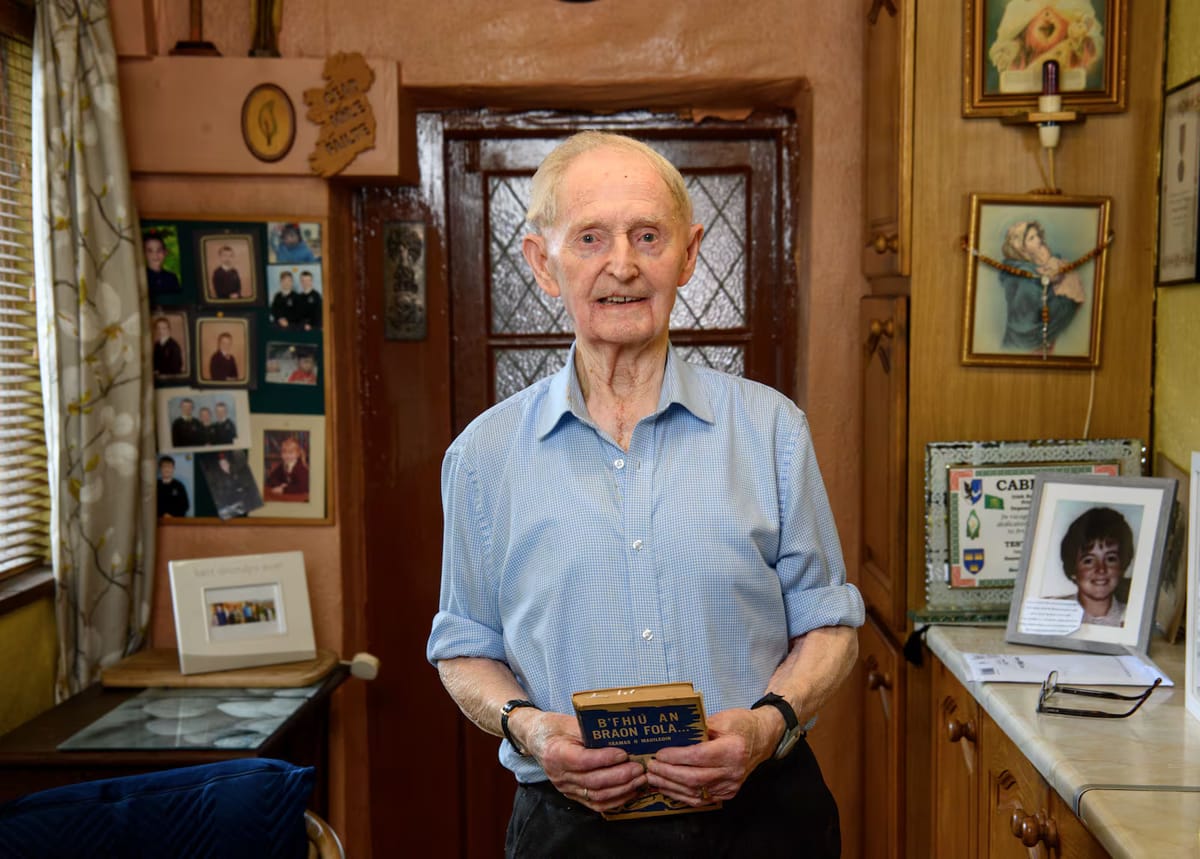
Republican Sinn Féin has called for support for a campaign by 90-year-old Republican veteran Séamus Ó Líonacháin seeking the lifting of excommunications imposed on Irish Republicans by the Catholic Church and a formal apology from Rome.
Ó Líonacháin, an IRA Volunteer who took part in the 1956-62 Operation Harvest campaign, remains a practising Catholic and has never renounced his involvement in the Republican Movement. He is now asking Pope Leo XIV to address what he regards as a centuries-old injustice against Irish men and women who resisted British rule.
Although the campaign of the 1950s and early 1960s is commonly known as ‘the Border Campaign’, Ó Líonacháin himself dislikes the description. Much of his own activity took place in Co Antrim, far from the Border, so he prefers the IRA’s name for the campaign: Operation Harvest.
He was captured in December 1956 following an IRA operation in Co Antrim and subsequently sentenced to ten years’ imprisonment. He served seven years in Belfast’s Crumlin Road Gaol before being released in 1963.
During the early part of his imprisonment, Ó Líonacháin says he was repeatedly refused absolution at Confession and denied Holy Communion because of his continued allegiance to the IRA. In his memoir, he recalls that Fr Tadhg O’Murchú later suggested that he sever his connection with the IRA while imprisoned and rejoin after his release. After his release and return to Cork, a priest suggested that he say he had finished with the IRA in order to resolve the matter.
He refused on both occasions.
“I would be a hypocrite,” he told The Irish Times, “and I’d be telling a lie in Confession.”
His dispute with the Church also reaches into his own family history. His father, James Joseph Linehan, was among Republicans affected by ecclesiastical sanctions during the revolutionary period.
The use of excommunication against Irish revolutionaries considerably predates either generation. The Fenians faced strong opposition from sections of the Catholic hierarchy during the nineteenth century and, in 1870, the Holy Office formally declared the Fenian organisations in Ireland and America to fall within a category of prohibited societies whose members incurred excommunication.
During the Tan War, Bishop of Cork Daniel Cohalan went further than the other Irish bishops. In December 1920 he issued a decree imposing automatic excommunication upon those within his diocese who organised or participated in ambushes, kidnappings and acts which Bishop Cohalan regarded as murder or attempted murder.
The Church’s intervention during the Counter-Revolutionary War remains particularly controversial. In October 1922, the Irish bishops declared the anti-Treaty military campaign to be without moral sanction and directed that those continuing to participate should be denied absolution and Holy Communion unless they repented and abandoned the campaign.
Whether those penalties amounted technically to excommunication has subsequently been disputed by canon lawyers. For many of the Republicans subjected to them, however, the distinction was of little comfort.
Archbishop of Armagh Eamon Martin acknowledged as much in 2023. Reflecting on the Church’s role during the Counter-Revolutionary War, he accepted that the bishops’ intervention had caused lasting hurt and that their failure publicly to condemn atrocities committed by pro-Treaty forces contributed to a perception that the Church had spoken with two voices.
He also acknowledged that, whatever the technical canonical position, excommunication was how many Republicans experienced the sanctions.
Ó Líonacháin’s campaign now seeks to take that acknowledgment further.
Republican Sinn Féin is asking supporters in Ireland and abroad to write directly to Pope Leo XIV requesting that ecclesiastical penalties imposed upon Irish Republicans, including IRA Volunteers and Fenians, be lifted and that the Church issue a formal apology.
The organisation argues that Republicans were treated by the Church in a manner not applied to Irish Catholics who served the British state, pointing in particular to the many Catholic priests who served as British Army chaplains during both World Wars.
For Ó Líonacháin, however, the issue is as much religious as political. Ó Líonacháin told The Irish Times that until April of this year he had attended Mass daily, stopping at the age of 90 only because driving had become difficult.
“The God that I love is not a God of vengeance,” he said. “I’d like an acknowledgment from Rome that this is an injustice and that they express sorrow for it.”
Republican Sinn Féin is asking supporters of the campaign to write to:
His Holiness Pope Leo XIV
00120 Vatican City