Reclaiming the Commons: Workers’ Control as Ireland’s Living Gaelic Inheritance
In Gaelic Ireland, the land and productive assets were neither the absolute property of a state or private owner. Under the Brehon laws, a tribe or clan held the territory in common.
Introduction
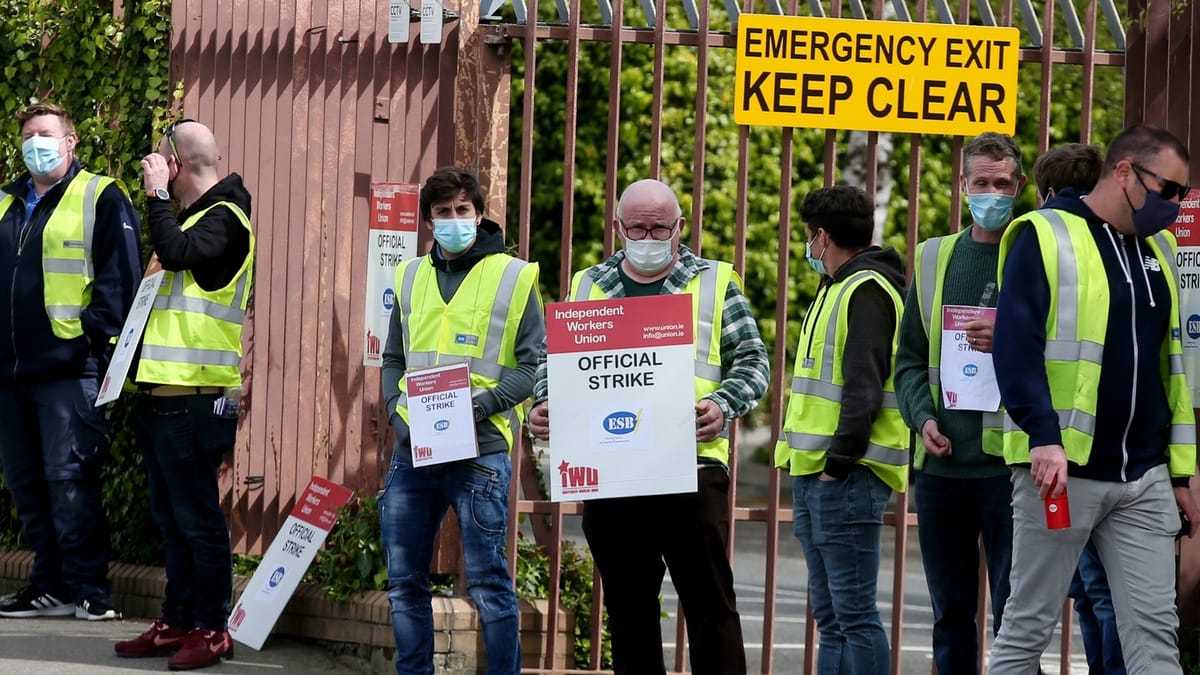
As industrial action gathers momentum across Ireland, from public services to transport and beyond, the question is no longer merely one of wages or conditions. It’s whether the economy itself can remain the private preserve of capital, or whether it must return to the hands of those who produce its wealth. The coming wave of strikes offers an opportunity not simply to resist economic malaise or precarity, but to advance a deeper claim: that the workers of this State should exercise democratic control over the means of production. This is no alien idea. It's a modern expression of the collective habits that structured Gaelic society for centuries, before the imposition of British common law opened the road to individualism, feudal hierarchy and, later, to contemporary capitalism.
The Gaelic Septs and Collective Ownership
In Gaelic Ireland, the land and productive assets were neither the absolute property of a state or private owner. Under the Brehon laws, a tribe or clan held the territory in common. The greater part of the arable land - the “tribe-land” - belonged to the free members of the sept. Individual families enjoyed temporary possession, subject to periodic redistribution through gavelkind. Ownership was never severed from the collective body of kin. Chiefs administered rather than owned; their authority rested on the consent and custom of the people. Commerce and production operated within a framework of mutual obligation and collective responsibility. The fine (kindred group) shared debts, liabilities and resources. This was a society organised around reciprocity, not accumulation by the few.
Anglicisation and Individualism
The Norman invasion and the subsequent centuries of English expansion introduced an incredibly different legal order. English common law, first asserted in the Pale and later extended by force, replaced collective tenure with feudal grants. Land became a commodity that could be held in fee, alienated, and concentrated. The Statutes of Kilkenny and later the Tudor and Stuart conquests systematically dismantled the Brehon system. By the seventeenth century, the communal fabric had been torn: the land was redistributed to planters and loyalists, and the legal architecture of private property, hierarchical lordship and individual contract was installed. What followed was the full flowering of landlord capitalism - rack-renting, clearances, and the reduction of the Irish peasantry to a class of tenants-at-will. The hierarchical and individualised systems of feudalism and capitalism didn't emerge spontaneously from Irish soil; they were imposed over centuries through the vehicle of British common law.
The mystic and poet, George William ‘AE’ Russell (the man who also designed the ‘Starry Plough’), argued in ‘The National Being’ that Gaelic Irish society had a strongly communal economic character, claiming that clans “had common interests” and “owned the land in common”. He presented this communal tradition as a potential model for modern Ireland, advocating co-operative organisation and collective ownership as a means of overcoming individualism and creating a stronger sense of social solidarity.
James Connolly understood this history with clarity. In ‘Labour in Irish History,' he demonstrated that the Gaelic order rested on communal ownership of land, and that the English conquest was simultaneously a social campaign that introduced private property in land at the point of the sword. He insisted that “an Ireland re-conquered for its common people” must therefore be a reconquest of the means of production by its working people. Socialism, for him, wasn't an alien ideology, but the modern adaptation of a Gaelic tradition of collective ownership and democratic control. He wrote that the socialist republic would restore, on a higher level, the principle that the resources of Ireland belong to the people of Ireland. To him, workers’ control of industry and the co-operative movement were the industrial expression of that old claim.
Pearse, Mellows and the Democratic Programme
His contemporary and revolutionary ally, Pádraig Pearse, had articulated a similar vision. In the years before the Rising, he declared that his instinct was “with the landless, and with the breadless man against the master of millions.” He insisted that the nation’s sovereignty extended not only to its people but to its soil, its resources and all wealth-producing processes. Private property rights, he proclaimed were subordinate to the public right of the nation. A few years later, Liam Mellows gave an explicit formulation. Referring to the need to end British Imperialism, the Irish Republic, he argued, must mean the ownership of Ireland by the people: heavy industry, transport, banks and the large estates under democratic control for the benefit of workers and farmers. Anything less would simply replace imperial tyranny with a local variant. The Democratic Programme of the First Dáil, influenced by both Connolly and Pearse, had already spoken of the organisation of the people into trade unions and co-operative societies, so that industries might be controlled and administered by the workers engaged in them.
Workers’ Control in Action
It’s important to note, however, that these ideas are not museum pieces. They find living expression in successful models of workers’ control. The Mondragón Corporation in the Basque Country stands as the most compelling contemporary case. Founded in 1956 by a Catholic priest named Fr. José María Arizmendiarrieta and a handful of workers, it has grown into a federation of roughly ninety autonomous co-operatives employing around 80,000 people, with annual revenues exceeding €11 billion. Worker-members elect the governing councils, set pay differentials (typically capped at modest ratios), and decide on the reinvestment of surpluses. Solidarity mechanisms transfer resources from stronger to weaker co-ops, protecting employment even in severe downturns. When the large appliance co-op Fagor collapsed, the network retrained and relocated thousands of members, rather than abandon them. Mondragón demonstrates that democratic ownership by the workers themselves is compatible with technological sophistication, international viability and long-term resilience.
Yugoslavia, despite its inherent authoritarianism (where it embraced many of the repressive measures associated with the USSR’s system) and numerous failures in the domain of human rights, lead one of the most innovative projects involving workers’ control. A since de-classified CIA report on the system remarked that “Yugoslavia's self-management system is based on the theory that political, social, and economic decisions should be made by those who are directly concerned, with no need for specific approval from above as long as such decisions conform to national guidelines. In its embryonic stage, self-management, or the workers' council system, was limited to economic enterprises,* but it has since been extended to social, scientific, and political activities.” It also asserted that “self management [had] proved successful in small factories.”
In the Tito-led state of Yugoslavia after the 1948 break with Stalin and foundation of the Non-Aligned Movement, a distinctive system of workers’ self-management was introduced from 1950 onward as an alternative to both Soviet-style central planning and to Western capitalism. Under the Basic Law of 1950 and later constitutions (especially the one from 1974), enterprises were placed under the formal control of self-management and workers’ councils elected by the entire workforce. These councils held decision-making powers over production plans, investment, the appointment and dismissal of managers, income distribution, and the allocation of surplus, while the means of production remained socially owned and market mechanisms were progressively introduced. However, these councils have been criticised for their apparent weakness in practice. Nonetheless, the system delivered greater formal worker participation than existed in other socialistic states and, for several decades (particularly from the 1950s through the 1970s), were regarded as impressive, contributed to relatively strong economic growth, higher living standards, and greater openness than in the formal Soviet bloc. It also generated significant international interest among economists and political theorists. In practice, however, professional managers often retained substantial influence, inequalities between enterprises grew, and the model encountered mounting economic difficulties in the 1980s and was abandoned by the time of Yugoslavia’s disintegration.
Broad Support for Workers’ Control
Worker-governed concepts, such as workers’ co-determination and co-operatives, command support across a remarkably broad spectrum. Trade unionists have recognised that workers’ co-operatives can provide jobs, democratise workplaces and complement collective bargaining. Irish Republicans, from James Connolly and Liam Mellows to contemporary movements, see them as concrete steps toward economic democracy. Subsequently cited by the Irish Labour Party, Mellows proposed that control of workshop conditions be vested in joint councils representing the workers’ trade unions and the state, as part of a broader programme of democratic control of industry in a revolutionary Republic. One claim by that party posited that it was influenced by Mellows’ “deep study of the pre-Norman, Brehon Laws of the Old Gael.” The IRA would subsequently incorporate these elements into its own programme, asserting that “the reorganisation of Irish life demands the public ownership of the means of production, distribution and exchange.”
Later, during the Irish Labour Party’s leftward shift in the 1960s, it adopted outline policy on workers' democracy. The document on workers’ democracy called for “full participation by all workers in all decisions involving the utilisation of resources employed by an enterprise”. It spoke disapprovingly of the “workers participation” schemes which it regarded as a “device for controlling and exploiting for private profit.” Labour’s declared objective was “fundamental change” which would require “new structures in the workplaces.” However, these ideas were never realised in a meaningful sense. In 1976, an article in ‘An Phoblacht’ proclaimed that if industry was organised on a co-operative basis, then “workers’ control could and should emerge from this.” Following Tito’s death in 1980, (Provisional) Sinn Fein president and former IRA ‘chief-of-staff’ Ruairí Ó Brádaigh declared that the Yugoslavia leader had pioneered “an economic and political system founded on workers' control and the principles of decentralised self-management,” and that this reflected his own party’s programme. In 1991, the Workers’ Party, previously known as (Official) Sinn Fein, as well as Sinn Fein - The Workers’ Party, outlined that “the development of worker ownership and participation in all economic sectors is fundamental to progress” and included such in its “strategies for democratising economic life.” In a separate document, it envisioned a “move from petty supervision to self autonomous work groups.”
Even the Catholic social tradition has endorsed the model, articulating support for stronger industrial democracy and labour rights. Though it may come across as surprising to some, in various encyclicals, Popes Pius XI, St. John XXIII, and St. John Paul II espoused an unusually progressive idea, where industrial democracy and the right to partake in management and ownership were inseparable from a worker’s human dignity and their natural rights. Other successive popes, including Benedict XVI and Francis, have praised co-operatives for balancing individual initiative with solidarity and humanising the economy. The latter asserted that “money at the service of life can be managed in the right way by co-operatives, on condition that it is a real co-operative where capital doesn’t have command over men, but men over capital.” Liberation theology, associated with revolutionaries in Latin America, has previously been in conflict with the Catholic Church's establishment, but placed a stronger emphasis on workers’ control of the means of production. Still, teaching on subsidiarity and the priority of labour over capital finds practical form in a workers’ co-operative enterprise.
Recent Initiatives and the Future
Though interest exists in Ireland, there has never been sufficient momentum to make workers’ control a widespread reality. The state had previously supported worker co-operatives through the Co-operative Development Unit, set up in 1988, but this infrastructure was later dismantled. Its closure left Ireland without a dedicated state body for the development of worker co-operatives, and was subsequently identified as a major contributing factor to the weakening of the sector. Though, in 2012, the Oireachtas’ Committee on Jobs, Enterprise and Innovation met with members of the Workers Co-operative Network to explore “the role of worker co-operatives in job creation and enterprise development.” One recent initiative was the Worker Co-Operatives and Right To Buy Bill 2021. A private member’s bill, it sought to amend the Industrial and Provident Societies Act 1893 to make it easier to establish worker co-operatives and to create a statutory “right to buy” mechanism, allowing workers to take over a business facing sale or closure. Unfortunately, it lapsed with the dissolution of the parliament and never progressed further.
The season of strikes therefore presents not only a defensive struggle over pay and conditions, but a chance to reclaim an older principle in modern form: that the wealth of the people belongs to those who create it, and that democratic control of production is the living inheritance of the Gaelic commons. In recovering that tradition - through co-operatives, genuine workers’ democracy, and the subordination of capital to labour - a deeply flawed system can yet honour the vision of Connolly, Pearse and Mellows, and build an economy worthy of its people.