How Ireland Can Save Ukrainian Lives
Sanctioning Aughinish Alumina will not save a single Ukrainian life. Russia's war machine has demonstrated it can function through numerous rounds of sanctions. Other ways to bring the war to an end must be tried.

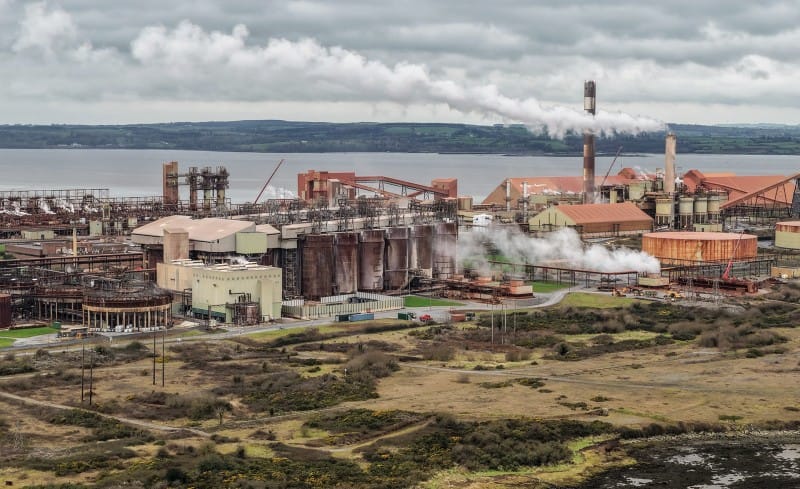
In recent months discussion of Aughinish Alumina has dominated the Irish media. The county Limerick bauxite processing plant is Europe's largest alumina refinery and exports approximately half its production to Russia.
In the spring, claims that its production might be going to the manufacture of military hardware were made. An obvious course of action is presented by campaigners: cut off alumina supply, reduce Russia’s ability to wage war, stop the killing in Ukraine. But is it really that simple? If we are serious about saving lives in Ukraine, we need to dig deeper.
Government investigations into the supply chain have not found anything incriminating. Realistically, alumina is not a metal that is in short supply. Well over half of global capacity is in China and the market is suffering a glut due to expansion there. Russia can easily go elsewhere for its needs, whether civil or military.
Sadly, it must be concluded that the Ukraine war will not be impacted by sanctioning Aughinish Alumina. The main effect will be to severely damage the regional economy in county Limerick where hundreds of jobs are dependent on the plant.
The futility of attempting to sanction Aughinish Alumina is illustrative of the pointlessness of the wider sanctions regime. The EU has imposed twenty-one rounds of sanctions on Russia in the last four years. Kaja Kallas recently claimed ‘EU sanctions have already cost Russia dearly’. But its economy, far from buckling under the sanctions regime is doing far better than Europe’s. Since 2023 the growth rate in Russia has been 3.3% while in the Eurozone it has been 0.9%.
Russia has spent the years since 2014 sanction-proofing its economy and reorientating its trade away from Europe towards global partners, such as India and China. Ian Proud, a former British diplomat has contended that: ‘economic sanctions have proven a catastrophic disaster - not for Russia, but for Europe’. Sanctions have significantly contributed to Germany’s recent deindustrialisation as it abandons cheap Russian gas imports.
When we see round after round of sanctions being regularly announced, it is hard not to draw the conclusion that the main effect sought is primarily about lending support to official EU narratives about the conflict rather than practically bringing the war to an end. We are constantly told that Russia is losing and will eventually lose, that Ukraine is on the verge of a breakthrough and if we only continue our support, their armed forces will achieve victory. This false narrative implicitly maintains that the fighting must continue and that diplomacy should in no circumstances be undertaken.
Since the failure of the Istanbul deal in April 2022, deliberately sabotaged by Boris Johnson, such a stance has had disastrous consequences for Ukraine. It has suffered more than half a million military casualties, with approximately 150,000 soldiers dead. This is a vast tragedy, a mountain of personal suffering and misery.
It is also an irreparable loss in a country whose demographics in the post-Soviet period were already calamitous. While reporting of the war in Ukraine typically concerns itself with the amount of territory lost, it has long been understood that a country’s population is as much, if not more, important than the land it occupies.
Ukraine has lost about 12% of its territory since 2022 but it has also lost millions of citizens to fighting and to emigration. Ukrainian demographers estimate the population has collapsed from 52 million at the time of independence in 1991 to 28 million today. Ukraine’s primary existential threat is not the loss of territory but of its people.
Only this week, Iuliia Mendel, Zelensky’s former press secretary wrote: ‘Russia can draw on the recruitment pool of approximately ten times the number of fighting age men. Waging a war of attrition is therefore national suicide, not valour. Yet this is the strategy that the Zelensky government pursues’. While Putin has never had to resort to conscription, Kyiv is not only forcing men to fight but adopting extremely brutal methods in order to coerce them to do so. Under a ‘busification’ policy conscription-age men are effectively kidnapped off the streets to be sent to the front.
Article 35 of Ukraine’s constitution theoretically guarantees the right to alternative service for conscientious objectors but that right has effectively ceased to exist. Beatings are commonplace and men have died at mobilisation centres. Recruitment officers have quotas to meet and men with serious conditions, including HIV, tuberculosis and cancer, are routinely declared fit for service.
One well-informed commentator reports: ‘the image of a Ukraine filled with patriotic liberals eager to fight a high-tech war until total Russian collapse is a fiction’. Ukraine is suffering a desertion crisis with the defence minister reporting earlier this year that 200,000 soldiers were missing from their units.
It is all very well for western politicians and commentators, from the safety of Brussels or other European capitals, to demand the fighting continue, and to cast any sort of negotiation with Putin as granting him victory. But what about the dead Ukranian bodies over which this is done? What of the widows, orphans and crippled in Ukraine?
The EU has recently excluded newly arriving military-age Ukrainian men from the bloc’s temporary protection scheme. Legal questions have been raised but it is clearly wrong for the Republic to send such individuals back to be subjected to unethical and illegal behaviour in Ukraine’s conscription machine.
If anyone is deserving of asylum, it is those fleeing this abusive system. If Ireland wants to save Ukranian lives, the most obvious practical step is to continue to give all Ukrainians sanctuary here, not sanctioning Aughinish Alumina.
Our government should also do all in its power to press the EU to engage in serious diplomatic efforts to bring the fighting to the earliest possible conclusion. This is the democratic desire of the Ukrainian population. In a recent Gallup poll 66% say Ukraine should seek to negotiate an end to the war as soon as possible.
Unfortunately, Ukrainians don’t appear to have the final say over their future anymore. EU chiefs have consistently put themselves behind unrealistic maximalist aims that are effectively a veto on negotiations.
Michael von der Schulenburg, MEP for Germany and a former Assistant Secretary General of the UN recently said: ‘European NATO-states must ask themselves whether a continuation of the war - which they have demanded and supported - can still be morally justified at all’. Europe needs to drop its bellicose rhetoric and hasten to the diplomatic table and start saving Ukranian lives rather than sacrificing them.
Dr Mihail Evans is Research Fellow at the New Europe College, Bucharest.