Re-Turn Outsources Welfare To Bins: Damhnaic's Story
“I collect bottles and cans to save up enough money to postpone being homeless into next spring instead of in the winter”: Damhnaic, a man in his 30s, is one of many people pushed into waste-picking by a Government that pretends struggle behind closed doors is no struggle at all.
While the Irish State’s half-century alliance with foreign investors, financiers and developers has lifted many Irish people out of destitution, it is also responsible for plunging hundreds of thousands of people into chronic insecurity, into situations where they barely keep up the facade of normal life[1].
Today, nearly one-quarter (23%) of people in the Twenty-Six Counties experience a measurable form of material or financial instability[2], an instability that is often masked by the individuals themselves, for the shame they feel leads many among them to think of themselves as just temporarily embarrassed members of the middle class.
Due to such self-censorship, this particular kind of suffering rarely becomes front-page news. It mostly only does so when that class’ youngest and most untethered victims lose themselves in right-wing ideology, criminality or daredevilling. The Government then uses these incidents to justify the expansion of Garda powers and the surveillance state, the same institutions which have a track record of harassing those very populations.
To keep this cycle going, that quarter must be kept in their purgatory. They must not be allowed to slip into obvious destitution, nor can they be physically disciplined en masse, for it would deeply upset the country’s Centre-Left, who still cling onto the pre-neoliberal belief that the stick must always be accompanied by the carrot[3].
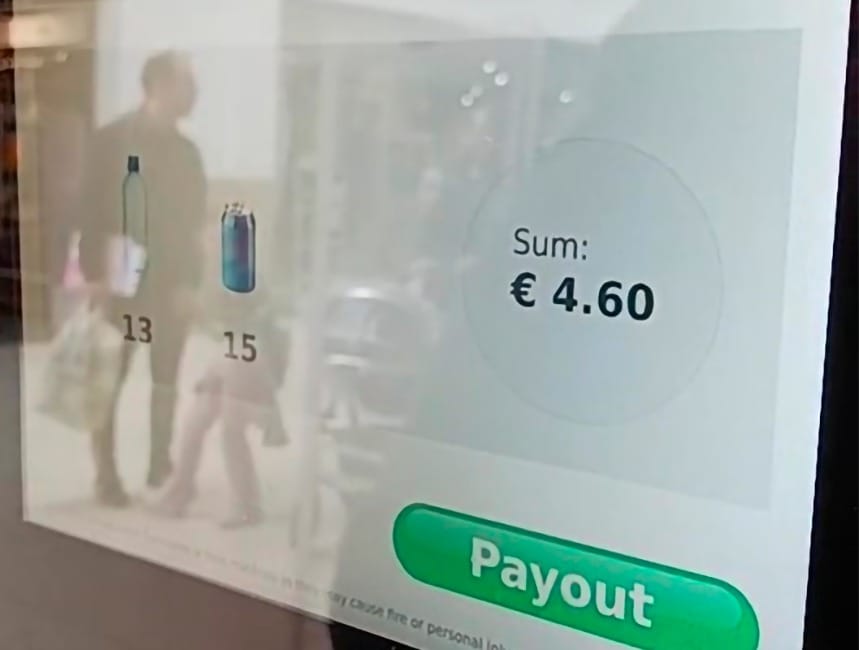
To this end, the Government introduced the Deposit Return Scheme in 2024. One of the Scheme’s unofficial functions is to prevent that quarter from slipping onto the streets by providing an opportunity for people to collect recyclable material, to become waste-pickers, in order for them to just about make ends meet.
One of the many people who have taken up waste-picking since the Scheme’s introduction is Damhnaic[4]. He is a Dubliner in his 30s who has recently spoken to Aontacht Media following our campaign.
Following a mental health crisis, Damhnaic has been unemployed and cohabitating with someone who maintains an entirely separate financial life. In order to keep himself afloat, and possibly find separate housing, Damhnaic has applied for various welfare schemes to which he is entitled, including Jobseeker's Allowance, Disability Allowance and the Supplementary Welfare Payment.
All his applications have been rejected due to an outdated bureaucratic rule that forces cohabitants to be jointly assessed for welfare purposes. This rule is a relic of 19th century common law, where the poorer partner – then typically the woman – would be made to surrender their legal rights and ‘fuse’ into their more powerful half[5].
The fact that cohabitants still cannot file joint assessment tax returns in Ireland adds more salt to the wound.
It is these fossils embedded into the State’s social protection system that had forced Damhnaic to start collecting bottles and cans to Re-Turn to, in his words, “save up enough money to postpone being homeless into next spring instead of in the winter”.
On top of his pre-existing mental health disability, this situation of Damhnaic’s has created in him a sense of embarrassment. This embarrassment stems from the widespread modern idea that poverty is the real-world manifestation of a personal moral failing. “Who failed me? Too many to mention but mainly myself,” he says, “Nobody is standing by me as I feel too ashamed to tell anyone the situation I'm in unless I don't know them”.
Damhnaic receives some non-financial support from the State-funded charity Pieta House, which like the Re-Turn company itself – a fellow non-profit – pays its highest executive a staggering salary to do a job meant for the Government as ordinary people do everything in their power to avoid falling into abject poverty.
For the many people suspended in purgatory as Damhnaic has been – with little help and endless obstacles – it is no surprise that a bleak but entirely preventable sentiment rings through their heads, as it does his: “I don't think life is ever a net positive”.
Cian O’Callaghan et al, “Topologies and topographies of Ireland’s neoliberal crisis,” Space and Polity 19, no. 1 (2015), 35. ↩︎
Ireland, Central Statistics Office, Key National Indicators of Poverty, Deprivation and Social Exclusion, SIA77. ↩︎
Massimo De Angelis, Omnia Sunt Communia (Zed Books, 2017), 380–381. ↩︎
Anonymised. ↩︎
Annie Miller et al, “The Gender Effects of a Basic Income,” in The Palgrave International Handbook of Basic Income, ed. Malcolm Torry (Springer, 2019), 181. ↩︎