Why Is The Irish Government Desperate To Join NATO Against The Wishes Of Its People?
Put neutrality into the Constitution, let the 71% have their say, and put the Triple Lock to the people before anyone removes it, and if the government means what it says it has nothing whatever to fear from the answer.
Good day, Aontacht readers,
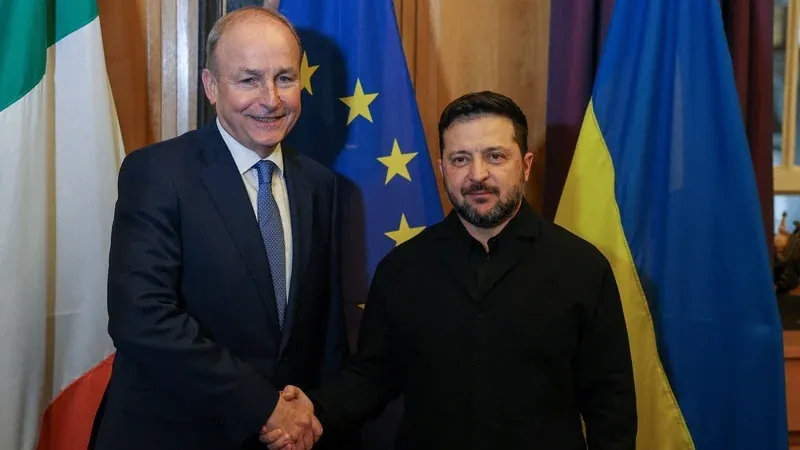
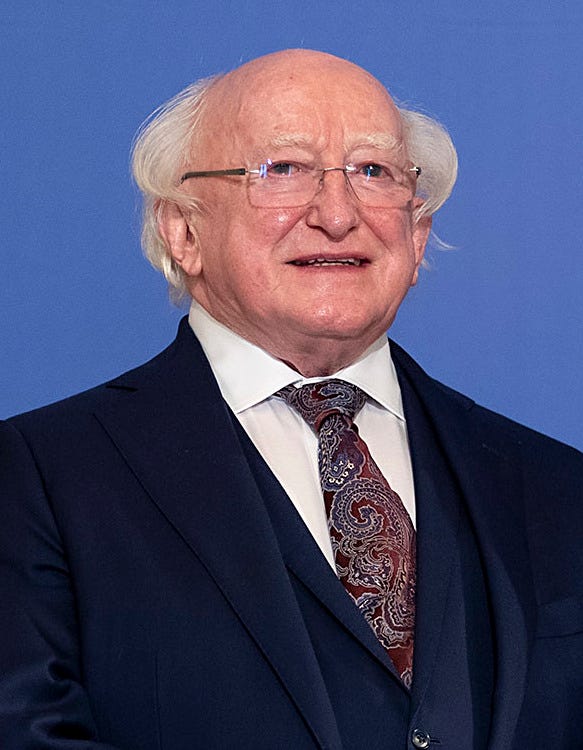
And at the end of October, when questioned about a warning from the former president Michael D Higgins that Ireland risks sliding out of its neutrality if the Triple Lock is scrapped, the current Irish Taoiseach answered with a question of his own, ‘what military alliance?’, before assuring the country that Ireland has no intention of joining NATO. It is a line that sounds fairly reassuring until you remember that it comes from the same Micheál Martin who told the European Parliament in 2022 that joining NATO would be a policy decision for the government and would not require a referendum, a claim that constitutional lawyers challenged immediately, and who has also described neutrality as a policy issue that can change at any time, which is not quite the language of a man who regards the matter as settled.
I am very prepared to take the Taoiseach at his word, in the sense that I am prepared to judge him by what his government is doing rather than by what he says when somebody asks an awkward question at the launch of a rural development plan, and what his government is doing, with a haste that can only fairly be described as desperate, is taking apart every safeguard that stands between the Irish people and a military alliance they have repeatedly said they do not want, while declining at every turn to ask them what they think about it. I should say, since this is a personal view and I am not going to pretend otherwise, that I do not know a single person in Ireland who wants to join NATO, and I have no particular desire to meet one.
Three and a half hours.
The Triple Lock is the rule that has governed the deployment of Irish troops overseas since 2002, and it says that no more than twelve soldiers can be sent on a mission abroad without the approval of the government, the Dáil, and quite importantly…the United Nations. This makes it, in practical terms, the mechanism that has kept Irish troops out of other people’s wars for the best part of a generation. On the 21st of October the government’s Defence (Amendment) Bill, which would remove the UN requirement entirely and raise the number of troops that can be deployed without a vote in the Dáil from twelve to fifty, passed its second stage by 79 votes to 71, following a debate that The Journal noted lasted around three and a half hours, which is not a great deal of time in which to decide whether to dismantle the central safeguard of a policy the country has lived by for decades.
Deep breath.
The Bill is not yet law, since it must still clear its remaining stages in the Dáil and the Seanad and receive the signature of the President, but the Minister for Defence, Helen McEntee, wants it enacted before the end of the year, has accused the opposition of delaying tactics for declining to agree a date for the next stage, and the government was reported to be considering skipping the committee stage altogether, a move that Sinn Féin described as abhorrent.
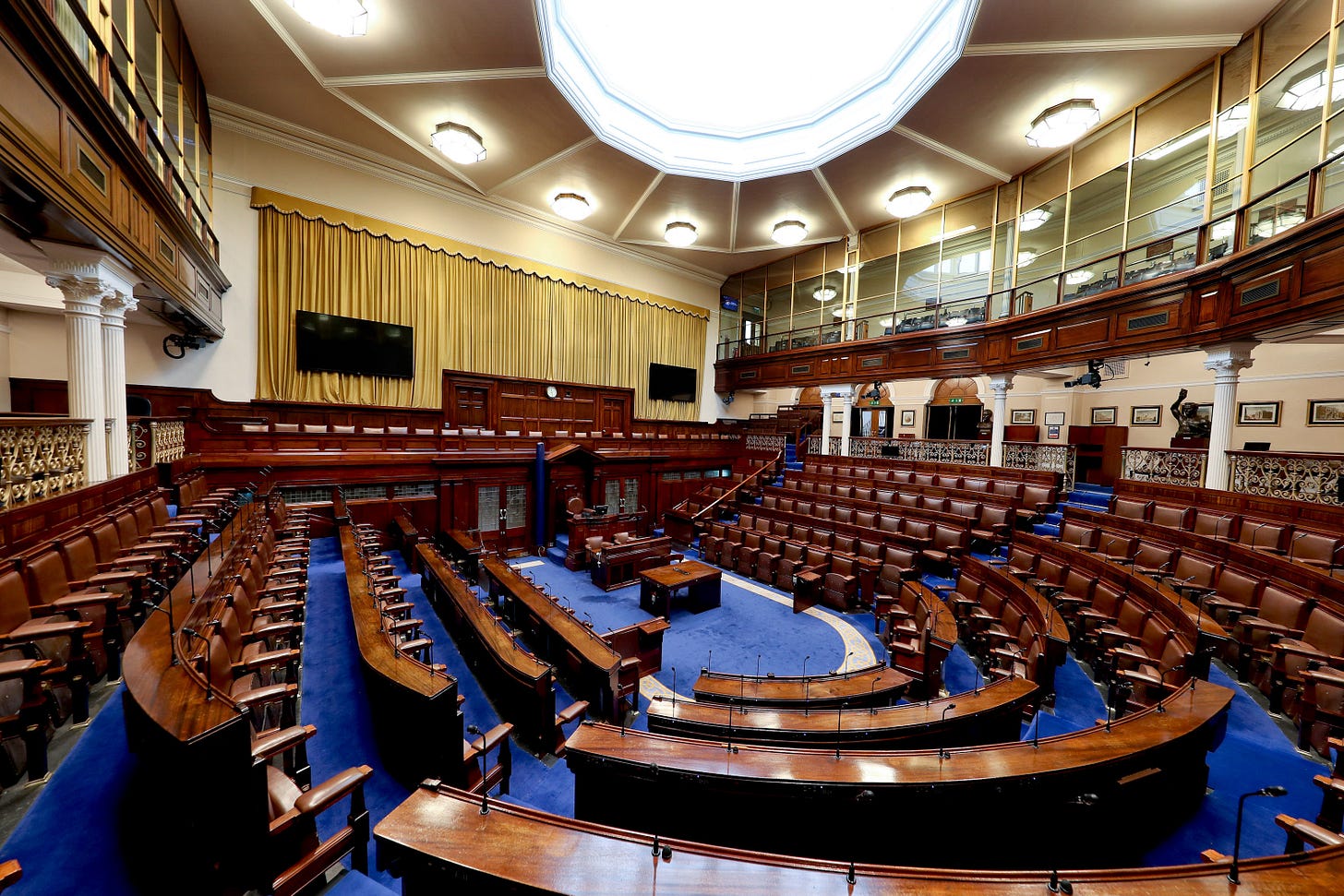
The government’s case rests on the proposition that it is intolerable for the five permanent members of the Security Council to have a say over where Irish soldiers are sent, with the Taoiseach calling a Russian veto morally wrong (but not a US one funnily enough) and McEntee describing it as absolutely crazy that five countries hold such a power. There is a certain logic to the complaint in the abstract, though it sits awkwardly beside the fact that the Lebanon mission the government keeps pointing to was brought to an end by an American, not Russian, pressure, which rather complicates the story that Moscow is the obstacle. It is also worth asking what the freedom is for. Under the law as it stands, it would be illegal for Irish troops to join a European mission in Lebanon to replace the UN force, and removing the Triple Lock would make it possible, which is precisely the scenario in which Pearse Doherty of Sinn Féin has warned that Irish soldiers could find themselves caught up in somebody else’s civil war; and that somebody is going to be the US and its proxies. Michael D Higgins, hardly a hysterical man, has warned that the country risks sliding towards the loss of its neutrality, and the government’s response has been to tell everyone that nothing is changing while changing it as fast as the parliamentary timetable will allow.
The referendum they cannot afford to lose.
The detail that turns all of this from a policy dispute into a question of democracy is that the government will not put any of it to the people. The Taoiseach’s position on referendums has wandered over the years in ways that would be impressive if they were not so predictable, from the claim in 2022 that none would be needed to join NATO, to the concession three weeks later in Madrid that in reality the people would have to be consulted on any change to neutrality more generally, to the position he has taken this year, which is that the people should not be allowed to write neutrality into the Constitution and that the Triple Lock can be removed by ordinary legislation. In February an Irish Times/Ipsos poll found 71% of voters in favour of inserting a guarantee of neutrality into the Constitution and only 18% against, with majorities in favour among the supporters of all the big parties, and the Taoiseach’s response was to say that he had significant concerns and to warn that such a referendum could straitjacket the Government democratically forever. It is not often that an elected leader states the objection to democracy quite so cleanly, because the point of writing something into a constitution is precisely that a government should not be able to change it on a whim, and it is the whim he wishes to protect.
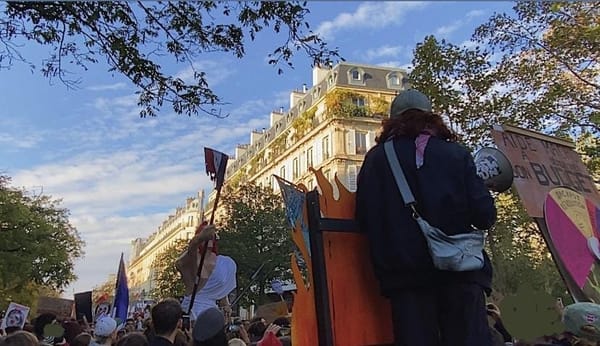
The government’s defenders will reach for the polling on the Triple Lock itself, where the same pollsters found in September that 44% want to keep it, 34% want it removed, and 22% do not know, which is a more comfortable number for the government than 71 to 18 but is still, on any reading, a larger share of the public wanting it kept than scrapped, and a curious sort of mandate for scrapping it. Sinn Féin has pointed out that the government never campaigned on any of this, and McEntee insists that the public put its trust in the government to make exactly this kind of decision, which is what governments say when they have decided not to ask. My own suspicion, and it is no more than that, is that the government knows perfectly well how a straight referendum on neutrality would go and has no appetite for finding out. It is a pattern that has become familiar across Europe, where the answer to the question of whether the people consent is increasingly to avoid putting it, and it rarely ends well for the governments that adopt it, as Macron’s has been discovering on the streets of France in recent weeks.
Russophrenia, and the nuclear power next door.
This past Friday, RTÉ, Virgin Media, Newstalk and the Irish Independent were evacuated after emailed bomb threats that were swiftly deemed hoaxes, at the end of a week in which airlines across Europe, including flights from Dublin, had received similar threats and a cyberattack had knocked out freezers in more than a dozen SuperValu stores. The vocabulary of hybrid warfare arrived more or less instantly from the usual suspects.
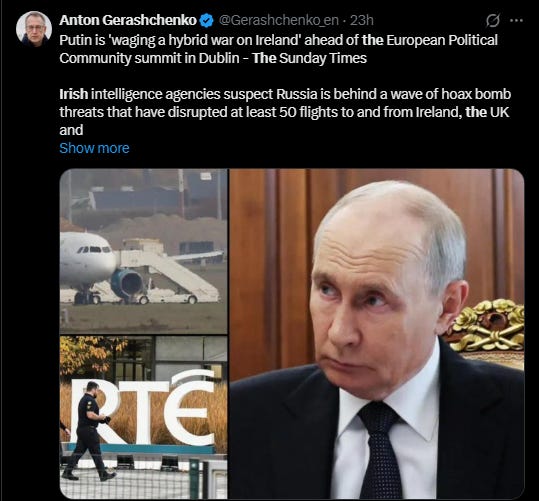
The Irish government followed suit, but far more subtly, they said they did not know who was behind the hoaxes and that it was too early to say whether Russia was involved in the threats against RTÉ while insisting that the general rise in hybrid attacks has a Russian connection. The Defence Minister said that Russian involvement could not be ruled out, which is true of a great many things and is not the same as evidence for any of them. The emails sent to airlines conveniently carried the name of a now non-existent Russian far-right group called Male State, whose founder has said it is absurd to blame a group that has not existed for years, and the Russian embassy in Dublin described the speculation as unfounded. Security sources have reportedly told the Irish Examiner that Russian involvement is credible, with the caveat that investigations will take time, and I will gladly revise my scepticism the moment anyone produces evidence rather than adjectives. In the meantime it is worth noticing that the officials who warn about hybrid attacks describe them as cheap to execute and easy to deny, which, as it happens, is also an excellent description of the accusation.
Set all of that aside, though, and ask the question that the Russophrenia is designed to prevent anyone from asking, which is who has ever actually threatened Ireland. Russia has never invaded this island, has no territorial claim on it, and has never occupied any part of it, whereas Britain has invaded it, colonised it, starved it, partitioned it, and still holds the North of Ireland under the Butcher’s Apron at this very moment, which means that on any honest reading of Irish history the most likely source of a military threat to the Irish people is a founding member of NATO, and the nuclear-armed state closest to our shores.
This is not a minor point, because NATO is a mutual defence alliance built on the principle that an attack on one member is an attack on all, and joining it would mean Ireland pledging, in principle, to treat an attack on Britain as an attack on itself. It would mean sitting down as an ally of the very power that is occupying part of our own territory, in a pact that exists to protect it. Ireland declined to join NATO in 1949 largely because the alliance included the state that had partitioned the country, and that objection has lost none of its force in the intervening years, for the simple reason that the partition has not ended.
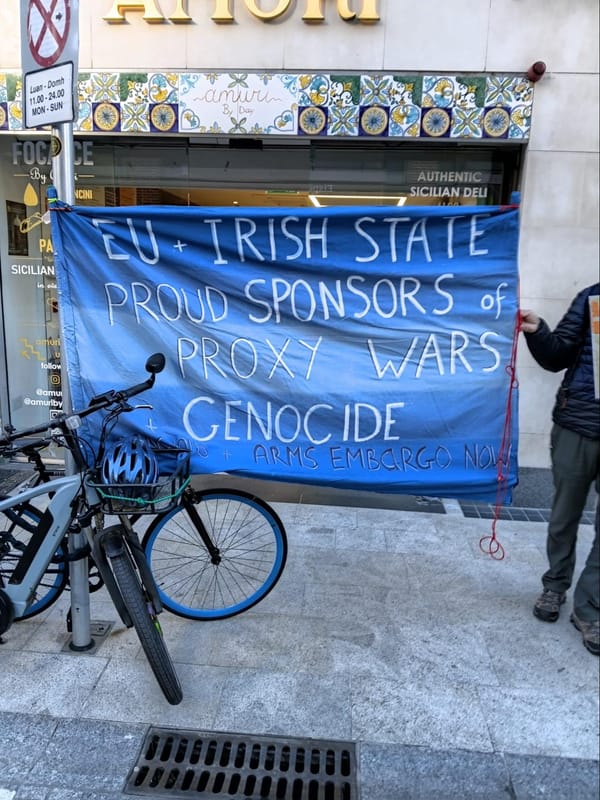
The alliance itself is led by a United States that is arming the genocide in Gaza, bombing Iran, and strangling Cuba, and that has spent the better part of a century destabilising countries across the Global South, and I struggle to understand why a nation that knows what it is to be colonised and partitioned and starved would look at that record and conclude that it wanted to be part of it. We are supposed to be the underdogs, which is why this country has spent three years flying the Palestinian flag from its balconies and marching in its thousands, and it is why the surest way to be dragged into the endless proxy wars of the empire is to join the alliance that fights them.
I have no objection, for the avoidance of doubt, to Ireland properly funding a competent defensive force capable of protecting its airspace, its waters, and its undersea cables, because a country should be able to defend itself in the event that anyone ever tries to invade it, and if anyone is going to, history suggests it will be the neighbour that has done it before and is, as we speak, still doing it. A defensive force answers that threat. Joining an alliance that includes that neighbour, and whose leading member has been at war more or less continuously for decades, does not. The Taoiseach says that Ireland has no intention of joining NATO, and I would very much like to believe him. So let him prove it. Put neutrality into the Constitution, let the 71% have their say, and put the Triple Lock to the people before anyone removes it, and if the government means what it says it has nothing whatever to fear from the answer. If it cannot bring itself to do that, we are entitled to ask what, exactly, it is keeping the door open for.
This article was originally published in the Spectacle.