FFG Ignores 400K With Foetal Alcohol Disorder
Since 2025, the Government has cut funding for foetal alcohol spectrum disorder (FASD) by 86%, delayed warning labels on alcohol until 2028, and left up to 400k people without adequate support, with thousands more to be born with it in the coming years.
Since entering office in 2025, the Fianna Fáil–Fine Gael-led 35th Government have systematically ignored and deprioritised care for the up to 400 thousand Irish people living with foetal alcohol spectrum disorder (FASD).
FASD is a preventable neurodevelopmental disability caused by the biological parents drinking two months prior to or during conception, and the mother drinking during pregnancy.
The disability is known to much of the public as foetal alcohol syndrome (FAS), the name of its most severe subcategory.
While people with this FASD can display traits similar to autism, ADHD and intellectual disability, people with FASD generally suffer from more severe impairments, particularly in regard to completing daily tasks, performing self-care and thinking through the consequences of their actions. Nearly two-thirds of adults with FASD get into trouble with the law as a result.
A quarter of people with FASD attempt suicide. Those with the most severe variant – FAS – have a death by suicide rate of 15%[1].
Funding
FASD Ireland is the only active national organisation that specifically advocates for people with FASD. It is based in County Clare, employs six people and runs an island-wide support service, which can be contacted at 065 670 3098.
In 2026, the State cut funding to FASD Ireland by 86%, citing the organisation’s inability to justify why it deserves the funding, HSE staff shortages and the lack of a “clearly articulated, clinically governed pathway”.
This decision was made after the exit of Anne Rabbitte from Cabinet, who served as the junior minister with special responsibility for disabilities. She was the only Government politician to have made a firm commitment to improving the lives of people with FASD.
FASD Ireland is one of the few State-funded organisations that had been publicly critical of the Rabbitte-less 35th Government.
Awareness
In July 2025, the Minister for Health Jennifer Carroll MacNeill delayed until 2028 the implementation of section 12 of the Public Health (Alcohol) Act 2018, which requires that alcohol containers have “a warning that is intended to inform the public of the danger of alcohol consumption when pregnant”.
Cabinet agreed to the delay shortly after Minister for Enterprise Peter Burke was lobbied by Ibec, Ireland’s largest business lobby organisation.
When section 12 comes into operation in September 2028, it will not require alcohol containers to mention that drinking “by the father 64 days prior to conception” or “by both parents at the time of conception”[2] also increases the risk of FASD.
Records from early 2026 indicate that FASD Ireland has been lobbying members of the Opposition on the topic of legislation.
When questioned on other ways the Government is to raise awareness of prenatal alcohol exposure, junior minister with special responsibility for public health Jennifer Murnane O'Connor stated that the HSE Alcohol Programme’s “current campaign focus is on cancer”.
This singular focus does not reflect the urgency of the FASD epidemic, as shown in publicly available evidence.
It is estimated that between 2025 and 2028, 15 thousand babies in Ireland will be born with FASD, compared to the 3 thousand people who will be diagnosed with alcohol-induced cancer. Cancer survival rates skyrocket in the same country in which 82% of the general public is unaware of what FASD – a disability with a life expectancy of 34 years – is[3].
The significant role that alcohol plays in the disabling of the Irish population has not led the Government to consider intervening on price. When asked in January 2026 about restaurants charging non-alcoholic wine drinkers the same corkage fees as alcohol drinkers, the Department of Enterprise declined to challenge the practice, saying that businesses are free to set their own prices.
Progress
On Wednesday 11 November, the Psychological Society of Ireland (PSI) will hold their annual conference in Galway. There is to be no formal presentation on the topic of FASD; discussion of the disability will be limited to a poster made for “viewing and final judging”.
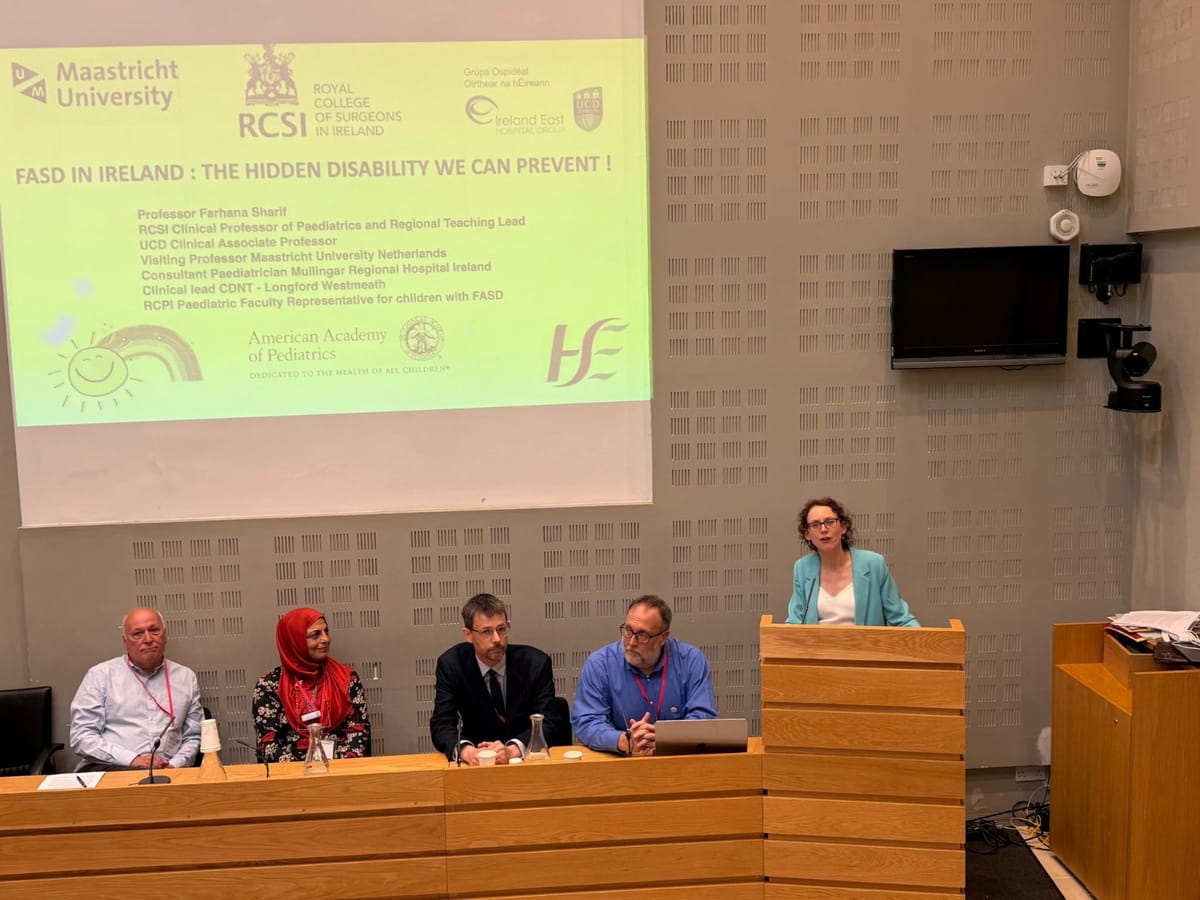
The poster in question is to be produced by Dr Farhana Sharif, one of Ireland’s leading FASD clinicians, together with staff from Treehouse Practice, a therapy service in Dún Laoghaire-Rathdown.
Meanwhile, FASD Ireland has launched a grassroots campaign urging people to email Minister for Health Jennifer Carroll MacNeill at jennifer.carrollmacneill@oir.ie to call for stronger supports, fewer barriers and necessary improvements.
Its support service, FASD Hub Ireland, remains open to public donations. The last donation to its GoFundMe was in 2025.
Angel Harper, Farhana Sharif and Jolanta Burke, Foetal Alcohol Spectrum Disorder in Ireland: Wellbeing, Living Experience, and The Need for Change (RCSI University of Medicine and Health Sciences, 2025), 14. ↩︎
Angel Harper, Farhana Sharif and Jolanta Burke, Foetal Alcohol Spectrum Disorder in Ireland: Wellbeing, Living Experience, and The Need for Change (RCSI University of Medicine and Health Sciences, 2025), 10. ↩︎
Angel Harper, Farhana Sharif and Jolanta Burke, Foetal Alcohol Spectrum Disorder in Ireland: Wellbeing, Living Experience, and The Need for Change (RCSI University of Medicine and Health Sciences, 2025), 14–25. ↩︎