Vote No On Sell-Out Public Sector Pay Deal
The public sector pay deal agreed between trade union bureaucrats in ICTU and the FFG government is a terrible deal. In fact, it is not a pay deal at all. The agreement should be understood as an ideological and private-lobby driven initiative to bulldoze any protective measures that workers’ want.
The public sector pay deal agreed between trade union bureaucrats in ICTU and the FFG government is a terrible deal. In fact, it is not a pay deal at all. It incorporates several elements, such as a push for AI, making it more a political package than anything which is the result of serious negotiations with regards to pay. The agreement should be understood as an ideological and private-lobby driven initiative to bulldoze any protective measures that workers’ want in their companies, such as an all-out AI deployment within the public sector.
Workers are expected to roll out the red carpet for Microsoft, Open AI and Anthropic, which would undoubtedly lead to a loss of jobs, not to mention result in Ireland’s increasing complicity with the same techno-fascist companies which are helping Israel perpetrate genocide in Gaza. Many unions have passed motions at their conferences that AI roll-out can't happen without union agreement--well, in one big sweep, all unions are expected to just comply and roll out Microsoft, Open AI, and Anthropic. The agreement’s slant on “productivity” and other corporate buzzwords should raise the alarm bell for all workers. This is not to mention that the moment the AI bubble bursts, or another financial crisis comes to the fore as is usual with capitalist economies, the government will undoubtedly respond with austerity measures.
The agreement also includes an “industrial peace” clause, with particularly perverse wording this year, which is particularly a problem given the public sector’s upcoming integration with AI. This means that there is to be a ban on all strike activity for the duration of the pay deal, which is set to be in place until 2029. What are workers receiving in exchange for the acceptance of this neoliberal, techno-fascist deal? Meagre concessions. It is inadequate in terms of pay, and perversely backdates the increases to September 2026, leaving August and July uncovered, as a reward to Jack Chambers for his Thatcherite hardlining. Unions have been putting calculators on their websites to let their members calculate how their salaries will change over the course of the next few years. Numbers going up in the vacuum of a zero-inflation calculator make very little sense and present nothing but deception.
The public sector strikes have shown that there is power in organised labour. The negotiating team have not only failed to put it to use, but were scared to do so. This is no doubt a consequence of the revolving door between trade union bureaucrats and civil service, as has been covered elsewhere in Aontacht Media. Communications coming from union executive committees to members before the ballot are, as expected, to accept the deal. However, the wording and the general attitude show insecurity, lack of confidence on the side of the executive, no clear explanations of why the deal is a good one, and overall indicate that the union leadership has cracks that an organised "No" campaign could put to a good use and bring this back to the negotiation table.
In fact, such a campaign has been launched on social media, which all Aontacht readers are encouraged to consult and support as much as possible. The campaign, “Public Workers For No”, puts forward strong arguments against the proposed pay deal, and calls on all workers to vote “No” in their upcoming ballots. “This proposed deal fails to account for inflation, defangs industrial action and works in harmful ‘productivity’ reforms, “ they state.
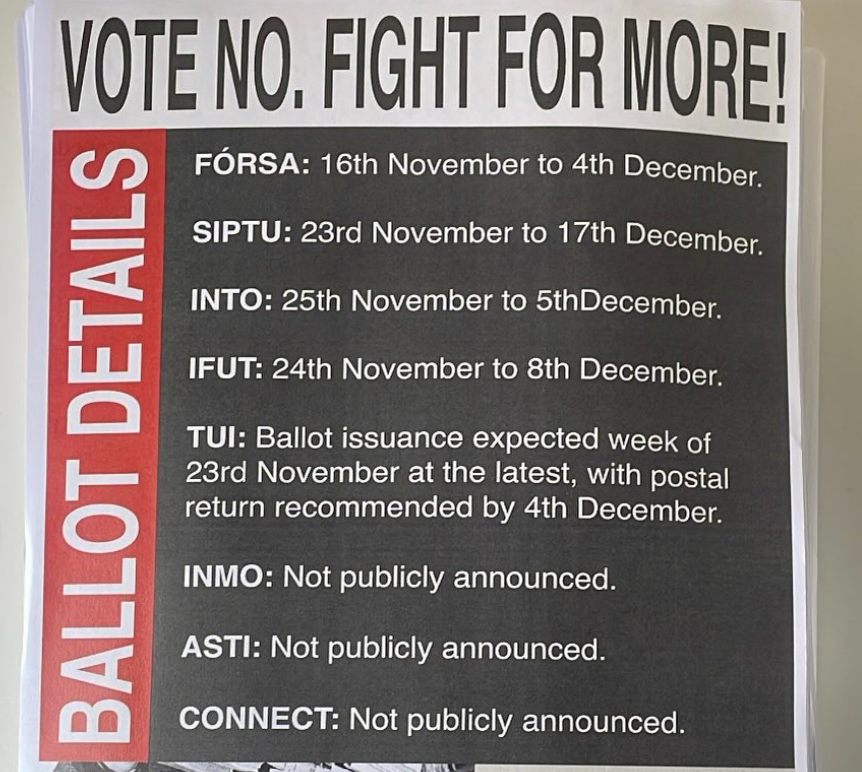
- FÓRSA: 16th November to 4th December.
- SIPTU: 23rd November to 17th December.
- INTO: 25th November to 5th December.
- IFUT: 24th November to 8th December.
- TUI: Ballot issuance expected week of 23rd November at the latest, with postal return recommended by 4th December.
- INMO: Not publicly announced.
- ASTI: Not publicly announced.
- CONNECT: Not publicly announced.