A Major Imperialist Offensive At EU Leaders Summit
The end of October, and beginning of November saw a major assault on the Irish working class and major steps forward on the road to European war. There was brave and principled protest, but it was overwhelmed by the State forces.
Anti-Imperialist Resistance Left Isolated
The end of October, and beginning of November saw a major assault on the Irish working class and major steps forward on the road to European war. There was brave and principled protest, but it was overwhelmed by the State forces.
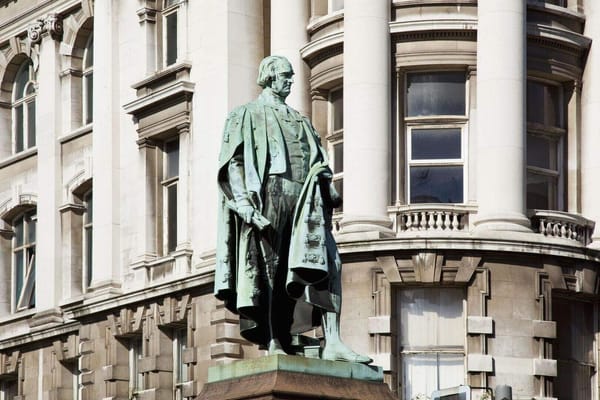
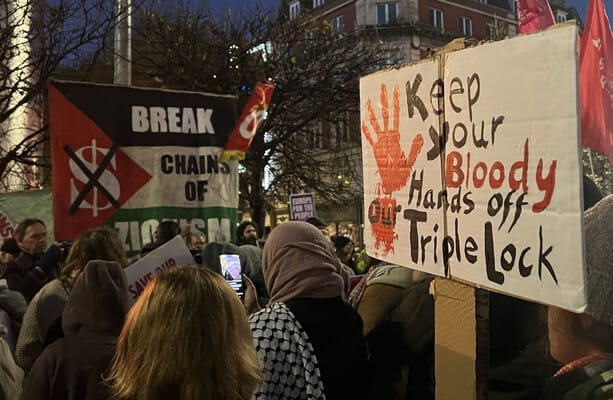
The assault began with a number of skirmishes. The government is forcing through the abolition of the Triple Lock procedure on military deployment and announced that further decisions on this would be restricted to the Dáil and would not involve referendums. The Hist society in Trinity College awarded Hunter Biden the Gold Medal for Outstanding Contribution for Public Discourse. Genocide Joe Biden and wife Jill attended the ceremony.
This award indicates the collapse of civic society in Ireland. The ludicrous award to a criminal and the son of a genocidal killer is simply another sign of the absolute capitulation of Irish capital to imperialism. It stands in line with the recent elevation of a Trump private visit into a ceremonial state visit and in line with Irish universities links to the US and Israel.
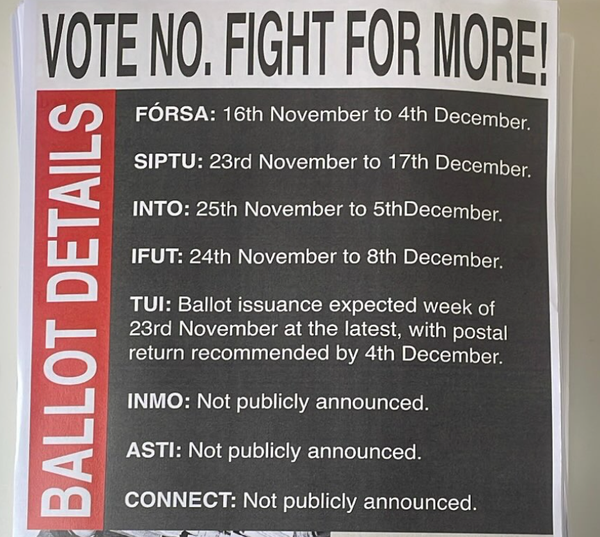
Much more than a skirmish was the acceptance of a public sector pay agreement by the Irish Congress of Trade Unions and the cancellation of industrial action. The working class in the public sector voted massively for industrial action. When the strike day arrived, they turned out in their tens of thousands on picket duty, indicating to both union leaders and to government their determination not to be forced further into penury. The leadership position was that they wanted a deal better than the last deal. The offer, 10.3% over 2 years and 9 months, ignores the guaranteed inflation following the war drives by the imperialists.
The high point of the Irish capitalist offensive was the Ukraine. The European Political Community meeting was significant by its very nature. Imperialism prefers static forms, but in crisis any vehicle will do. The EPC is simply an ad-hoc alliance of anti-Russian forces, including sections of the Eurasia community outside the EU and even including Canada, eager to take the place if the US as defenders of the West. Last year’s meeting was on the Armenian border, celebrating the shift of the Armenian regime from alliance with Russia to alliance with the West. Conference participants went from declarations that Russia had to be forced to negotiate (that is, no negotiation, victory on the battlefield) to insistence that they themselves had to be included in negotiations. As their basic orientation has not changed this is essentially an attempt to prolong the war. The conference included Trump’s representatives, updating both the Ukrainians and the Europeans in the talks with Putin and introducing the new demand of European inclusion.
The Taoiseach, rather than simply observe or supervise the discussion, rushed to the fore, with preliminary discussions with Zelensky and then announcements that Ireland was joining with Ukraine to manufacture battle drones.
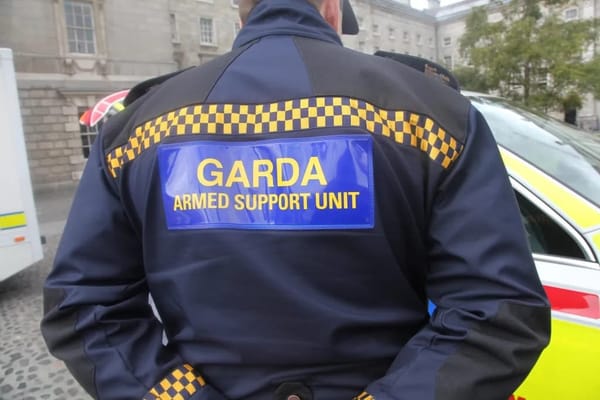
That was another aspect of the conference. It extended well beyond the political expression of warmongering to practical action. The talks were surrounded by a combination of Irish and European military forces practicing coordinated action. The Garda operation involved participation by the PSNI and a number of European Police forces.
While breathing fire over Ukraine, Micheál Martin dismissed the increasing terror of the Israeli siege in Gaza. He wept salt tears, but claimed it could not be added to the agenda of the meeting. It later turned out that the state, claiming to be inching towards a boycott of Israeli goods, had actually installed Israeli anti-drone technology as part of the European war machinery.
It’s against this background that we should view the massive lockdown in Dublin. Why not hold the conference outside Dublin? The answer was that the lockdown was itself an exercise, with the Irish state flexing its muscles and demonstrating a capacity for large scale control of the population. Protests were tightly controlled and in the most extreme case, a migrant was seized in an ICE- style operation and jailed awaiting deportation.
The entire operation demonstrated the limits of opposition in the Irish state. By excluding Gaza from the discussion the Taoiseach was able to take advantage of the Russophobia that has been built up in Ireland and which is present in the Irish left, moving many into direct support for NATO and the imperialist powers. At a time when Europe is burning somewhat over a thousand activists turned out in protest.
This incapacity is where are we now. Activists comfort themselves by saying; “We do what we can” and making even greater efforts. But the questions we have to ask are: “Where do we go from here?” and: ”where is everyone else? Why aren’t they here”
We can start by acknowledging the political project of the Dublin government. They believe that by smoothing the way for transnationals and for finance capital they have made the country rich. The growing instability of US decay is to be met by doubling down and getting more investment, for example in the form of data centres that no-one else wants. For this strategy to succeed it cannot simply be political. We must prove ourselves worthy by moving to the fore in supporting imperialism’s aggression in Europe and in West Asia.
The problem for revolutionary socialists is that the majority of political forces in Ireland accept much of this argument. Chief among the forces of acceptance was the Trade Union leadership. The likelihood of mass demonstrations of public service workers during the conference was a major embarrassment for the government. They were called off by hasty acceptance of an incomplete agreement that even the negotiating team admit will be a hard sell. In fact the decades if social partnership with government is precisely partnership to attract transnational investment.
The political parties are no better. They look for improvements within the system. The wealth should go to the workers, they say, just as it flows away from them. The more they adopt to reformism, the more they restrict themselves to parliamentary stunts in the Dáil.
We should remind ourselves of the tasks of solidarity. The first is to show that workers at home and abroad are facing the same enemy. The bloodthirsty monsters driving war abroad are the same people rack renting and smothering democratic rights at home. The second task is to see that the main enemy is at home. We need to specify the enemy by name. The government is constantly advancing towards war with Russia and accommodating genocide in Gaza. There are some protests, but almost no attempts to obstruct government. Targets such as the GAA, FAI, Allianz or trade union presence in the central bank are never made the targets if coordinated national action.
In the absence of a strong resistance movement there remains the internal contradictions of capitalism. On the international stage we see the fragmentation of the European alliance. There is an assertion that Europe must be present at negotiation while asserting that no negotiation is possible without capitulation by Russia and rivalry around who should represent Europe.
At home the issue that made the government triumph at the EPC possible was the ending of the public sector industrial action. The bureaucracy themselves admit that winning acceptance of the deal from the members will be no easy task. Informally it is reported that the increases will pay for themselves in the form of major job cuts and productivity deals.
That’s the link between the war drive and worker’s living conditions. The capitalists gear up for war, we are to pay for it. The fight is on, both around the pay deal and around the broader political and economic offensive by the Irish capitalist class.