Free Palestine! But Not For Growing Indian Community In Ireland
The cry for free Palestine on Irish streets has grown over the last three years, but as diverse as Irish society is right now, the participation of the Indian community is minuscule. The reason is internalised anti-Muslim sentiment and the popular IT headquarters in Ireland.
Apart from racist attacks in Ireland, the only other reason the country makes headlines in global news media is for its consistent pro-Palestine support. The cry for free Palestine on Irish streets has grown over the last three years, ever since the destruction that took place thousands of miles away. As diverse as Irish society is right now, the participation of the Indian community is minuscule, a community subject to colonialism, just as the Irish were.
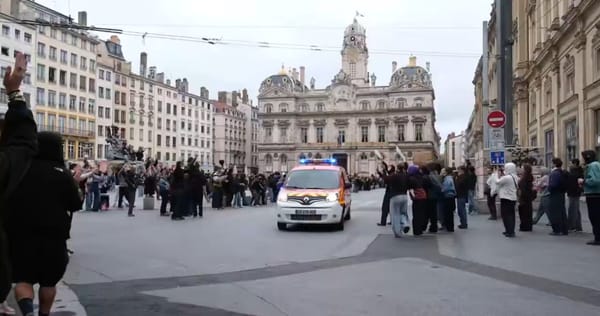
Ireland Palestine Solidarity Campaign (IPSC) is an organization that has conducted events like mobilizing people, fundraising, and cultural events all across the country for the last eleven years. The frequency of this campaign, along with other organisations, is so gigantic that one just can not turn a blind eye. “Europe’s most pro-Palestinian country,” solidarity runs from common people to political reforms, from artists calling out the massacre on global stages to sports fans demanding a boycott from the World Cup tournament.
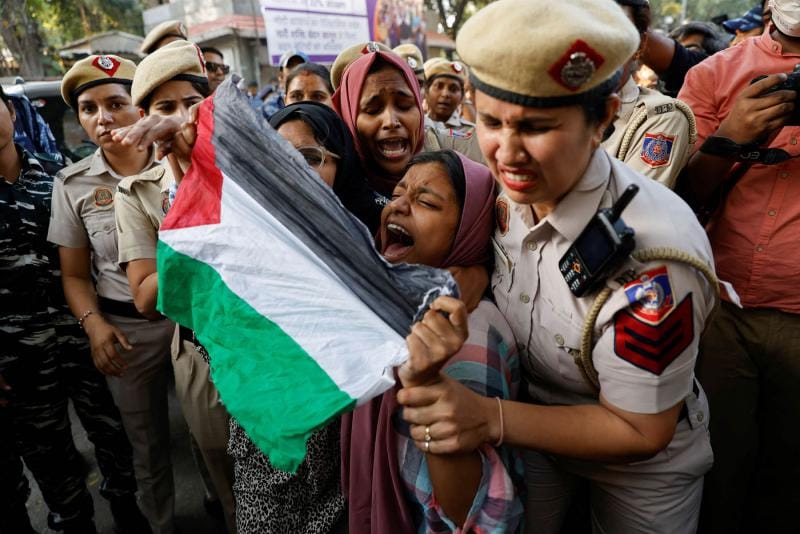
On the other hand, back at home, the citizens of the “largest democracy in the world” are being subjected to detention without trial, arrested over hoisting a Palestinian flag on the roof of their home, and suspended over simply putting out stories on social media, primarily targeting Muslims. For andh bhakts (blindfolded) Indians, meaning those who blindly support the ruling right-wing BJP party, it is a matter of religion that shows up in current India’s foreign policy as well.
Hindu superiority runs in blood
The Hindutva government has made sure that Indians lose any empathy for minorities which ends up reflecting on Indians abroad. Jessica Braganza, a PHD student at Dublin City University, sees the problem in Ireland’s tech haven economy that attracts thousands of Indians from an IT background. She says, “They (IT sector Indians) have so much privilege that they don’t have to look beyond Dockyard.” As a Christian minority from India, she adds, “Most of the crowd is upper caste Hindus, and I haven’t met a lot of Indian Muslims.”
Last year, my Indian flatmate bluntly said, “They (Palestinians) deserve to be bombed because they are Muslims,” in a casual dinner conversation. The Indian education system has successfully sown a Hindu superiority narrative, which migrates with Indians who manage to migrate from the country. I went down to dig deeper and landed myself on a subreddit group ‘Indians in Ireland’ and within ten minutes of asking, “Irish people support Palestine, where does the Indian community stand?” I got banned from the group, and the question was taken down.
Rajiv Sinha, founder of the UK-based organisation, Hindus for Human Rights (HfHR), is a second-generation British Indian, and he recounts his memory of growing up in a Hindu majority community in the UK “Growing up 20-25 years ago, you’d hear Islamophobic jokes, comments, insults, slurs, stereotypes all the time. I’ve watched and experienced that increase massively… BJP has a huge-huge factor in that.”
Protest is an art of public dissent, and a key to healthy democracy, yet, in India, it is seen as an ‘anti-nationalist’ and separatist movement.
The booming IT sector of Ireland
The evolving relationship between India and Israel is discussed loudly in every corner. Meanwhile, a small percentage of pro-Palestinian Indians are crushed before it could make any noise. With the help of social media, the fascist narrative runs in a loop. For instance, Meta removed a popular Indian Instagram profile, Shrishti Khanna, for posting Palestine Action.
Riya (name changed for anonymity), an IT employee based in Dublin, says, “With several IT headquarters in Ireland, most of the Indians end up working for these companies that actively contribute to the harm.”
One could speculate that the reason is visa restrictions or what Sinha says, “a lack of stronger community in Ireland” as compared to the UK. He says, “South Asian diaspora is more established, particularly in England, than in Ireland, for obvious historic roots, resulting in a deeper and more extensive tradition of British South Asian politics and resistance in the UK.”
Ireland has a smaller settled Indian community compared to the UK, and protesting in a place where you count as a minority does sound like inviting trouble, but Riya thinks otherwise. Due to Ireland’s high demand for IT and healthcare, which are mostly taken up by Indians, “they come here with an expectation of having a comfortable job where they are not challenged too much.” “Back home in India, we’re comfortable in stepping on somebody’s neck (referring to caste and class difference) to get ahead. We come here with that same ideology.”
Indians conveniently make this genocide a religious war, as Riya calls it, “a great façade to cover up. It’s uncomfortable to recognize what’s fundamentally happening in Gaza, especially for Indians who come from discomfort.” Adding, “But the distance between the group that doesn’t want to give up their comfort and the group that is actively penalized and killed is very small.”
For decades, India stood in solidarity with Palestine, becoming the first non-Arab country to recognize its statehood in the 1970s. Around fifty years later, it flips to take a stronger stand with Israel, or as the Hindutva government calls it, ‘de-hyphenate’, meaning it would donate $2.5 million to the United Nations Relief and Works Agency for Palestine Refugees (UNRWA) while also excessively trading arms and war supplies to Israel, as per a recent report by Al Jazeera.
Jessica says, “Ireland is an inspiration. They don’t care if there’s a political community, and they empathize because that has happened to themselves.” “So, I think it’s about the level of empathy and less about privilege,” she adds.
Though Jessica and Riya find attending pro-Palestinian protests safer and more “polite” in Ireland than in India, it is still not ideal. Barganza has attended around six protests across Dublin and recalls feeling safer attending these protests with her Irish boyfriend than alone.
Riya prefers to take more precautions and hide her face in a way that one can not even detect her facial structure with facial recognition AI. “As somebody working in tech, I know how simple it is to grab some of these facial matrices from a frame and run across references.” Mentioning the recent Belfast far-right attack, she says, “I leave my phone at home so my location stays intact.”