Fintan O’Toole Reads the Wrong Room on Fuel Protests
Fintan O’Toole as usual waits for the dust to settle before giving his safe take for the Irish Times audience, acknowledging some factors but completely missing why these protests saw popularity across Ireland and why some people have shifted to a more “anti-state” ideology.
Domhnall O'Gaothne
You can always trust Fintan O’Toole to come out with a safe analysis of an event once the dust has settled. Once he’s had a chance to read the room, he can safely pull out a few thoughts to feed to the Irish Times readership as if a wise scholar looking down upon events. Writing in the Irish Times, classism and derision are a safe bet so perhaps he has no need to actually read the room when it comes to the mood of the broader population but the article was so far off the mark, it warranted a response.
In his piece “Ireland’s far-right movement will emerge from the ‘breakfast roll-atariat’” [1], O'Toole takes shots at the fuel protests that spread across the country from the position of someone sheltered away from the people. Whilst focusing on the self-appointed spokespeople of a fairly decentralised movement, he uses derision to undermine the struggles that these people face. However, the biggest thing he misses in this self-congratulatory piece is why such a small subsection of Irish workers, mainly from places outside of Dublin, saw such widespread support across the country and in the capital.
The people of Ireland have been struggling through a cost of living crisis for years. Currently, things are blamed on the Iran conflict. Previously, it was Ukraine, and Covid before that. Go a little bit further back and it is the crash and housing crisis. Young people have not known a capitalist system that is not in crisis. To make it worse, not only have we had never-ending crises, we have also struggled through them with inept leadership in the form of Fine Gael and Fianna Fáil. These days, they rule as if they are surprised to still be in power, in shock and awe that Sinn Féin’s failure to appeal to voters has allowed them to cling to power. They feel so invincible, they seem no longer able to even feign care. It is the shattering of this veneer coupled with very real and existential cost increases for farming and transport workers that created these protests. We can all see prices climbing at the petrol pump so naturally the ones most reliant on fuel would be disproportionately affected. However, as with the water charges, the issue is not solely fuel but the unbearable cost of nearly everything. Complaints were falling on the deaf ears of our overpaid public servants, too busy running off on their two week holidays.
The water charges campaign was a grassroots movement that grew not out of a particular care about water but from a feeling that this was one burden too many. People had been hit with bin charges, property tax and then the water charges. The movement grew from frustration and didn’t follow “proper channels” such as the unions. It grew on the streets in confrontation with the state and with those trying to put meters where they weren’t wanted. The left stepped up to aid and support this movement and got very real results via direct action, civil disobedience and what the state tried to call “false imprisonment” [2]. More recently, when deprived working class communities and small rural towns, both long since abandoned by FFG, were chosen to house immigrants without the addition of any additional services or investment, this also became a burden too great for some. In this case, a hesitant left, afraid to touch the topic, left space for the far right to step in and misdirect that frustration into the poisonous rhetoric we see too often today. In both cases, the mobilising factor was not the source but the final nail in the coffin. This is also the case with the fuel protests. It is felt a burden too great for people barely keeping their head above water with no end in sight. As Mario Savio once said:
“There is a time when the operation of the machine becomes so odious, makes you so sick at heart, that you can't take part; you can't even passively take part, and you've got to put your bodies upon the gears and upon the wheels, upon the levers, upon all the apparatus, and you've got to make it stop. And you've got to indicate to the people who run it, to the people who own it, that unless you're free, the machine will be prevented from working at all.” [3]
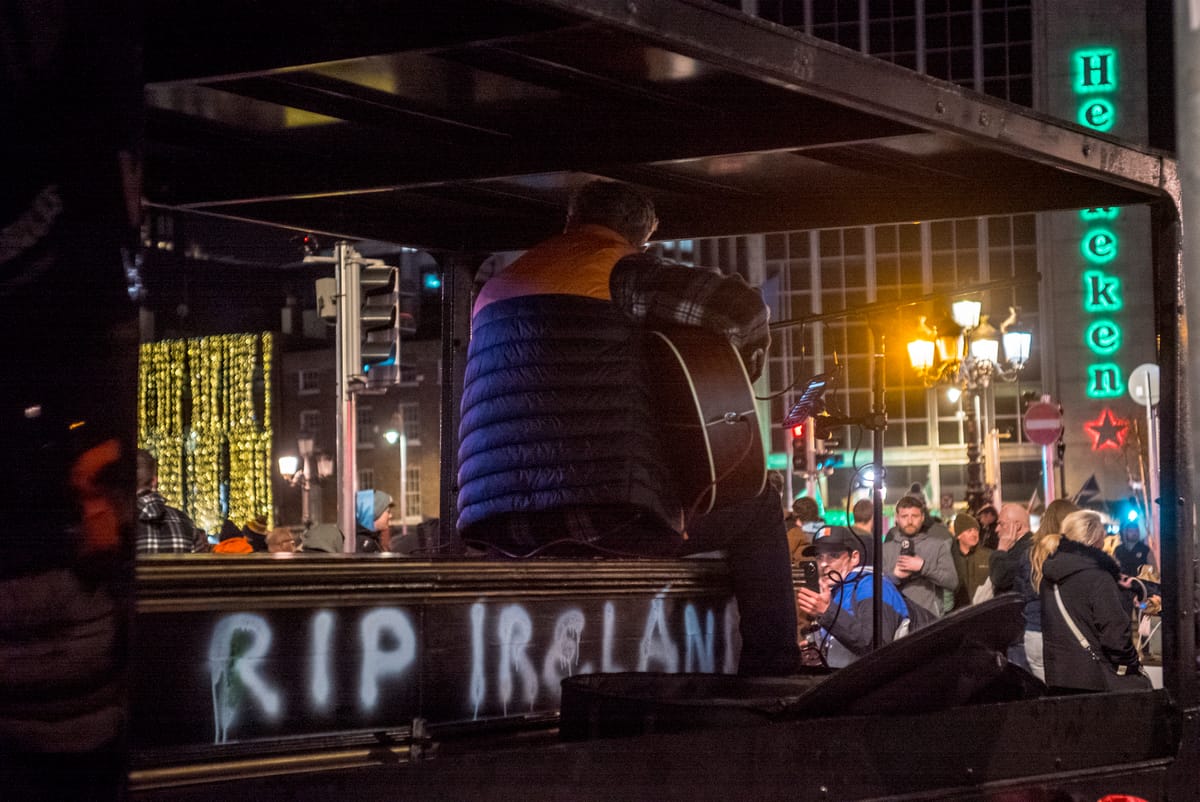
What happened in the past week was the biggest show of unity among the population we have seen in at least a decade. Despite O’Toole trying to paint the movement as the “HGV Soviet” (interesting choice if trying to paint it as far right), the solidarity from people showed that it represented far more than that. As someone who was actually down among the protest on O’Connell Street, it was a wide coalition of people with no shortage of grievances against this heartless government. The urban-rural divide was out the window as Dublin locals chatted with farmers and truckers from all corners of the island. People came together to show support for a protest that was successful in getting attention and having more of an impact than the all too common and frequently ignored walks to the Dáil. The city centre was peaceful, the quays were empty of moving traffic and people roamed freely among the streets and parked vehicles. There were people who had stood on opposing sides in previous demonstrations and counter-demonstrations standing among people who had never protested before. Of course the far right had a presence. Unfortunately, that’s where the country is at, currently. Wherever there is a grievance, they will show up to try to hijack it and steer it to punch downward. This was shown in Paul Murphy showing up to support and getting chased off by a handful of people shouting about LGBT issues. Their role, whether knowingly or unknowingly, is to divide a movement, distract from the issue and make it so toxic that people can’t get behind it. That didn’t happen this time, and it was in no way illustrative of the movement as a whole as thousands of workers across the country united to just get the ear of the government. A wide variety of left wing groups showed their support, albeit some slowly. But the government didn’t want to hear. The far right had not done their job and the media hit pieces weren’t having an effect. Instead, the government sent in the riot police. Instead, they threatened to use our Defence Forces on our own citizens and big man Jim O’Callaghan threatened to destroy property [4]. For a peaceful protest, this was the first call of its kind but the unity against them was a big cause of concern for them. Fintan O’Toole talks about how “more people will acquire the taste for dictatorship”. Well, it certainly looks like our ruling class has.
The article states that there’s a shift from “being against the government to being against the state” but when the same two parties have always ruled in this state, that distinction gets more blurry. When FFG openly gut the state and sell off its resources, waste tax money on idiotic investments and developments and hand huge amounts directly to landlords, developers, advisors and property speculators, what is left of “the state” but the ruling parties themselves? It appears some are only waking up to the corruption of our crony civil war parties. O’Toole says the protest “attacks the legitimacy of democracy itself” but FFG attack the very idea of an Irish sovereignty state through subservience to foreign capital, the EU and disregard for the wishes of the people for neutrality by allowing the US military to fly unimpeded and uninspected through our airspace and airport. The Occupied Territories Bill is still stalled and trade remains high with that infamous genocidal nation. It is very possible that the delay in responding to the protesters was due to needing to check with the bosses in Europe regarding tax. Considering Micheál Martin was grovelling at the feet of Donald Trump only a month ago, it is fair for him to share some of the blame for the rising fuel costs. It is also dishonest to only blame that conflict considering it is not our main source of fuel, nor is it to blame for the tax imposed on us in a society where only the wealthiest can avail of the grants to purchase electric vehicles.
So, why didn’t protesters use their unions? Well, what could the unions do for the immediacy of the situation that the protesters felt? Nothing. While the protesters had tried to use the IRHA and the IFA, there had been no result and some feel they are already at the cliff edge. The unions in Ireland are ineffective and muzzled. People complain that union membership is down and that is why they are ineffective, but the truth is that they are ineffective because the union bosses took a better pay deal for themselves and agreed to the Industrial Relations Act. They have restricted union members' ability to get results, to show solidarity, to pressurise the government all the while taking the wages of high paying civil servants. They now act like civil servants. Comfortable bureaucrats with inflated wages, content in the slow-moving status quo, using endless red tape only appearing for an occasional photo op or appearance on a march. The ICTU has been woefully ineffective, unable to mobilise more than a single housing march every few years despite being involved in various coalitions like Raise the Roof. This morning their general secretary, Owen Reidy, on RTE News [5] complained about the protesters, probably fearful that he may now be expected to do something. Maybe even actions that would actually ruffle some feathers. We are in extraordinary times for workers, yet the comfortable classes act as if the anger is coming from nowhere. But when single sector strikes and long negotiations can only get marginal wage increases at a time when inflation and the cost of living are far outpacing wages, it becomes time for more drastic measures.
One example of the negative impact of unions on workers’ demands for action was the Iceland workers and the betrayal by SIPTU in 2023 [6]. When Iceland decided to pull a Clerys/Debenhams and close up shop without warning and leaving workers unpaid, some of the staff members with the aid of the Independent Workers Union and PBP decided to occupy their stores [7]. Whatsapp groups were set up among staff across different stores in Ireland to prepare each other for what they all knew was coming. Eventually, the staff in Waterford got their notice that the store was to be closed. Workers occupied this store. In the case of Waterford, however, some staff were already SIPTU members. No solidarity with the IWU had been shown from any of the other unions up to that point, and it was no different with SIPTU. Instead, they presented this closure as if it had come from nowhere. Completely unexpected, how could a store owner do something so nefarious without warning to solely their members? Worse still, they convinced their members to end the occupation of the store with the promise that they had reached an agreement with Iceland. An agreement just for their workers? Even this wasn’t wholly accurate. Instead, Iceland agreed to pay their staff once the other costs had been accounted for. As someone who followed the situation, this meant not receiving anything. Among a variety of debts and costs, the landlord came first, the workers last. The workers were at their strongest before SIPTU came in to sabotage the direct action taken by workers who only wanted to be paid wages that they were owed.
Direct action and confrontation with the state is more prevalent in places like France on demonstrations where unions play a central role on the frontlines. Here, with the exceptions of CATU and the IWU, unions work at a snail’s pace and achieve far too little to warrant the 6 figure salaries of their general secretaries. These are not solidarity wages, they are status quo maintenance wages.
For the fuel protests, the slow moving union bureaucracy was replaced by slow moving vehicles that had an instant impact and forced us to listen. They provided inspiration for tactics that work and that is one of the main reasons why people got behind them. In a society where those on the top actively ignore the suffering of those around them, a sudden burst of community spirit broke through the grey. On O’Connell Street and at the protests around the country, people brought food, snacks and drinks. People sang songs and played music. People danced, laughed and some cried. Unity was in the air despite the very best efforts of the ruling class.
O’Toole states “this is arguably the most serious insurrection the State has experienced in a century” and he could be right there. It was a powerful moment seeing people putting their livelihoods at risk to say enough is enough. Standing up to a government that wouldn’t listen and bringing parts of the country to a standstill. Without the common courtesy of even meeting the protesters to placate them, government representatives and army officers were on the war path. What type of nation turns its army on its own people? The thing that brought this closest to an insurrection was the government’s unwillingness to listen to the pain of its own people. When people are stretched and their elected representatives refuse to listen, that is a democracy in turmoil. The likes of O’Toole would do well to read the mood of the population writ large. Despite surviving a vote of no confidence in the Dáil, this government has weakened its own power through its actions. What started as a day of disruptions became a week-long stand-off with the state. It became a campaign to unify around and it illustrated to the public the power of the people and the mechanisms to wield that power against the state. They may ignite a summer of civil disobedience. Pearl clutchers like O’Toole and his colleagues in the mainstream may worry what this means for our fragile democracy, but for many others, that democracy was hollowed out long ago.
1 O’Toole, Fintan. “Ireland’s far-right movement will emerge from the ‘breakfast roll-atariat’” https://www.irishtimes.com/opinion/2026/04/14/fintan-otoole-rule-of-the-breakfast-roll-atariat-this-is-how-irelands-far-right-movement-will-emerge/
2 Kenna, Colm. “Jobstown trial: Six cleared of Burton false imprisonment” https://www.irishtimes.com/news/crime-and-law/courts/circuit-court/jobstown-trial-six-cleared-of-burton-false-imprisonment-1.3137761
3 Savio, Mario. “Operation of the Machine”
https://www.youtube.com/watch?v=lsO_SlA7E8k
4 Sherlock, Cillian. “Army called in to remove vehicles blocking depots as owners told 'not to complain' about damage” https://www.irishmirror.ie/news/irish-news/defence-forces-ireland-fuel-protest-36987917
5 RTE. “Fuel protests show 'rules of engagement have changed' - ICTU”
https://www.rte.ie/radio/radio1/clips/22600976/
6 O’Donovan, Brian. “Iceland workers reach agreement after sit-in” https://www.rte.ie/news/2023/0826/1401826-iceland-workers/
7 Súil Chlé. “Iceland Workers Continue Occupation As They Push For Wages Owed” https://www.youtube.com/watch?v=rmxpbRCuwF0