Europe's Human Rights Failure Starts at Home
The test is not whether leaders condemn racism abroad, but whether a Congolese IT worker in Dublin, a Roma man in Teplice and an asylum-seeker at the Belarus border can expect equal protection.
For years, Europe has treated racism as a foreign import—something to be condemned in American policing or debated in international forums. The reality is closer to home. In Dublin, Teplice and on the Belarus border, the same sequence recurs: force against racialised minorities, official denial, and accountability that arrives too late or not at all.
Dublin: A Death on Henry Street
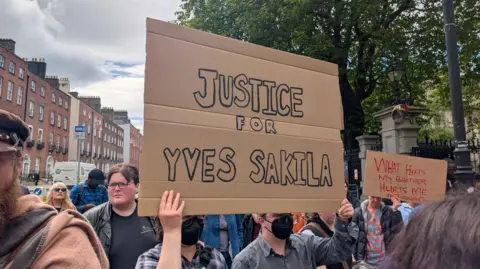
On 15 May 2026, Yves Sakila, a 35-year-old Congolese national who had lived in Ireland for 22 years and worked in IT, was restrained by private security staff inside Arnotts department store on Henry Street, Dublin. He was alleged to have stolen a bottle of perfume. Footage appears to show five security staff holding him face-down for four to five minutes; one appears to kneel on his head and neck, while the others control his body and limbs. Sakila lost consciousness and died in hospital.
Within days, the Irish Council for Civil Liberties called for an independent inquiry into reliance on private security firms and whether racial bias shaped the use of force. Licensing private security does not outsource state accountability. Amid anti-immigrant sentiment, housing pressure and asylum strain, Sakila's death has come to symbolise a structural failure to protect those on the margins. At the opening of the inquest on Thursday, the court heard that a postmortem by State Pathologist Sally Anne Collis recorded the cause of death as cardio-respiratory arrest following a period of prone restraint, with mixed drug intoxication and raised BMI also noted. It does not settle legal responsibility, but reframes the question: why did he die? A suspected shoplifting is not a capital offence. If five private security staff can hold a man face-down for four to five minutes over a bottle of perfume, and the postmortem records his death after prone restraint, the problem is not confined to one shop. For campaigners, it points to a system that treats some lives as disposable.
Teplice: Five Years to Strasbourg
Two months later, on 16 July 2026, the European Court of Human Rights ruled in a case that had taken five years from death to final judgment. Stanislav Tomáš, a 46-year-old Roma man, died on 19 June 2021 after police in Teplice, north Bohemia, pinned him face-down and bound his hands behind his back. Police said he died of a drug overdose and denied that the restraint caused his death.
In March 2022, the Czech General Inspection of Security Forces closed the case, finding the officers' conduct lawful and the restraint not causally linked to his death; no criminal proceedings followed. In March 2023, Tomáš's sister filed a constitutional complaint alleging excessive force, failure to protect the right to life and an inadequate investigation. The Czech Constitutional Court dismissed it. In July 2023, with lawyers from the European Roma Rights Centre and Forum for Human Rights, she applied to the European Court of Human Rights. On 16 July 2026, the Strasbourg court found that Czech police had placed Tomáš in a life-threatening position, failed to monitor him adequately after he lost consciousness, and violated the European Convention on Human Rights. It ordered the state to pay €20,000.
For many Roma, the presumption of guilt begins in the police van and continues into schools, housing offices and hospitals.
Lithuania: Exclusion by Policy
Lithuania presents not a single viral death but a policy. Since 2021, rights groups have accused Lithuania of pushing back migrants and asylum-seekers at the Belarus border and holding many in closed reception centres and camps. Human Rights Watch, UNHCR and the Council of Europe's rights commissioner have criticised asylum restrictions and detention conditions. The government cites a hybrid attack orchestrated by Belarus. The security threat is real. But emergency measures cannot become permanent racialised exclusion. When a state turns people away without individual assessment, detains them without dignity or leaves them without remedy, it is not simply defending borders. It is defining whose humanity counts. Rights groups say EU funds have flowed to border infrastructure while monitoring has lagged.
The Pattern Is the Problem
These cases differ: private security in Dublin, police in Teplice, border guards in Lithuania. The pattern does not. Force is used against racialised minorities; official accounts minimise what happened; inquiries are narrow or delayed; politicians exploit anti-migrant and anti-Roma sentiment; structural reform stalls.
The temptation is to treat these as isolated failures. Yet EU law offers important protections, though unevenly enforced. The European Convention on Human Rights depends on national courts to make it real. That is not an argument against European law, but against pretending that law enforces itself. Too often, European leaders lecture others while tolerating practices at home that would be condemned elsewhere.
The deeper problem is that racial equality has rarely been treated as a matter of national identity, only as a nuisance. Each death follows the same ritual: shock, candlelight, a narrowly framed inquiry, little change in institutional practice. Governments speak of border security and cohesion while leaving bias in policing, housing and criminal justice untouched. So the next death arrives with a familiar vocabulary already prepared for it.
Ben Bowling, professor of criminology and criminal justice at King's College London, says: "European countries must recognise that their future is multicultural and diverse and that every citizen must have the same life chances." The words are unimpeachable. The political will is not. If Europe cannot guarantee equal life chances, it will keep producing its own versions of the same crisis.
Beyond the Candlelight
Living in Europe, I am not asking Europe to be perfect. I am asking it to stop pretending. The test is not whether leaders condemn racism abroad, but whether a Congolese IT worker in Dublin, a Roma man in Teplice and an asylum-seeker at the Belarus border can expect equal protection. The answer is not another vigil. It is the harder work of independent investigation, lawful limits on force, challengeable border policy and politicians who stop treating racism as an electoral weapon. Without those, Europe's promises will remain a work in progress, and its most vulnerable people will keep paying for the gap between rhetoric and reality.