Totalising Politicisation: Voluntary Associationism in Student Unions for Progressive Ends
The closed-shop student union model has paradoxically led to an all-encompassing, yet strikingly unrepresentative model of democracy.
Throughout the year, the union held consistent meetings of the Campaigns Committee, on topics including but not limited to the housing crisis, masters’ fees and period products.
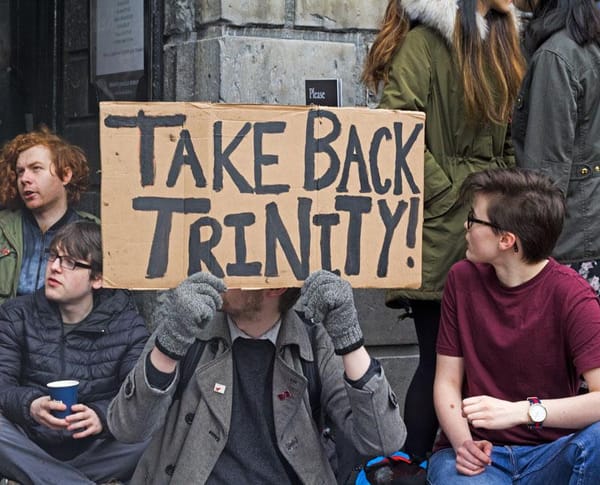
Our third-level institutions profess to promote equality, diversity and inclusion in their words. Yet, in their actions, they increase fees and rents, put our teachers on insecure contracts and foster unethical connections with greedy politicians, big business and unsavoury industries.
The alienation of our union’s main decision-making body from the grassroots is by design, not by accident.
The Department of Further and Higher Education, Research, Innovation and Science is putting forward a bill repealing and replacing the Higher Education Authority Act (1971).
Our union’s political strategy is ridiculous, and one that I will never manage to understand. It is painfully obvious which way our union is facing. Instead of relying on students for its power, it turns towards College.
It is safe to say that Trinity-owned accommodation is in a constant state of crisis, spurring out continuous scandals.
Trinity College Dublin’s Student Union (TCDSU) has spent 122,055 € on their annual “Class Rep Training” from 2015 until 2019, when due to Covid-19 the event was moved online and incurred little to no costs.
News
Essentially, Ms. Scanlon’s Tweet about her dissent is the way the wider student body discovered the new proposed location
Opinion
This is somewhat of an open secret amongst people familiar with academic research, but is not widely known.