A Commentary On Anti-Sectarian Writings From The Red Hand Magazine
This work will be the republication of a number of articles and excerpts thereof; with additional commentary suited to the moment attached, of pieces from the Ulster-focused Red Hand magazine.
This work will be the republication of a number of articles and excerpts thereof; with additional commentary suited to the moment attached, of pieces from the Ulster-focused Red Hand magazine. The Red Hand magazine was a Sinn Féin-oriented periodical circulated throughout Ulster with the express purpose of placating the Protestant workmen of Ulster, and Ireland more generally, to bring them into the fold of Republican revolution, and in select articles to bring them into the fold of world-revolution. I suppose the Republicans of Ireland today have abandoned that task, in many cases have actively impeded it, and with the continued appropriateness of Republicanism in Ireland in and of itself being it’s nation-building project that sees the Protestant, Catholic and so on not as constituent peoples but as communities to be substituted for the commonality of Irishman; it is paramount that this task of unity is approached again with the earnest sincerity, as it was during the time of the Red Hand’s circulation in the early 1920s.
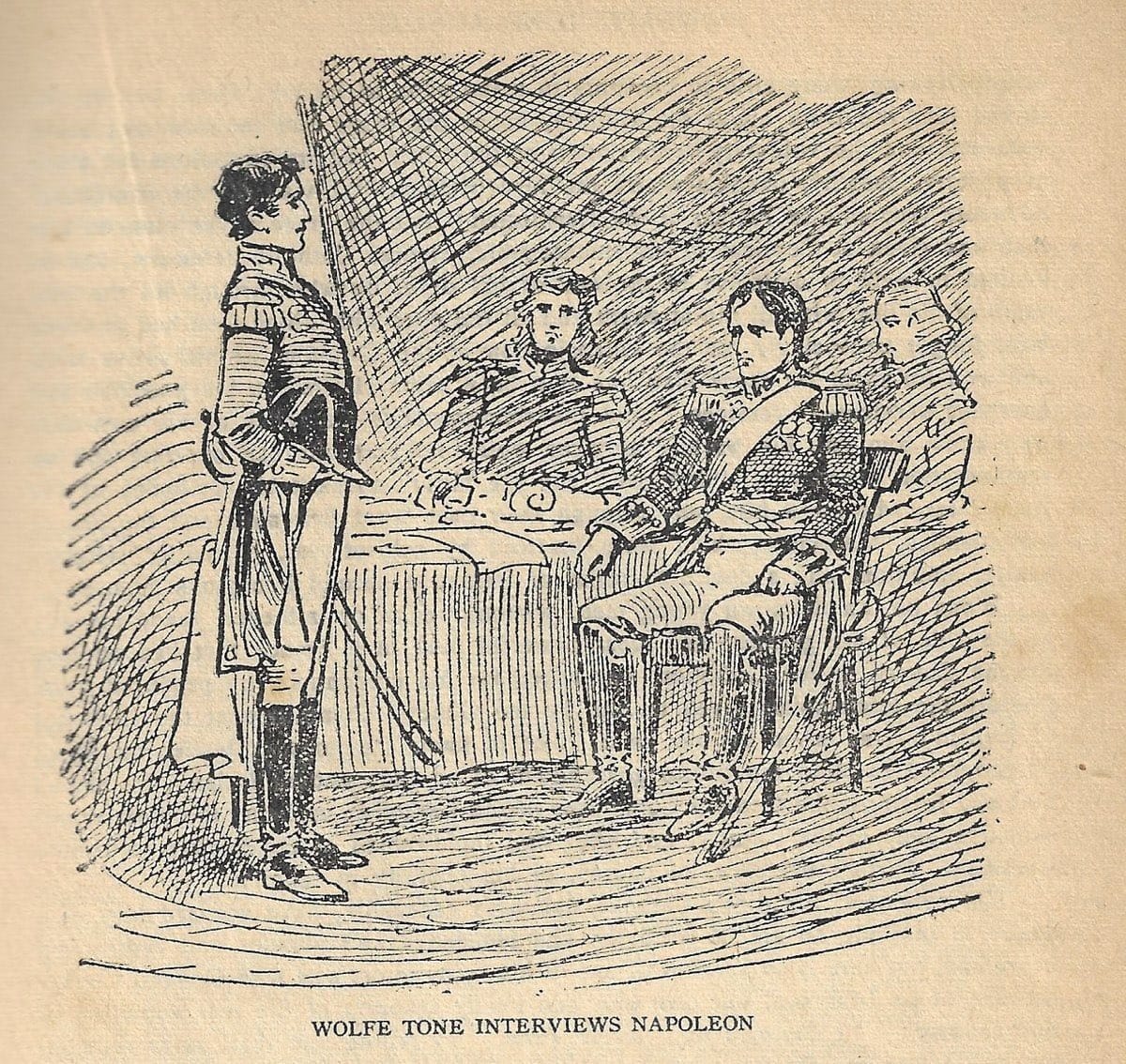
In Ireland we are Socialist Republicans rather than Socialists expressing patronage with our radical Republican history. This will remain insofar as the historic mission of these revolutionaries past remains unfulfilled, we see the unity of our people, Protestant and Catholic as fundamental to our own mission of proletarian self-abolition and the division of our people through partition and through subtler means as the fundamental enemy of ours just as it was theirs. The French Socialist expresses patronage with his Jacobin forefathers in the continued appropriateness of their civic demands for equality, which Socialists uphold not as an axiomatic truth but as the ventilation of the proletariat the real content of their political demands; the demand for the abolition of classes. The English Socialist expresses patronage with his Leveller and Chartist forefathers in their continued appropriateness likewise, but in Ireland the character of our Republican movement differed fundamentally contingent on our national peculiarity, namely that Ireland as is contains fragmented, constituent peoples witheld from self-activity through foreign imposed sectarian division. From this we inherit the programme of Tone and the United Irishmen, a programme emphasised in their name itself – “To subvert the tyranny of our execrable government, to break the connection with England, the never-failing source of all our political evils, and to assert the independence of my country [..] To unite the whole people of Ireland, to abolish the memory of past dissentions, and to substitute the common name of Irishman.” It is in this unfinished revolution we find our situation, and I emphasise the point here that this unity has just as much it’s enemy in Catholic nationalism as it does in Protestant loyalism. We are in lockstep with Tone, Emmet and Mitchel in a tune that could not be said of a French Socialist, who is not a Jacobin, or of an English Socialist, who is not a Leveller. In the sense that the Jacobin, Leveller and even Chartist for the greatest part had his fundamental demands secured in the respectively abolished and limited monarchies, secured in the popular parliamentary democracy which exists in both France and England, however exhausted their appropriateness is to our epoch. Ireland enjoys no such all-Ireland parliament and only a limited break in the connection with England, and without the unity prerequisite to that parliament’s existence. Subsequently we begin where Tone left us on the gallows, as much then for 1803, 1848, and so on.
From here I will reintroduce the words of the Red Hand magazine’s contributors to our current moment, the first of which will be the words of Cpt. J. R. White; which were in response to an article of Major Hugh O’Neill M.P. and a writing of Father O’Flanagan’s in defence of partition, in the effort of debloating this article I will omit the more direct correspondence between White and O’Neills’/O’Flanagan’s words. Instead I wish to bring into focus the holistic approach to history White champions as he delineates the historic development of the Catholic and Protestant divide; and proceeding from this holism champions the emancipation of mankind in general as our remedy.
– I submit that history has worked and is working steadily to make one nation in Ireland. What is history? It is a meaningless record of disconnected facts unless read in the light of its plan and purpose. But when we become aware of the trend of historical evolution towards a purpose that satisfies the heart and mind, history becomes the parment God weaves to enable us to see Him. Father O’Flanagan as quoted divorces the temporal from the Spiritual in history, with the result that he understands neither. The key to history is the struggle of the workers against oppression ‘till they overcome their menial status in each nation and so abolish the external tension between nations, which is the result of and safety-valve for the internal class tension. Connolly has shown this in masterly fashion with regard to Ireland in ‘Labour in Irish History.’ A careful study of that book alone would have shown Father O’Flanagan the key both to Irish nationhood and the ultimate solution of the Ulster problem within the Irish nation. For Connolly shows how the cause of oppressed races and oppressed classes is one and the same, and how stable national freedom is impossible without universal working class emancipation. He shows how it is necessary for Ireland to get back to Wolfe Tone, and to combine Catholic and Protestant, Gaelic peasant and Ulster operative on a basis which is national because it has its roots in reality, and international because it is universally true. Read thus, history has shown in the past what it is about to repeat with final emphasis in the near future: that Ulster is the point where a fusion of the distinct religious elements in Ireland with a unified Irish nation advances pari passu with great world movements for the healing of the nations. In the cosmic heat of the French and American Revolutions the separate religious elements in Ulster fused, and in the rebellion of ’98 made the symbolic sacrifice for the idea of Irish nationhood organically one with human brotherhood. Here is the content of Ireland’s spiritual destiny. Nor was the sacrifice of ’98 in vain. Such sacrifice must precede all spiritual achievement. In ’98 Ulster vibrated in response to the declaration of the idea of the rights of man. Already today Ulster vibrates in response to the realisation by Russia of the idea which Napoleon lost, but left to germinate in the ashes of Moscow, and Hoche lost, but left to germinate in Ireland. First the corn, then the ear, then the full corn in the ear. The French Revolution was the corn, the Russian Revolution is the ear, the World Revolution will be the full corn in the ear. Ulster will ripen with the full corn.
Says Major O’Neill, with some reason — “The date of Irish union may seem far away just now, but before long all sorts of forces may come into play of which we have no conception in existing circumstances.” But we have a conception of those forces—at least, I have, for one; and so might Major O’Neill, if he were not blinded in heart and mind by the false feeling and false thinking of his imperial tradition. They are the forces of the Spirit of God, no less, working to liberate and unify the world. And Ulster is their Western focus. It was no accident that the extreme tension in Ulster in 1914 merged into the world war; nor will it be an accident that the tension of 1920 will merge into another and fiercer world-war before it is finally solved. Already the clouds gather, and burst they must. I can point out to Major O’Neill the falsehood in his own premise that keeps him blind. “The Ulster people and the Ulster movement are essentially democratic. Belfast is a great working-class community.” No, Major O’Neill. That the Ulster people are essentially democratic I grant, for all people at heart are essentially democratic; but the Ulster movement is essentially reactionary, an affair of Dukes and dupes, very dangerous for both, especially the former. Dukes are not the natural allies of great working class communities. But there is a great world-wide movement, based on the will to power of such communities, armed or arming, over all Europe, controlling much of Central Asia, and knocking at the gates of the Far East, both within and without, and the strains of the Workers Internationale will drown your music, charm ye never so wisely.
But it may be objected: even granted that natural affinity will align the industrial workers of Ulster with the aims and action of the Russian Revolution, how does that reconcile them with the aims of Sinn Fein, which are reputed to be almost fanatically National? Because, to quote Fintan Lalor, Sinn Fein is seeking not to repeal the union with England but to repeal the conquest, and with it the feudal system it introduced, and thus to cut down beneath the roots of Capitalism to a communal past; while Russia clears the way for a communistic future. Ireland restores the old roots, cutting out the poisonous graft; Russia hacks away the poisoned branches and helps each vampired nation to help itself.
I am loath to conclude without touching on the deepest aspect of the Ulster question—the religious—the aspect which, rightly understood, is the key to all the rest. Major O’Neill speaks of a better understanding between Protestants and Catholics bred by working together under an Ulster Parliament. It is strange he does not see that the argument applies as forcibly to an all Ireland Parliament. But that is a detail. I wish not to sink the religious differences for the sake of political harmony, leaving the members of the creeds divided from each other in their most fundamental relationship. I hold that the divorce of religion from politics is the shallowest fallacy, and that man’s attitude to man must always be deeply affected by a common or divergent conception of his relation to God. The common son-ship of God is the first requisite of the Brotherhood of Man.
I wish rather to show that the divergences of the Catholic and Protestant ideas are necessary, or have been necessary hitherto, because each represented an aspect of truth. That each is bound to be unswervingly true to itself until such time as their truths can be reconciled and manifested without surrender on the part of either. If it is grasped that the spiritual and material orders are connected all along the line, that divisions in the material must be projected into our conception of the spiritual, and persist there ‘till they are healed here, both the origin and end of the root division between Protestant and Catholic can be seen and foreseen. Ulster appears as the meeting point of all that was stable in the old primitive community with all that is fluid and free in the world community about to be. Catholicism stands in the main for the rights of the community, Protestantism for those of the individual. The Protestant Reformation synchronised with and was evoked by a greater fluidity of commerce and world-intercourse requiring a greater liberty of individual thought. World-commerce bred world-empires, and the Protestant empires beat the Catholic out of the field because they had a more expansive religious philosophy. But since Protestantism stood for the detachment of the individual from his stable base in a particular community in the interests of a more fluid world-intercourse, it missed in its transitional function the factor of a stable community-sense at all. Thus Protestantism with its economic reflection (individualistic capitalism) was bound to be pulled up short by the flaw in its philosophy. Its function was to go as far wrong as it could, to overstep the limits of the old communities, and to provoke, by reaction against its inherent individualism, the idea aud reality of a world community.
The function of the Protestant idea, as distinct from the Catholic idea, cannot continue after the idea of a world-community is born, and cannot cease before it. In world communism the rights of the community and of the individual find at once their fullest expression and their harmony. It is thus that Protestant and Catholic will reach a better understanding by realising that the ideas for which they respectively stand are complementary, not opposed. They are reconcilable in the full Brotherhood of Man, which is the realised unity of God. Indeed, Major O’Neill subserves a greater union than he knows.
I need not impress on our readership the weight of White’s own words as I thought it best to style this article as a republishing because of it, however what I will do is provide background on the sort of thinking he appreciates from others. White’s logic on the reconcilability of Catholic and Protestant in the unity of man before God stems from the logic of the radical Republican and Protestant revolutionaries who mobilised the peasantry of Germany; that the Republic reduces governance to man before God, which is freedom. White carrys this logic through from it’s antecedents which were in Germany historically limited and realised with the completed world-intercourse; that the common son-ship of God as White calls it, as did the German radicals, is the requisite for the brotherhood of man, or the world-community.
White succinctly delineates the historical development of the rupture of Catholic and Protestant. That the latter proceeded from the beginning of world-commerce and the ideas suited to the epoch, and that the former had not been exhausted, but fastened itself further to the dispossessed peasantry of Ireland. Of course this isn’t to say that Protestantism was entirely in the scope of bourgeois innovation, far from it in the instances of the Independents of the English civil war, who’s gospel found it’s home in the masses of Ulster and brought them into the fold of Republican insurrection alongside their Catholic compatriots. Then again, 1798 would have not been possible without the largely Protestant peddlars who through their network disseminated revolutionary material and propaganda throughout the marketplaces, to the linen manufactory worker and cottage weaver alike, they laid the foundation for the political infrastructure which made insurrection possible. The Defenders had mobilised the dispossesed peasantry, though often preaching a gospel interwoven with a message of Catholic ascendancy alongside of emancipation, in spite of this the motivation of the men who gave their lives for the Republic is inscribed in their own testimonies and diaries. In 1798 for the first time the youth and genius of our Motherland, Protestant and Catholic, sanctified our soil with their blood not just for Ireland a nation, but for the universal rights of man.
From here I will introduce another article from the Red Hand magazine; an excerpt from “Fiddling Amid the Flames” by Edmund B. Fitzgerald. I want to bring into focus Fitzgerald’s approach of historicising to the workers of sectarian Belfast their shared position in history as that history is working itself out. He insists that they understand each other before all else as men, and to hear the voice of their shared martyrd dead from the shadow of Cave Hill which blankets over Belfast City.
– They begin to see that every worker, irrespective of creed or politics, is born in much the same way, exists through some fifty years in much the same poverty, at much the same toiling, that they, everyone, die amid much the same squalor, and are together forgotten altogether as the countless millions who preceded them. What, then, can matter laws to the worker, except it be the law of Liberty? What matter any mode of language except it be the gaiety of heart and laughter that proceeds of content and happiness? No time with such for idle wasting in vain quibbling over theories, the splitting of hairs over inexactitudes of case other than that of the genitive particular, the one case that is for them, though there should be many heads to split in its practical and just application—the one demonstrable case of the worker’s right to a sufficient part in the proceeds of his labour, and to a complete liberty in the disposal of his person—in fine, the Liberty ordained to him—such a Liberty as many an Antrim man and good Protestant, own brother to themselves, has known to die for upon an English gallows. And many are the ghostly halters, their chains clanking in the gusty nights, their corpses swaying in the chequered starlight, that stand out. upon the countryside through Protestant Antrim—demonstrable history for an Ulster eye to see, an Ulster ear to - hear, an Ulster arm to avenge! And for such a Liberty, many a good Presbyterian of the North is ready to bare the arm, and, as his brothers before him, will be ready and - proud to yield up an undaunted spirit into the embrace that folds Protestant and Catholic alike into a perfect and everlasting Freedom denied to them here. Aye, in the crucial hour that is opening fatefully for all Ireland such will fight again and right manfully, and will die, if need be, but he will overtake the Liberty his fathers died for, the Liberty his soul desires, if not to be enjoyed of himself, then to be the assured and rightful inheritance of his children and his children’s children forever. Nor will he stay to inquire if at last they shall be Catholic or Protestant, but only if they shall be free and not bond; for only freedom matters to the worker wherever he may be, the awaking worker of Belfast begins to sense, in his stolid but humanly accurate reasoning, since, argues he, all true fidelity to God and all good government among men proceed of themselves and of Freedom, and are essentially one and the same thing. Do you ask, you people, who are strangers to the North, is bondage less galling to the Unionist than to the Nationalist? Come as the writer did and live among the workers of Belfast, and you shall speedily learn that it is not. And these men are well worth the knowing. Hard and uncouth exteriorally, their hearts are as big as any in Ireland; and their hands, if a little less ready to grasp that of the stranger, when once they grasp, grasp with the warmth that proceeds of a great and generous heart; and their hands are not lightly withdrawn. Or do you ask if an alien taxation rests lighter on the shoulders of a Northern Portestant than on those of a Southern Catholic? Ask the island worker or the tramway man; or, for that matter, the linen-lord or the tobacco magnate. Mark his eye and his brow on the day he receives the foreigners demand for a levy on his hard-gotten wages or his easy-gotten profits, as the case may be; for, - alas, the easy-gotten profits is ever one of the grinding resultants where income-taxes provide princes with palaces and peasants with poorhouses. Hear him growl when he reads the haughty challenge of his overlords: Pay—or be paid!
But that you might probe to the very kernel of the mind of the Ulster of today, ask the Volunteer of 1913 who came back from Flanders at the end—not the official termination, mark you, of the war—and there remain some few existing of the few who did come back—ask any one of them—I should more correctly say, the half of any one of them— for most brought back only the half of the body and of the four lusty limbs they carried away with them—ask him to tell you how upon the return of the maimed half of him he found his place completely possessed by a complete Englishman—one of the quasi-aristocratic ‘refugees,” the like of whom swarmed into Belfast when conscription loomed imminent in England, and who now stick to all the easy and profitable jobs like old men of the sea on the backs of the workers, or blood-suckers on the vitals of soft-shelled crabs—let him tell you how he relishes the sight of these white-livered eldest-born of English squires and mayors and half-pay majors: ask him if the blank ingratitude of the shifting and sycophantic merchant-prince, Protestant and Unionist like himself, reconcile him to the loss in youth of limbs or eyesight; if the semi-starvation that is worse than mortal hunger may not be as clamant at the stomach of a deluded Ulster Volunteer as at any other man’s. And, lastly, ask him, was his betrayer the Catholic workman whose pitiful little home is lying - reduced to smouldering ashes to-day, who himself was similarly betrayed by a like cajolery for a like plundering: or, rather, ask him was it not the Protestant landlord who, not satisfied to have robbed both him and his Catholic fellow-working man of a common birthright in their native soil, and in the possession of their strong limbs, now proceeds to rob him of the wherewithal to live, callously flinging him out to beg along the Catholic countryside so that yet more room may be made for the relations of the elegant and suave Englishman, more discreet than valorous. Poor deluded Irishmen of the North! And though you burn the little homes of your Catholic fellow-sufferers, you shall not beg in vain along the countryside of Catholic Ireland; nor, while a Catholic peasant shall remain in possession of a mud-cabin, shall you lie of nights without a roof to shelter your broken bodies and your poor afflicted minds, distorted with a gas infinitely more poisonous, a thousand times more insidious than any gas ever invented out of the evil genius of the English or German militarist.
Slavery, starvation, hunger—think you, such men can much longer have any stomach left for the fiddlings and drummings of the Twelfths by which they were bemused and betrayed? for the platitudes and the calvinistic threnodies of mournful theologians who preach them hell for desiring liberty? or for the aftermaths that are the visible manifestations of the invisible and bloody-minded Nero who inspires them, who, shorn of but a single letter, is the incarnation of the arson that rages along the back streets of Belfast? To believe such a libel on humanity were to deny the existence of that Providence that is shaping the destinies of mankind to an earthly freedom as complete and perfect as anything of earth may be. More burnings, more woundings and dyings there may yet be; but in the end a common sorrow and affliction shall unite the workers of the North, who will coalesce with the workers of the world. Already, though unconsciously, the ear of the Protestant worker of Belfast is irrevocably turned toward the voices of his martyred Protestant brothers that call to him from the sacred and immemorial hill that overlooks his city. Like a child he is imbibing from them (whilst yet against his will) a learning that shall offer him the sole remedy for the ills under which he has long laboured, and which today loom up like mountains amid a miasmal gloom, threatening to fall upon him and annihilate him and his children forever.
Out of Cave Hill breaks like the first ray of dawn the promise of a happier morrow that shall be for him and for his children till the end of time. And the vials of scorn and condemnation poured out by Ulster’s heroic dead upon that gross materialism and greedy pantheism that would get itself up as Christianity over a new and horrid world of its own devising. Even unto Ulster the voices yet sound from the historic past of Cave Hill into the present. Misery and agony, want and despair stagger and grope through the smouldering back ways of the city, and that shall sound into eternity—the same vials are filling with like scorn and indignation for a condemnation soon to be poured out in an irrepressible and inexorable utterance by voices whose accent is that of the voices that speak out of Cave Hill— the Voices of Ulster’s Protestant and martyrd Dead. Returned broken in England’s wars; thrown into the gutters of their native land to beg of the aliens who fill their place and purloin their small substance, the Men of the North begin at length to realise that England’s message to Ulster today is identical with the message of hate she has sent to Ireland through seven centuries—that Ulster, too, may go beg or hang with Connaught, but the England of Westminster and the House of Lords shall batten on the Irish worker, Catholic or Protestant, Unionist or Nationalist. Today he runs amok, like a long tortured and infuriated beast, knowing not friend from enemy, seeing nothing before him. Tomorrow he will stand and think: and who shall doubt of the answer he will hurl back into the teeth of Ireland’s inveterate and age-long enemy? What other answer can there be for England from the long deluded and at length awakening worker of the North than that given by his Protestant brothers before him — the answer that Cave Hill and the Mountains of Wexford flung across the Irish Sea from the maimed throats of Protestant and Catholic martyr alike—their unequivocal No to anything less than the complete Liberty that is the Law under which mankind is subject only to the Sovereign Goodness that created man and gave to him the wide world to be to him and to his children’s children in everlasting possession while time should be. Thus Ulster, together with the four fifths of Ireland, turns a deaf ear to the music of the charmer that ever lured to slavery and destruction, and listens to the voices of his brothers that out of the past sing him the anthem of Liberty and salvation—of a Freedom without licence, in whose benign law is an unfettered Living.
Fitzgerald’s words; emotive and partnered with colourful language, capture the energy of the Irishman envisioned by the United Irishmen, one which returns the nation to immediacy against the projection of conflicting histories forwarded by warring Capitals which suspend the Irish worker in perpetual conflict with himself in order to withold him from self-activity, ie the self-activity demonstrated by the men of 1848, 1871, and 1917. He recovers the programme of the United Irishmen from history; insisting that the memory of past dissentions be abolished, and for the Irishman to realise himself in the world-community
There are many articles within the Red Hand magazine which cover the subject matter I am reintroducing to our moment today; but I chose this one alongside White’s because they capture the shifting world-spirit active in the wake of and aftermath of the Imperialist war. There was the sense that; as Fitzgerald described, mankind having long done penance and the hour of absolution being at hand, of the blood of the workers of the world beneath Flanders’ fields and beyond instilling in each working man the social initiative to strike his own bourgeoisie as did the blood of Frenchmen slain instill it in the communards. What proceeded from this seismic shift was the only movement so naked in it’s revolutionary nature to-date as Paris was; as White stated “a great world-wide movement, based on the will to power of such communities, armed or arming, over all Europe, controlling much of Central Asia, and knocking at the gates of the Far East.” The second of it’s kind, the first in it’s world-historic measure. The first proletarian revolution had taken Paris; the second, a sixth of the world, and what it did not realise in control it expressed further beyond in demonstrations of self-activity in monumentous strikes, wars of national liberation and in the organisation of Communist parties positioning themselves to realise the world over what Lenin had realised in Russia. The proletarian movement ultimately retreated, and the world-spirit which moved White and Fitzgerald gradually dissipated. What followed was the movements absorbed or courted by the proletarian movement continuing without it; the national movements, the women’s movement and so on had become increasingly fragmented and particularised to their respective spheres, still in opposition to Capital but progressively divorced from the universality of the proletarian movement. Subsequently so did Sinn Féin retreat from the universality of the United Irishmen’s programme and ethos, an error that has not yet been reconciled by the continuous expressions of Republican struggle in Ireland in spite of the great efforts made during the 1960s.
I had two things in mind when I decided to republish these articles; in the first to encourage the historic recovery of Tone’s programme just as both of these men did, and in the second as something of a love-letter to the spirit that had gripped the Irish nation to-be in 1798 as much as in the early years of the last century. I hope that by reintroducing the works which I think best capture that spirit that it might be explored once more; that as the policy of the Red Hand magazine sets out– “we hope to retune the dumb string of ’98 in the subconsciousness of the Ulsterman till it vibrates, as it vibrated in our forefathers a century ago, through the whole Irishman.”