What Should Aontacht Be?
Aontacht will be a newspaper which reports on events from a socialist perspective, as well as hosting theoretical debate. If Gript are the right-wing Gramscians, we will be the left-wing Gramscians.
This document has been endorsed by consensus in Aontacht.
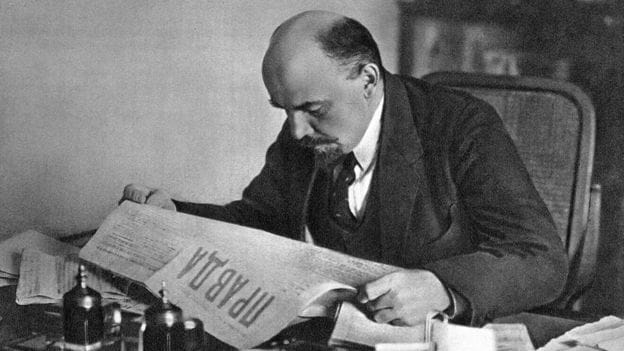
"The role of a newspaper is not limited, however, merely to the spreading of ideas, merely to political education and attracting political allies. A newspaper is not only a collective propagandist and collective agitator, but also a collective organiser. In this respect it can be compared to the scaffolding erected around a building in construction, which marks the contours of the structure, facilitates communication between the builders and permits them to distribute the work and to view the common results achieved by their organised labour. “
- V.I Lenin, Where to Begin (1901)
What is Aontacht? It is (1) a newspaper for working-class news and its associated social media(s), (2) a theory hub which aims to become the new ‘center’ for socialist debate in Ireland, and (3) a WhatsApp group of leftists dissatisfied with the direction of the mainstream socialist parties. It is these parts of the overall machinery which must be taken into account when deciding on the tactical and strategic direction of the paper. It is from this that we must begin our investigation into how to grow the newspaper. I imagine Aontacht to be similar to Gript, but from a left-wing perspective. Gript’s secret recipe is the interaction between carefully-curated news and opinion pieces which clearly push a political line. It is thus a sort of “center” for right-wing politics, around which a multitude of writers and opinions revolve, and which in this way intervenes into cultural hegemony. They are the right-wing Gramscians, and we, in turn, will be the left-wing Gramscians.
Our news section, akin to Gript, will push a political line. There is nothing to hide here: Communists disdain to conceal their views and aims! Our news will be focused on ordinary people as they participate in working-class protests. It is from the micro-political that we will proceed first and foremost. Each individual, through their speech, expresses a certain political point of view; it is this which we will pick up on. Therefore, we should avoid focusing on the leaders of political parties, bureaucratic organisations and so on. There is a gap in the market, so to speak, on elevating the voices of ordinary people, just by themselves, without tying this to an explicitly-named political project. When attending events, it is thus the responsibility of our journalists to find ordinary people to interview. It is worthwhile to look for ordinary people who would strike the right tone to secure engagement from the audience, and express their political worldview from the perspective of their personal standpoint. This affectivity is central to the work of the newspaper, the aesthetics, the attitude and the smaller details which contour the appearance of the subject, who then, through their own storytelling, allows the opening for a political interpretation to seep in, unnoticed. The key is the smooth transition from the personal to the political, without it seeming abrupt or forced. In the past, the focus of the newspaper has been that which would be receptive to a wider audience, simple and straightforward, such as evictions, the fuel protests, workers’ strikes and demonstrations opposed to rent increases. These topics lead into human stories, ones which are difficult to find flaws in. There was a recent example of an interview, which was Alex Homit’s expulsion from Mandate over his criticism of trade union bureaucracy; there was no need to attend the event for this one, but rather, to reach out to him and ask for a comment, in this way this was a fresh take on the original video circulated. It is not our role to re-hash articles in the bourgeois press, to tail them, but rather, to directly intervene in whatever is currently ongoing, elevating the experiences of ordinary people, or alternatively, writing pieces on the events to examine them through an alternative angle. Original content is at the heart of Aontacht. It is also advisable to do “confrontation”-style interventions at specific meetings, such as with Ministers, TDs and leaders of trade unions, in other words, with high-ranking political actors who oppose the project of working class emancipation. These should be done by the journalist and express a political line which is of a commonly-held belief. The prime example of this is the questioning over IPAS profiteering at the Uplift.ie event launch on corporate influence in Ireland; it was not merely a matter of speaking to the academics at the event, but of taking account of the entire political scene, and making exciting what would have been a fairly tiresome re-hashing of facts already known through the bridging of the event with the wider discontent of the working-class over IPAS profiteering. In addition to this, it was mentioned by the journalist that the IPAS system has a detrimental effect on both locals and asylum seekers, thus framing it through a class-based, rather than a right-wing populist, lens. It is through this process that readership is acquired, who are then introduced to the theory-based section of Aontacht.
The readership of the occasional news pieces will also encounter the other section of Aontacht, which is the theory-based articles. These operate on a policy of radical openness, as much as permissible, and with respect to the need for political maturity, that is the avoidance of conspiratorial wording, especially those similar to the Gabriel Rockhill, Grover Furr and Ludo Martin narratives. In turn, this means, that in the place of the now-widespread left-wing approach, that is forcing a set political line down peoples’ throats, through infographics, statements, an enumeration of reasons why a specific idea is wrong, there is a gentle introduction to socialist politics. Through the exchange of multiple perspectives aired out via open debate, polemics and back-and-forth commentary, there is an opportunity, rather than a demand, for people to engage with socialist politics. It is through this process that a mass line emerges. At each step of the way, headlines should indicate tension, critique and openness; those the paper comes into tension with, critiques and scolds should in turn be invited to offer response pieces, in a never-ending series of dialogue. This open-ended process is what culminates into a new “center”, where there can be a circulation of a diversity of thought, while also maintaining its character as a socialist paper. This is a newspaper, yes, of unity, but a unity born out of fighting each other, in a polite, comradely, if at times polemical manner, a unity of covering important events from a human-perspective and working upwards to formulate the theory around it. This means that there is a modulation of real-life processes through theoretical wrapping around them. Note that during the fuel protests, our members made the two, the news section and the theory section, fight each other, on purpose. While we were reporting on the fuel protests, pro- and contra- articles were being published, leading to engagement. The two threads run concurrently, but not always in agreement; it is constantly pitted against each other, sometimes agreeing, sometimes disagreeing, always in flux. This flux is at the center of what Aontacht does. The flux will attract comrades, as well as ordinary people to watch, intervene and engage, and these ordinary people will become comrades, because the flux implies tension; it reveals the non-sectarian nature of our newspaper, of our group, of our ability to debate out in the open, and this is why we grew so fast, and this is why our newspaper is crucial to the Left, because it is introducing a new culture, a democratic culture, a culture of criticism and self-criticism.
Occasionally, when an article or video or such is published, there should be a call made to join the Aontacht WhatsApp group, propelling its growth. The debates may start in the WhatsApp group, but should be taken to the paper itself, so that the contending positions may be elucidated precisely, and a record of them kept; it is also possible to organise in-person discussions in the future. Those who join should not be under the impression that this magazine is free from political influence as such, while it is free from party political influence or that of a dominant political line, it is precisely the Gramscian vague socialist Left center which it is trying to foment. Mostly socialist, but sometimes, Aontacht diverged, one notable example is an article criticising Sinn Féin from a reformist soft-left perspective; this was immediately then followed up by a critique of Sinn Féin from a revolutionary socialist perspective … allow some leeway to drift leftwards and rightwards as understood from the Marxist deviationist axis at times, look at the newspaper in its motion, rather than judging a decision from the standpoint of its correctness in the present. There is, one can say, at a fixed point in time an outrageous article, which is bound to upset people, but there is also, what follows it, which is a correction, and it is this wave which the newspaper continually rides. This is why it is a center, not a sect, in that it lacks a political line which would be applied, which would delineate what is permissible and what is not permissible on every single issue, while also retaining a vague political line, which falls in the general area of socialist politics. What is this a center of? It is a center of gravity which attracts and produces socialist thought. What resembles a center of gravity? A black hole, which chews up events and spits them out, then repeats the process as it flies around in outer space. Unlike a black hole, there are basic, but not overly-stringent, limits applied to Aontacht. New members should understand the nature of this endeavor. It is a semi-orchestrated process of reporting on the best moments of working class politics, which all adds up together, gathering steam; then these moments are interrupted by interventions of a more theoretical nature, which then gets deeper engagement, and sporadically, debates, critiques and polemics break out. There is thus, at the same time as tension within the theory section, an overall politics, which forms an us-versus-them hegemonic bloc, that is pitted against the Other, the ruling class, the government and assorted right-wing forces.
“The political center itself educated for full revolutionary Marxism. At the same time, the party/movement it called for was an all-inclusive socialist party in which the revolutionary Marxist center would constitute one tendency, hopefully eventually dominant. Both sides of the picture conditioned each other: “Before we can unite, and in order that we may unite, we must first of all firmly and definitely draw the lines of demarcation between the various groups [tendencies],” wrote Lenin on launching Iskra. But the lines of demarcation were not to be drawn along sect lines, with organizational walls bounding them: this was the sect course which he did not follow.”
- Hal Draper, Anatomy of a Micro-Sect (1973)
This is the route that we will take; and the route opposite to this one, is the one that we should avoid. This will allow people to figure out the theoretical issues of the Left, while also being active in the working class movement, constantly in contact with it, and so there is a two-way interaction between the two, practice (news reporting) and theory (theory section); conditioning each other, being conditioned by each other, and so on. This openness is reflective of the transgressive nature of Aontacht. Should this paper become widely-read amongst the working class, it will serve as a counter-cultural current, the sum of all its diversity being larger than its parts, like a rising tide which lifts all boats, which can overwhelm the central nervous system of the capitalist press, break the capitalist cultural hegemony, then translate into political capital to secure the consent necessary for a radical break with capitalism towards socialist transformation.
"Don’t give financial assistance to the bourgeois press, which is your adversary. This is what should be our battle cry in this moment that is characterized by the subscription campaigns of all the bourgeois newspapers. Boycott them, boycott them, boycott them!"
- Antonio Gramsci, Newspapers and the Workers (1916)