The PBP-ification of the Irish Left
A recent X post by Wyatt Reed stated that “Ireland is home to some of the most anti-war, pro-Palestine people on the planet” and then listed all the things that the Irish state has been able to do to aid and abet genocide and imperialism, with virtually no real resistance from the very vocal but ineffectual ‘left’ or even the national IPSC. The IPSC for example voted down a number of motions that would have gradually sought an escalation in its work. These motions included presenting support for direct actionists and taking a stronger line on the inactivity of the trade union movement. Instead the predominantly Dublin based delegates doubled down on “lobbying” and organising civil, peaceful and non-disruptive protests. IPSC has split a few times around the country and lost many decent people because of this limited approach to solidarity with Palestine.
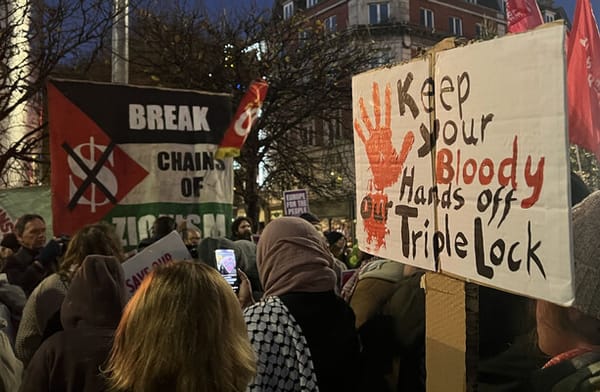
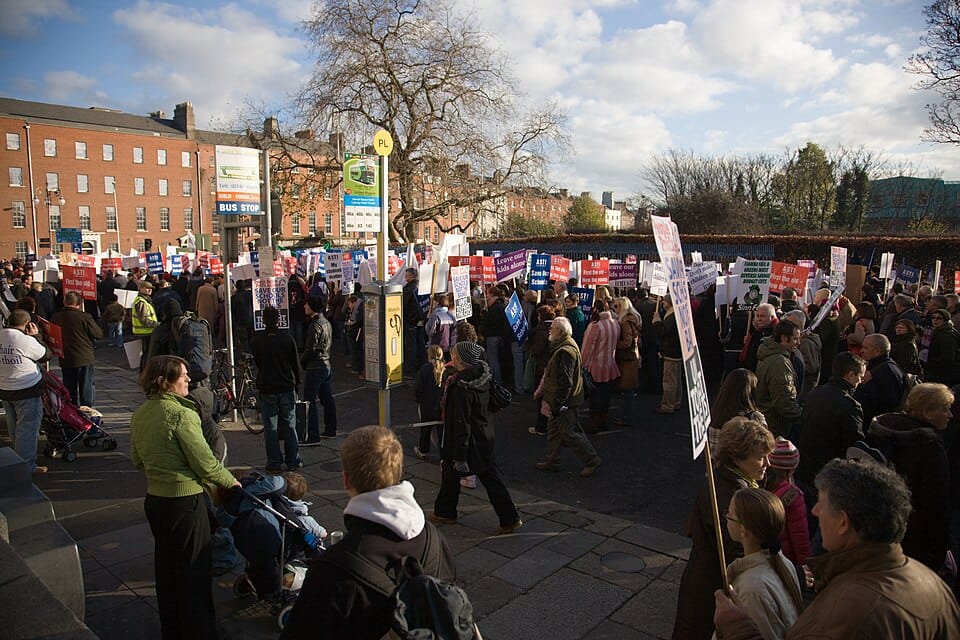
Attend a protest, any protest, and ten different groups will hand you their shitty flyer outlining their sick and boring take on issues A–Z, each one purporting to be more radical than the other. A shopping trolley of organisations ranging across the political spectrum. On the surface, this may appear to be a very positive reflection. People are involved in left-wing politics across the spectrum. In substance, however, the left collectively exercises no leverage to make any of its demands a material reality.
The left hasn’t stopped the erosion and destruction of neutrality. The left has no effective armed campaign against British rule. The left in Ireland cannot organise a strike in solidarity with any campaign because the left and the workers’ movement are not meaningfully integrated in the way they are in other countries.
There are campaigns on the aforementioned A–Z number of issues, and they tend to all have generally the same ‘solutions’ to said campaigns. Demand X, demand Y, call for this, call for that. Regrettably, each political group on the left—republican organisations included—has fallen into the same trap of the death cycle of bullshit protests, stickers and vacuous speeches, all of which would be fine if they worked. Unfortunately, these activities have no leverage to impact change.
What is leverage? Leverage is the collective power people, workers, tenants, etc., have to compel someone to do something. What leverage does the left have? Can any left-wing party stop a city? Shut down an airport through its contacts with the workers in the traffic control tower or the mechanics? No. The left can write articles, hand out flyers and chant outside empty offices, demoralising both themselves and the people we’re purporting to support.
If political groups took a more metric-based approach to their own activity and started to ask why they are doing what they are doing, whether people are getting engaged and whether it is making a difference, then the answers to those questions would override the vague and wordy platitudes circulated by leadership bodies. What is being done is not working or delivering what we want; therefore, it must change.
When the tactics of political organisations do not change despite not working, members need to put serious questions to their own comrades. But they must also ask themselves whether the organisation they’re spending time and money on is actually worth their time and money. After all, every minute and cent we put into something should actually have some sort of meaningful and practical outcome, shouldn’t it?
I call it the ‘PBPification’ of the left because PBP is the largest representative of what is ostensibly a ‘socialist’ organisation, but has effectively doubled down on a death rattle of pointless protests and schools with celebrities instead of organisers.
At this stage, I have resigned myself to the fact that the leadership bodies of most groups are so set in their ways that preserving the identitarian image of their “group”, no matter how small, ineffectual or irrelevant it is at making meaningful long-term change, is more important than the change itself. I would encourage members of every party to ask themselves and their comrades:
- What have we achieved in the last X amount of years, and what do we hope to achieve in the subsequent years? E.g., do we have a plan?
- Did we set out to achieve what we wanted to achieve, and can success or failure be measured?
- Are the tactics we are deploying working to bring about the change in Ireland we want to see or to meet our targets?
- Who benefits from our existence as a group—our class and community, or someone else?
- Is there a level of self-awareness in our group/party about the above, and is it honestly discussed?
These are crucial political questions that have to be asked, and that must be asked, to get out of the collective quagmire we are in. I, for one, believe that many of the answers lie in deep organising and embracing the organising cycle. I do not mean doing so in a superficial way to pad one's political CV by saying that you are “a part of” something, but to truly embrace it in a way that places your political party secondary and bridges the massive disconnect between our class and ‘the left’ through diligent and honest work.
A real party committed to working-class rule must aspire to power. In order to obtain power, it must have leverage. In order to have leverage, it must be rooted, grounded and organised among our class. Not in a bookshop or in a private meeting room ranting about Lenin, where everybody agrees, but among our class and throughout our class, prioritising organising on the basis of materially shared interests with those we disagree with.