Olive Trees In The Gaza Strip During The Israeli War
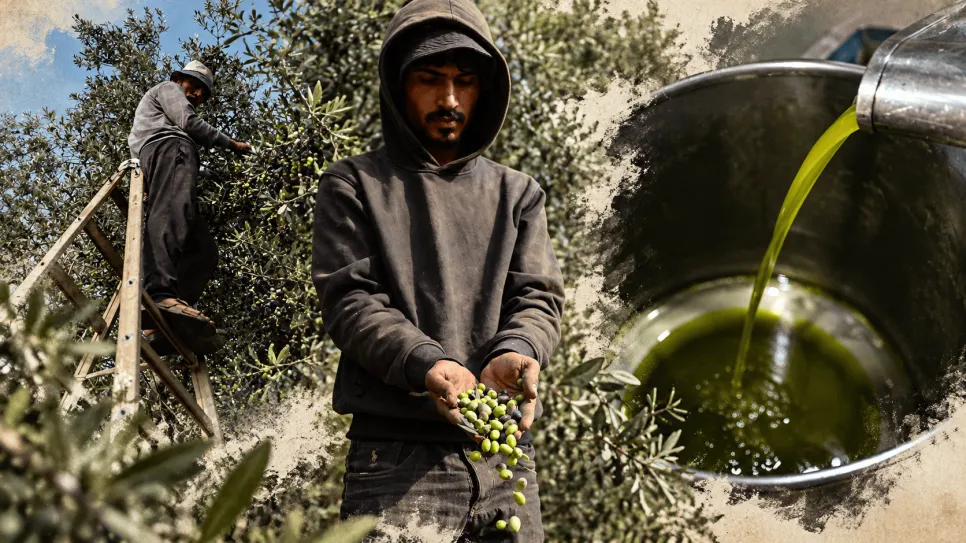
Olive trees (Olea europaea) in the Gaza Strip were never merely a source of fruit and oil. For decades they were a pillar of the agricultural economy, a renewable resource for thousands of families, and an integral part of Palestinian identity and family memory.
Trees Under Bombardment and Bulldozing
Olive trees (Olea europaea) in the Gaza Strip were never merely a source of fruit and oil. For decades they were a pillar of the agricultural economy, a renewable resource for thousands of families, and an integral part of Palestinian identity and family memory. They also helped protect the soil, provided shade and habitat for living creatures, and supported biodiversity on farmland. But the Israeli war of 2023–2026 has inflicted widespread damage on this agricultural heritage, through bombardment, bulldozing, uprooting of trees, damage to farmland and agricultural infrastructure, as well as fires that can kill trees or weaken their ability to recover. It indicates
From Two Million Trees to 150,000
According to a Reuters report published on 14 October 2026, citing Palestinian agricultural estimates, the number of olive trees fell from about two million before the war to roughly 150,000, and fruit production dropped from about 40,000 tons to 5,000 tons, while oil production fell from around 5,000 tons to about 700 tons. Compared directly, these figures mean a loss of about 92.5% of the trees, a drop of about 87.5% in fruit production, and about 86% in oil production.
The loss is not limited to a single season’s harvest. A mature olive tree is a long-term investment, and newly planted trees may need years before they regain a viable level of production. Uprooting the groves therefore means losing an economic and environmental resource that may take many years to replace. These estimates indicate that the losses have affected agricultural assets whose value accumulated over generations, and that rehabilitating the sector requires more than providing seedlings: it requires restoring the land, soil, water and agricultural inputs, as well as safe access to the olive groves.
Bulldozing, Burning and Environmental Degradation
The damage to olive trees takes many forms: uprooting them entirely, bulldozing the land where they grow, destroying trunks and branches, and burning or fire damage. Satellite imagery helps detect changes in vegetation cover, but it cannot by itself establish the circumstances of each incident or who is responsible; that requires field evidence, documented testimonies and dated photographs.
The effects go beyond lost production. Removing tree cover may increase soil erosion and degradation, and lead to the loss of bird and insect habitats and other living creatures. Heavy machinery passing through can also alter soil structure, hindering the restoration of its productive capacity. Destroying olive groves is thus an environmental loss as well as an agricultural one, and it ties recovery to the rehabilitation of soil, vegetation cover and biodiversity.
Olive Mills, Farmers and Markets
The olive production chain has not been spared the effects of the Israeli war. In October 2026, a Reuters report stated that only seven olive mills were operating, out of about 40 before the war. These figures reflect a decline in the capacity to press and market the harvest, which affects farmers, workers, traders and consumers.
A farmer who loses his trees loses his source of income; a mill owner faces a shortage of fruit and reduced operations; and a household as a consumer faces rising oil prices and difficulty obtaining it. Higher prices do not necessarily mean better conditions for farmers: someone who has lost most of his grove has no harvest large enough to offset his losses. Thus the damage to the trees turns into an intertwined economic crisis encompassing production, employment, income and food security.
Olive Trees and Palestinian Memory
The olive tree carries a value beyond its fruit and oil. It is tied to household provisions, family labor and inherited memory. In many families, ancient olive trees are a legacy passed from grandparents to children, and a witness to the continuing bond with the land. When these trees are uprooted, not only is an economic resource lost; an agricultural and cultural heritage that is hard to replace quickly is damaged too. Planting a new seedling does not immediately restore the value, productivity or ecological role of an ancient tree.
Hence, documenting the destroyed groves, their locations and the number of trees, wherever possible, is necessary for preserving agricultural memory, estimating losses, and setting priorities for compensation and rehabilitation.
How Can the Olive Groves Be Restored?
Restoring olive groves requires an integrated scientific plan. It begins with a survey of the damage using satellite imagery, agricultural records and field surveys, followed by an assessment of the surviving trees and their capacity to recover, and the replanting of land that has lost its trees. The plan must include soil rehabilitation; providing suitable seedlings, water and fertilizers; financial and technical support for farmers; repairing damaged mills and facilities; and providing energy and spare parts. Enabling farmers to reach their land safely is also an essential condition for resuming agricultural activity.
International and local estimates confirm that agricultural damage in the Gaza Strip is broader than the olive sector alone. The rehabilitation of olive groves should therefore be integrated into a wider program to restore agricultural production and natural resources.
Saving the Tree Means Saving the Land and the People
The losses of olive trees in the Gaza Strip during the Israeli war of 2023–2026 reveal a catastrophe that goes beyond reduced fruit and oil production, encompassing the destruction of agricultural resources, environmental degradation, the loss of families’ livelihoods, and damage to a Palestinian heritage passed down through generations.
Ancient trees cannot be replaced simply by planting new seedlings. Recovery requires protecting what remains, rehabilitating land and soil, supporting farmers, and restoring agricultural infrastructure. Saving the olive tree is not merely restoring an agricultural crop; it is an investment in environmental sustainability, the preservation of Palestinian agricultural identity, and the restoration of hope to the land and its people in the Gaza Strip.