“It’s Hard To See How She Survives This”: Shinners Turn on Mary Lou
Sinn Féin members are expressing increasing discontent with the leadership of Mary Lou McDonald after poor results in the Dublin Central and Galway West by-elections.

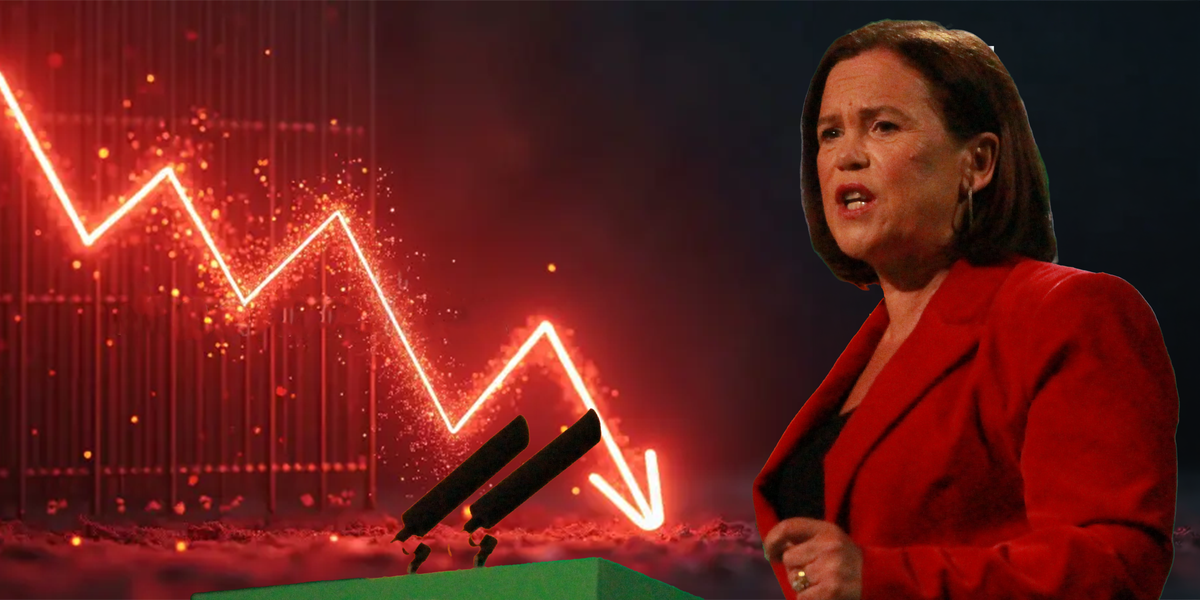
Sinn Féin members are expressing increasing discontent with the leadership of Mary Lou McDonald after poor results in the Dublin Central and Galway West by-elections, with several members who spoke to Aontacht Media saying that they do not see a path for her to lead the party into next year’s Assembly Elections in the six counties.
While the counts are only at the tally stage, there is no realistic possibility for Sinn Féin to take either seat. In Dublin Central, Sinn Féin candidate Janice Boylan came in behind the Social Democrats’ Daniel Ennis, who is likely to benefit heavily from transfers from Labour and Green Party voters.
In Galway West, meanwhile, Sinn Féin’s Mark Lohan received only 6.1% (1,918) of the first preference vote, failing to pick up over 6,000 of incumbent Sinn Féin TD Mairead Farrell’s 2024 first preferences. The seat, in which there was significant talk of a ‘Left Unity’ pact, following the election of Catherine Connolly to the Áras, is likely to be taken by Independent Ireland’s Noel Thomas or Fine Gael’s Sean Kyne.
This follows poor showings in the 2024 Local Elections - where Sinn Féin dropped to 11.8% of first preference votes from 24.5% in 2019 - and the 2024 General Election, where Sinn Féin’s popular vote dropped by 5.9% against 2020, and even more against polling taken between the two elections, which regularly saw Sinn Féin approach 40%.
Speaking to Aontacht Media on the condition of anonymity, one Sinn Féin TD said, “The messaging is a mess. Some of us never stopped saying the right things. We’ve tried to tell her.”
Another long-term Sinn Féin member said, “All we do now is react – and normally far too late. She has no vision.”
Janice Boylan was selected as Sinn Féin’s Dublin Central candidate over Mary Lou’s preferred candidate, scoliosis campaigner Gillian Sherratt, in what many members viewed as a rebellion of the leader’s home cumann (local branch) against her authority. This has led to anger nationally, with one well-placed Sinn Féin member telling Aontacht Media “Janice Boylan has once again proven herself unelectable as a TD and should never run again.”
The contrast of Mary Lou’s electoral fortunes with those of the party in the six counties, where Michelle O’Neill became the first nationalist First Minister in 2022 is also a source of significant tensions within the party.
A long-term member of the party apparatus in the six counties said, “We are stale. We need to seriously change direction internally before we can begin to convince people we can change the direction of the country.”
Other members in the north feel that the party has lost touch with it’s working class base, saying, “The Trinity boys and liberal lefties that staff the corridors of Leinster House have been a significant part of our undoing…[That they’re] more concerned about the font of an Irish language text—in a party that has done more to advance it than any other—rather than meeting the needs and concerns of forgotten communities is deeply unhelpful. Being a good boy on Twitter doesn’t win elections or make change.”
These tensions bubbled over at an ill-disciplined Ard Fheis in Belfast last month, where debates over contentious issues such as fox hunting and Trans rights were argued with little deference to the wishes of Mary Lou’s leadership.
On the podium, several delegates blasted both her and the party’s ruling Ard Comhairle for overriding the wishes of members established at a specially convened conference on gender rights.
A ban on fox hunting, meanwhile, was passed by the membership, but not before someone set off the venue’s fire alarm to disrupt proceedings.
Mary Lou was elected Sinn Féin leader unopposed following the retirement of Gerry Adams in February 2018. At the time, there was a widespread belief that a more ‘acceptable’, middle-class leader from the twenty-six counties would lead to rapid electoral gains.
Her actual performance turned out to be mixed, with a strong showing in the 2020 General Election forcing Fianna Fáil and Fine Gael to merge their century old duopoly, but still stopping some way short of delivering left-of-centre-led government.