A Marxist Analysis of Ireland's Fuel Prices Protest
A comprehensive Marxist analysis of the Irish movement against fuel prices, uncovering its class basis, political ideology, organizational methodology and world-economic origins, travelling from the base to the superstructure, the determined and contingent elements which make up its totality.
László Molnárfi
As the U.S pushes ahead with its imperialist war of aggression against Iran in order to counter-balance the tendency of the falling rate of profit, fuel prices skyrocket, threatening to destabilize the world economy. The shock spreads across the globe. In Ireland, diesel and petrol prices surge to €1.90 and €1.81 per liter respectively as of March 2026. In response, there is mass discontent amongst certain layers of the population, especially rural areas where public transport provisions are weak or non-existent, propelling them into action. The economic dialectic asserts itself, but not as a deterministic mechanism, rather as a force which allows people to ease into mobilization, suited to the specific milieu of their social existence. What are the main characteristics of class struggle over fuel prices in Ireland?
It is, at first, drivers and small business owners in the land-based transportation industry who stand at the frontlines of this economic shock. This is because the rise of fuel prices has a disproportionate impact on their livelihoods and profit margins. This is because fuel is a key input to their business operations, and there is a high dependency on it; in turn, larger firms to whom they contract refuse to accept the passing of costs. At the same time, they fulfil an indispensable role in the circulation of goods, from the factory to the supermarket, from the farm to the butcher’s, from the port to the city. Without them, no product can be valorized on the market. They also circulate people. Thus, they also have the leverage required to be able to grind the economy to a halt[1].
The small business owners, the petty bourgeois, are at risk of being proletarianized, and hence, sides with the working class, with whom it now shares a common interest in the current conjuncture; at the same time, these very same small business owners are also the hauliers, truckers, bus and taxi and professional drivers, construction and heavy-machinery, towing and recovery operators, whose positionality is nearing that of the working class. They employ the owner-operator model, thus are oftentimes in bogus self-employment, and despite in appearance operating their own businesses, are in servitude to large corporations, long hours and increasing expenses. It is also the case that they often own their vehicles only on lease and are thus indebted, making their situation economically precarious. The lines become blurry here between the small business owner and the working class; they are at threshold, at the in-between.
They are joined by farmers. At the outset, their interests, regardless of whether they be small or large farmers, align, because if transportation grinds to a halt, their livelihoods are affected. They too, nominally petty bourgeois, have undergone a process of proletarianization in recent decades, as far as small farmers are concerned. They could be technically enterprises, while functionally living in poverty, and therefore closer to the positionality of the working class. Rural poverty is high. Large farmers remain petty bourgeois, but they too, feel the pressure. In addition, those farmers who own small businesses outside of the farm, that is to say, are agricultural contractors, suddenly find themselves spending exorbitant amounts of funds for fueling their machinery, and the transport of that machinery. Farmers regardless of size who use the agricultural contractors, in turn, would also be paying more as costs are offset onto them.
When looking at more “pure” cases of colliding interests between classes, small business owners outside the transportation and agricultural sectors - who still depend on transport in some capacity - will also be squeezed by rising fuel prices in their business operations, and so are likely to support these protests, in tandem with members of the working class, especially those commuting from rural to urban areas to work, as it is in their immediate interests.
It is them who ring the alarm bells, and through social media, call for action. Who follows this campaign on Facebook? Behold, Mc Gettigan Travel Ltd, Kenna Transport, TheTowTruck.ie, T.1.T Towing & Recovery, DCI Ltd Trailers, and so on and so forth from the transportation industry; Duggan Agri Contractors, Mc Mullan Plant Hire, Irwin Agri Ltd and so on and so forth from the agricultural sphere; and to pick an example from neither of these industries, and reflecting a purer small business owner interest, Murphy’s Cleaning and Gardening Services, while to ascertain working class support, one needs to look no further than comments left on social media pages.
We are a group of Professional Drivers, Hauliers, Farmers, Bus Operators,Taxis & Plant Operators. We want to change the Fuel Taxes & Charges for Everyone In Ireland.We need your support!
- The People Of Ireland Against Fuel Prices Protest (henceforth shall be abbreviated as TPOIAGFPP)[2]
It is also worth noting that increased fuel expenses on contractors will affect food prices down the line in two years, when the calves and lambs born this year will be slaughtered and the increased prices of their rearing reach consumers due to the higher costs of stored grains. The cost of transport will affect everything society eats and uses. It will significantly worsen the cost of living crisis even to those who do not own a vehicle at all.
The level of messages we are getting every single day from people all over Ireland is honestly heartbreaking.
We now have 47,000 followers, and the stories coming in are deeply upsetting. Families are struggling to heat their homes, workers are wondering how they will get to work, and parents are worried about how they will even get their children to school next week.
Home heating oil has more than doubled. Diesel has risen massively. Green diesel has gone through the roof as well. At all the meetings we have held lately, one thing is very clear — people are at their absolute wit’s end.
This is no longer sustainable for ordinary families, small businesses, hauliers, farmers, fishermen, bus operators, recovery drivers, and every sector that depends on fuel just to survive.
The government is taking between 50% and 65% of every litre in tax and charges. So when someone puts 10 euros worth of diesel into their vehicle, up to 6.50 of that is going straight back in tax. That simply cannot continue.
We are now hearing from bus operators that services may not even run next week. Big companies are already telling drivers to stay at home because they cannot afford to fuel the trucks. Families are being pushed closer and closer to the edge.
This country is sinking, and sinking fast.
We have tried meetings, we have raised the issues, and we have given every chance for action. But enough is enough.
It is time for real help, real support, and real change.
The time to act is now.[3]
- The People Of Ireland Against Fuel Prices Protest (henceforth shall be abbreviated as TPOIAGFPP)
The risk of proletarianization for the small business owner, the risk of further impoverishment for the worker, a downwards turn in the economy, creates a frenzy to cling on to one’s position; it is class collaboration which defines this social movement. It is the working class in alliance with the left-wing of the petty bourgeoisie, but this alliance, really, has collapsed into a singular class interest as, due to the obfuscatory nature of the employment involved, it is hardly possible to distinguish between them in the cases of the transportation and agricultural sector; outside these sectors, the class collaboration is clearer. There is the abstract categorical schema of class analysis, and then how it actually exists, endowed with all the nuances of the historical context, and this will be the co-interaction between the base and the superstructure.
Men make their own history, but they do not make it as they please; they do not make it under self-selected circumstances, but under circumstances existing already, given and transmitted from the past[4].
As the economic dialectic asserts itself, it is violent, and so people begin talking, and prices keep surging, and people keep talking, and then it spills over into social media, and it is then through social media where it is molded with an organisational shape, and so TPOIAGFPP is re-activated on March 5th 2026. The coinciding interests of a diversity of actors are thus made visible after a series of discourses, and it is from here that there is an over-determination into a protest movement, which expresses class struggle through a nebulous, populist rhetoric, the dichotomy of the people versus the elites, akin to the yellow vests protests. There is criticism of the European Union, and the loss of sovereignty it incurs for Ireland; however, this is coupled with only an aside recognizing ‘global conflict’, showing that it is far from a class-conscious anti-imperialist understanding which would connect the price shock to the root cause, the imperialist war of aggression against Iran by the U.S, at the behest of Israel. They rally around a few simple demands, which, they say, will benefit the whole of Ireland, and it is this shared narrative that holds together disparate social forces, the utmost expression of this being TPOIAGFPP. This makes it pluralistic[5]. Left- and right-wing political actors operate on this terrain, from the National Party[6], to Elaine Mullally[7], Independent Ireland[8], Aontú[9], the Social Democrats[10][11] and Sinn Féin[12][13], vying for dominance over leadership[14], or rather, trying to seize as much territory as possible, some more implicitly and some more explicitly, as leadership is for now firmly in the hands of organic activists; but the organic activists themselves are in conflict with each other.
"[...] as long as ALL Traders, ALL Truckers, ALL Taxis, and Buses.....ALL Farmers and Farm hands are welcome. The IRELAND FIRST WANABES are tryna claim it..... But its not about Colour or Creed..... Its about BUSINESS' AFFORDING TO STAY OPEN. Its about Familys being able to afford travel. EVERYONE IS GETTIN' SHAFTED BY 60% TAX.. AND THATS IT."[15]
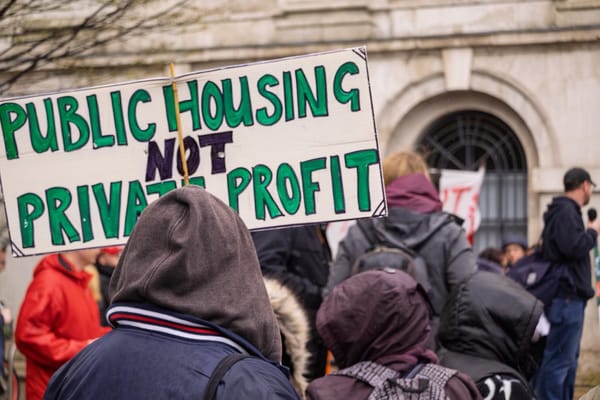
Foolishly, the socialist republican 161crew, declares pre-emptively what it is destined to be, calling it “far-right”[16]. Similarly, People Before Profit and Solidarity are nowhere to be found, terrified of this impure movement; in the abstract, they oppose the rising cost-of-living, but in the concrete, they cower. Paradoxically, despite their supposed socialist ideology, they are the meekest in expressing any sort of opinion on the mass stirrings. They cede it to the Right, rather than intervening in it for the benefit of the Left.
"To imagine that social revolution is conceivable [..] without revolutionary outbursts by a section of the petty bourgeoisie with all its prejudices, without a movement of the politically non-conscious proletarian and semi-proletarian masses against oppression by the landowners, the church, and the monarchy, against national oppression, etc.-to imagine all this is to repudiate social revolution."[17]
The movement thus is a radically open, contested terrain, in the political sense. Will they protest, or will the State cede to its demands, these being to abolish carbon tax on fuel, cap fuel at a realistic and affordable price and immediate government intervention to protect jobs, transport, farming, and essential services? There are contingent elements which come into play, the failure of the Government to reach a negotiated settlement with the disaffected layers as was announced on the 4th of April 2026, the Irish Road Haulage Association’s (IRHA) refusal to organize protests and the pre-existing political actors on the Left and the Right in Ireland. A sense of rebelliousness takes hold. The movement refuses capture. If the dissenting energy cannot be channeled through the official mechanisms of the State, it will burst open in circumvention of it. Owing to the sheer scale of mass fervor, TPOIAGFPP chooses to decentralize the organisation of direct action to WhatsApp leading to mushrooming chatroom as shown by Figure 1; in turn, the propagation of the message is also decentralized through social media, TikTok, Instagram and Facebook livestreams appear[18]; and thus, so is leadership decentralized in an ad-hoc manner across platforms. This stands apart from the despotic signifying regimes of political organisations, which often seek to assert themselves over mass activity. As such, the movement becomes radically open in organisational terms, too.
Figure 1
|
WhatsApp Organising Groupchat |
Number of People |
|
Waterford |
83 |
|
M7 monasterevin junction
14 heading to Dublin |
207 |
|
East Midlands, N4 Kinnegad |
405 |
|
Feeder Group from M1 to Dublin |
133
|
|
Mayo-Castlebar |
95 |
|
390 |
|
|
Gorey Area |
1,023 |
|
Sligo-Donegal, North West |
398 |
So, what chooses the tactical and strategical direction of civic disobedience? The tendency of the rate of profit to fall is determinate on the U.S’s actions in Iran, which is determinate on Irish fuel prices, which is determinate on the stirrings of a cross-class alliance between workers and small business owners, which is determinate on the political logic employed, populism, and then, it is infused with the aforementioned contingent elements, paving the way for political and organisational openness, which then allows for the tactical and strategic direction of civic disobedience to be its emergent property, as the mass line is reached through discursive iteration, scaffolded by their class interests, and the resources at their disposal, the trucks, tractors and buses, and so on and so forth, and, therewith, they make their way from rural areas towards Dublin en-masse with the vision of blocking the roads and hindering the circulation of Capital.
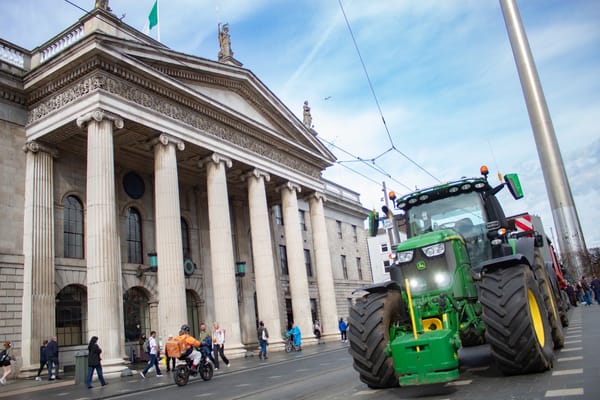
At the protest, on Tuesday the 7th of April 2026, bus coaches, trucks and tractors line up at O'Connell Street, the designated carpark. It is estimated that around 500 - 1,000 took part. Hundreds of vehicles block various parts of the city, the port, the centrum and Leinster House. A workers’ inquiry conducted on site by left-wing activists returned the following sentiments, as seen on Figure 2, and only 1 of the 11 participants expressed (soft) anti-immigration sentiment.
Figure 2
|
Occupation |
Sentiment |
|
Farmer |
“And we can't afford to keep going the way we are. Every day one
tractor could be extra 220 euros per day. And if you have a lot of tractors,
that's a lot of money. The bus companies are the same. They've contracts with
the government. Sign contracts and they can't do it. Everyone is just at
their wits end and the government is doing nothing. Take off the carbon tax
and take off all the other VAT and that would be a big help. But they won't
even talk. So hopefully something will happen after today.” |
|
Agricultural contractor |
“Because the price of fuel is basically closing our business down
and the government is giving us no help. So we're asking the government to
cap the fuel price to keep us working, keep the building business open. The
house building sector has just collapsed and when the house building
collapses we have a major recession and a major recession not good for the
country and the government can't see it coming. We all can see it coming
because we're all self employed people so we feel the pain first and we're
just trying to wake up the government to stop robbing us of the fuel. And if
they have to cap fuel, they're going to have to cap them and keep us in
business. Keep the economy open, keep the house building, keep the
agricultural sector open because it's closing down and closing down rapidly.
There's men not going back to work next week in the buildings. There's
agriculture contracts, and I can't afford to buy these and do work on farms.
So it's so serious the government just literally has to wake up. We're doing
it for everybody. It's not just for us. Everybody who buys fuel, everybody
who has a car...” |
|
Lorry driver |
“Well, it affects us probably more seriously than anything we've
seen in the past. It's actually affecting us to the point that we will be
gone out of business. Like you can't add 50% to your, your fuel cost and
effect and carry on as normal. It's just. Isn't possible. And I just want to
clarify, we left Navin this morning. Coming up here, it's not just farmers,
contractors and truckers. We have buses, taxis and families with us. Families
just in cars came with us because they can't afford to heat the homes or put
fuel in the cars. So, like it's, it's across the board, so it is.” ““Oh, no, they haven't cared about ordinary people in Ireland for
a hell of a long time. No, absolutely not. They're actually more
concerned about people that don't live in Ireland or people who only, who
only arrive here. Ireland has always been a welcoming place, always
been a charitable country. But we can't let our own businesses fail, we can't
let our own businesses fail because the businesses, the farmers, the bus
companies, everyone else are the people paying the tax, paying the wages.” |
|
Trucker |
“We're just watching everything that's going on here. And we're
up from the southeast of Ireland, mostly around the Gory in the Wexford area.
We were all concerned that we had to show our faces. We're sort of taking the
day off, some people say. So we're wasting fuel. We're driving around. Are we
wasting fuel? If we can highlight something to the government, I don't mind
putting an extra drop of diesel in my lorry, she does, in old money terms,
six or seven miles to the gallon on a typical day of hard work. Not that it
works hard every day, but if it was working hard, that's an extra cost of
about €200 to me. So putting a bay fuel in the truck today to come up here
and show our support for everybody in Ireland. And we're doing this for
everybody in Ireland. We're not doing just for truckers. We're here for
farmers. We're here for the housewife. We're here for everybody and the. The
price. And if you'll just can't be soaked up by the ordinary man and woman or
business here at the moment, it's too much. A lot of people are. Have set
contracts.”” |
|
Farmer |
“I'm a farmer from Carlow and I'm up here to support
the farmers today. So supposed to be a good turnout, some. Most of the
turnout is coming down the road now.” “Fuel prices, whether it be transport, farming or even. You're at
your home heating oil in. In Ireland due to the war, the prices have just
surged massively and something has to be done. Just the cost of living is
unacceptable at the minute, really, to be honest. Just any help from the
government at all, to help us get through this tough time would be great.” |
|
Farmer |
“Something has to change.
Something has to change. Can't really go on the way it's going either.” |
|
Agricultural contractor |
““I'm working for an agri contractor in Carlow as well, and we do
a bit of building at home and it's just this building nearly has to stop now
with the price of everything and just something has to change. You can't go
on the way it's going on anyway, so something has to change.”” |
|
Agricultural contractor |
““I'm a farmer contractor from County
Kildare. The protest today is calling on the government to save the economy
because we're in a diesel crisis and coming from a farming background, the
government gave us three cents. It was an insult to the farm and the
contractors and 4% of that goes back to them in Vash anyway. And the haulers
at the IRHA, they got something around 20 cents as well. But like, I mean,
it's an insult to the haulage companies around the country that employ a lot
of people that need, need to be able to stay going. And with the diesel
crisis that's happening and the diesel is rising on a daily basis and nobody
knows where it's going to finish up. And we are calling on the government to
save the economy because the diesel needs to be capped, the green diesel
needs to be capped, the white diesel needs to be capped, petrol and so on,
and the excise duty needs to be taken off and the carbon tax needs to be
taken off in the interim anyway, if not at all abolished. So that's basically
it. And I mean, the government needs to sit down urgently and deal with the
matter because if, if they don't, the country is going to stop running
because businesses.”” |
|
Agricultural contractor and machinery sales |
““We basically have no choice. And I know we're agricultural
based, we're getting badly hit with the fuel cost. But the whole industry,
the building industry, we're involved in plant hire as well, the economy is
going to crash unless the government takes action and they're going to have
to retire, reduce the price of fuel and put a cap on the price. Otherwise the
building industry is closing down this week and next week. People can't
afford to run buses, we can't afford to run tractors. My diesel bill in my
business has gone up €70,000 this year. I can't afford €70,000 extra to
produce food and we just, we just run out of business. It's as simple as
that. And the government isn't listening. So what we're trying to do is
educate the government to reduce the fuel to save the economy and keep people
in business and keep the general public with money in their pocket because
this is causing major inflation. And when you take money out of the economy,
it leaves no money to go around the economy. And when money stops going
around the economy, you're into a major recession. So the government can
solve the problem, they can sort this out if they want.”” |
|
Agricultural contractor |
“We're just here representing farmers and contractors in our area
and all across the country because we're being decimated by the price of fuel
and the government's doing nothing to help the contractor or the farmers just
seem to look after whoever's inside the M50 circle. And anything outside the
M50 circle is forgotten about because when they go into the doll, they don't
want to know anything else.” |
|
Truck driver |
“So we might have upset some people today. But think of the bigger
picture. How much is your home heating oil now? And do you think the fellas
in the big houses cared about you when the heating goes off? They won't.
They'd be in sunny Spain. So unless we all stand together like the last time,
we got 20 cents off the last time. Let's go again. But just remember, it's
the government that is taking the money, not us. Over 60% is going back to
the government. So they're really rubbing their hands. They'll do all the
platitudes and they'll be out on the media. Given all the interviews. This is
terrible. This is terrible. But they have the power. They have the power in
their hands to do this and fix this right now.” |
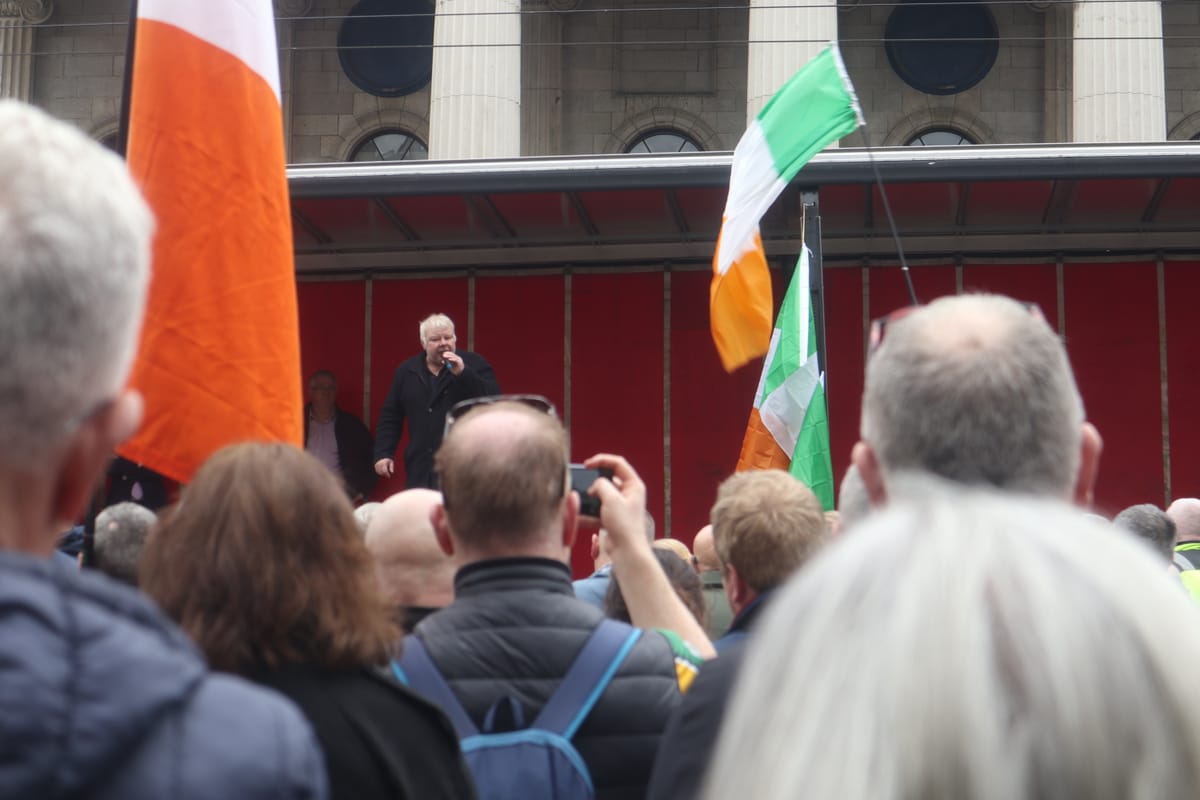
However, the Right is trying to assert itself. There are no politicians present at the start of the protest, around 11am, except anti-immigration Cllr. Gavin Pepper, who seems well acquainted with members of the protest, especially those from Dublin, and is networking around the scene in a friendly manner. At about 1pm, his radical flank, the usual far-right agitators arrive on scene, led by Philip Dwyer and his bicycle gang crew, who begin conducting interviews with the protestors, who in turn see no issue with this, and oblige. Malachy Steenson is also seen passing through the crowd. A series of confrontations ensue between the few left-wing activists and a larger faction of far-right agitators led by Dwyer, namely on Zionism (this, in fact, is a topic of discussion within his nationalist-populist circles too), racialist policies and class struggle; it is all livestreamed and recorded. The protestors have a mixed reaction to this. One of them expresses concerns that Gript.ie “twists whatever we say into their mode of thinking”, while yet another supports Pepper, and yet a third confronts Dwyer’s on his racism on the livestream. This reveals that the political terrain is contested between the Left and the Right; here the carving of the territory is played out in real time, a struggle for cultural hegemony. It is disappointing that the Left is severely underrepresented, not just at the protest itself, but throughout the entire campaign, seemingly having no inroads to rural workers, and this is a contingent element, which then allows the Right the possibility to have a determinant effect on the direction of the social movement. In fact, it is the Right who has been most vocal in supporting these protests, undertaking ground-work to attend local planning meetings, entrenching themselves in every constituency. When, at about 4pm, speeches begin, held from a red truck with one of its sides opened, Independent Ireland, Aontú and Sinn Féin are represented as political parties. Pepper is also a speaker. As Sinn Féin speaks, one of the protestors turns to me and tells me that they are traitors. This is an opinion held by a sizable faction of the protestors. Suddenly, the people shout, “Traitors!”, “Get off stage!”, “Boo!”, which, in light of the situation, is both an inorganic insertion and an organic belief held by those swayed by far-right agitators. This, without a doubt, is gravely concerning, and it is plausible that far-right elements will wrestle control of this protest movement.
Spontaneous self-organisation of the classes, an instinctual, semi-conscious reaction to a crisis, is apparent here. It is, as an aside, noteworthy to mention that the water charges movement started out similarly, before they were captured by People Before Profit and Solidarity, who bombarded them with party directives and campaign dictators. The authentic Communist vanguard accepts this self-organisation as the source of the proletariat's self-liberation, and builds structures which lead rather than ones that smother.
[1] As an aside, interruptions in the supply-chain are dangerous to Capital, and apart from the transportation sector, we may add dockworkers as one of the most threatening social bases here; it was in Italy that a strike was undertaken precisely at the ports, leading to the State to change its tune on Palestine.
[2] The People Of Ireland Against Fuel Prices Protest. “The People of Ireland against Fuel Prices Protest | Dublin.” Facebook.com, 2026. https://www.facebook.com/IrishFuelProtest/.
[3] Personal communication.
[4] Marx, Karl. “18th Brumaire of Louis Bonaparte. Karl Marx 1852.” Marxists.org, 1852. https://www.marxists.org/archive/marx/works/1852/18th-brumaire/ch01.htm.
[5] This emphasizes that populism is a political logic, rather than an ideology, as argued by Laclau and Mouffee; it also has similarities to Peter Camejo’s idea of independent mass action.
[6] Redmond, Stephen. “I’m Fairly Certain That the Convoy Protesters Today Believe That Ireland Belongs to Irish 🇮🇪.” X (formerly Twitter), 2026. https://x.com/SteRedmondNP/status/2041478671546937736.
[7] Mullally, Elaine. “‘The Irish Government Don’t Want to Help the People of Ireland.’” Instagram, 2026. https://www.instagram.com/reels/DWw1QQfkmhe/.
[8] Independent Ireland. “INDEPENDENT IRELAND STATEMENT.” Facebook.com, 2026. https://www.facebook.com/photo?fbid=122279257922028834&set=a.122135116010028834.
[9] SnDMedia. “Dawn of Disruption: Nationwide Fuel Protest Convoy Set to Paralyse Dublin Traffic in ‘Peaceful but Massive Demonstration.’” X (formerly Twitter), 2026. https://x.com/SnDMediaNews/status/2041228862148026461.
[10] News, RTÉ. “‘Outrageous’ Fuel Price Rises across Country, Dáil Told.” RTE.ie, March 5, 2026. urn:epic:1561760.
[11] Social Democrats Cllr. Chris Pender has also been active in supporting this campaign, as was revealed in personal communication.
[12]Doherty, Pearse. “Time to Recall the Dáil .” Facebook.com, 2026. https://www.facebook.com/reel/26250123441322893.
[13] Masterson, Danielle Russell. “Fresh Calls for ‘Further Supports’ over ‘Surging Fuel Prices’ as Tuesday Protest Action to Cause Travel Chaos Nationwide.” The Irish Sun, April 6, 2026. https://www.thesun.ie/news/16785375/fuel-price-protest-travel-simon-harris-iran/.
[14] Brennan, Cianan. “Motorists Warned to Brace for Traffic Chaos as Hauliers Distance Themselves from Protest.” Irish Examiner, April 6, 2026. https://www.irishexaminer.com/news/arid-41823083.html.
[15] Byebye Corrupt TDs, a left-wing individual involved in this mass movement, and this comment was posted on Facebook publicly on April 5th 2026.
[16] 161crew. “This Protest Is a Far Right Protest.” Facebook.com, 2026. https://www.facebook.com/photo.php?fbid=1386650240143279&set=a.460792766062369&type=3&comment_id=26344770458541570.
[17] Lenin, Vladimir. “V.I. Lenin: From the Archives – Lenin on 1916 (1916).” Marxists.org, 2021. https://www.marxists.org/history/etol/newspape/irishmr/vol04/no14/lenin.html.
[18] For instance, on 06.05.2026, Murphy’s Cleaning and Gardening Services from Cork, a small business owner, held a meeting online with 115 viewers, ahead of the direct action. They said that they cannot afford to work.