Wine-Bar Imperialism: How The Colonial Gaze Still Frames Ireland
In the minds of the political classes in Westminster and Brussels, however, Ireland remains something lesser: a post-colonial backwater whose people are expected to know their place.
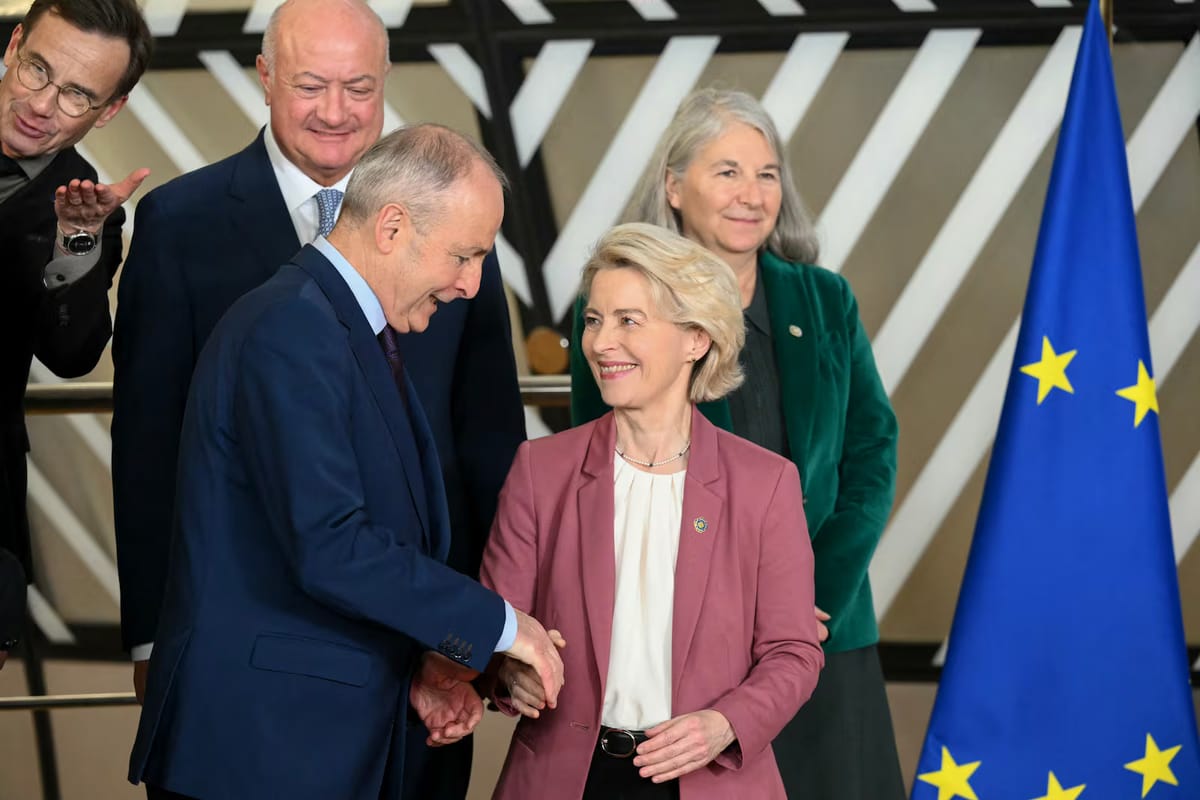
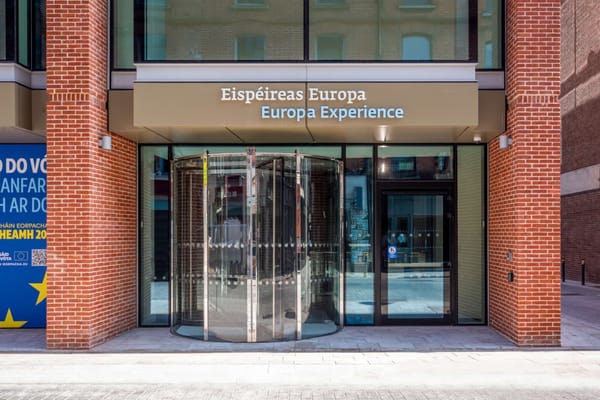
The state and its government has been engaged in extensive diplomacy in 2026. Recently, we saw UK Prime Minister Andy Burnham, ever the chameleon - enjoying a well-choreographed pint with Micheál Martin at the Brian Boru Irish Club, based near Manchester. Also this year, the state obtained its rotational share of the Presidency of the Council of the European Union. In a primarily symbolic role, it chaired key meetings, played a role in facilitating the next long-term budget, and managed the fraught post-Brexit relationship with the UK. On paper, this is the role of a highly influential, EU member-state. In the minds of the political classes in Westminster and Brussels, however, Ireland remains something lesser: a post-colonial backwater whose people are expected to know their place. The old imperial hierarchy has been politely updated, but the sneer of superiority hasn’t disappeared.
British elite attitudes have long treated the Irish as a people requiring management, rather than equals. Nineteenth-century statesmen such as Benjamin Disraeli famously described the Irish as “wild, reckless, indolent, uncertain and superstitious,” possessing “no sympathy with the English character.” That colonial taxonomy never vanished. In the 1970s, Home Secretary Reginald Maudling, after a visit during the Troubles, asked his staff for a large Scotch with the immortal line: “What a bloody awful country.” The contempt was casual, automatic, and revealing. Ireland wasn’t a neighbouring equal - it was instead an inconvenience that offended the refined sensibilities of the imperial centre. Writing in ‘Labour in Irish History,’ James Connolly decried how contemptuous attitudes of Ireland in Britain had lowered the Irish “in the eyes of the world." Later, Constance Markievicz (who outlined in a parliamentary debate as an Anti-Treaty deputy her belief in “James Connolly's ideal of a Workers' Republic”) would critique the training of Irish boys to appreciate the supposed superiority of the Empire, and instilling “forgetfulness of their country’s and class’ needs.” She believed that they would be “used either to batten their own class into submission into a class war at home, or giving their lives in an Imperial war made to hold Ireland as a slave state within the British Empire, fighting always the battles of the international financier…”
The same superior tone reappeared during Brexit. Boris Johnson reduced the Éire-NI border, a site of decades of conflict, to the congestion-charge boundary between the London boroughs of Camden and Westminster. During a Conservative leadership campaign, the subsequent Chancellor for the Exchequer, Sajid Javid, dismissively referred to Ireland as “the tail that wags the dog.” The implication was unmistakable: a smaller, supposedly less significant country was presuming to constrain the will of its former masters. The main British papers blasted Ireland during this period. For example, ‘Daily Mail’ columnist Richard Littlejohn asserted that Westminster had reminded the Taoiseach “on which side of his bread he'll find the Kerrygold." Clearly oblivious to historical sensitivities, Priti Patel remarked that Britain should raise the issue of food shortages in Ireland over Brexit, if Dublin didn’t relent on their stance. When Dublin-based diplomats successfully shaped the EU’s negotiating position, the British establishment reacted not with respect, but with indignation that the old colony dared to act in its own interest. Of Leo Varadkar, Boris Johnson even remarked “why isn’t he called Murphy like all the rest of them?” As was quipped in ‘Irish Central,’ “the British are increasingly incensed that Paddy won’t lie down.”
Ignorance is the constant companion of this snobbery. Karen Bradley, appointed Secretary of State for Northern Ireland, admitted she hadn’t known that nationalists didn’t vote for unionist parties and vice versa - the most elementary fact of the political landscape she was tasked with governing. She confessed that she had been “slightly scared” of the place. On another occasion, when a law student at QUB told her that they were from Co. Kerry, she was quick to confidently correct them by saying that it was sometimes called “Londonkerry.” This gaffe was mocked for the ignorance that a Westminster cabinet member had of a part of Ireland for which they were responsible for administering. Reports later circulated that another Northern Ireland minister, Shailesh Vara, had once asked an official whether a passport was required to travel to Derry. Whether the anecdote is precisely accurate or not, the fact that it was widely believed and repeated in Westminster circles itself exposes the depth of the elite’s incuriosity. Despite its proximity, Ireland isn’t studied; it’s occasionally noticed and then dismissed.
Though revisionists and the perhaps naive would like to assert otherwise, this isn’t an issue confined to Conservative politicians. The similarly imperialist UK Labour Party has also been criticised for having an “Irish blind spot,” with its imperialist approach to Ireland being well documented. Writing in 1913, James Connolly was acutely aware of how there were little similarities in the labour politics of Britain and Ireland beyond that of their names. Sharing an overlapping sentiment with Varadkar, he referred to “the invincible ignorance and unconquerable national egotism of the British electorate” and eloquently outlined that “the historical backgrounds of the movement in England and Ireland are so essentially different that the Irish Socialist movement can only be truly served by a party indigenous to the soil.” In the latter part of the century, one anecdote reveals that, after Prime Minister Harold Wilson visited Ireland in 1971, Patrick Hillery recorded his impression of Wilson's visit as one of “almost nausea at the lack of understanding of Irish politics and the extraordinary attitude to Irish people that even a well-intentioned person in English politics can have.” Roy Mason, while from a working-class mining background in Royston, South Yorkshire, was notoriously prejudiced against the Irish, blatantly addressing Irish civil servants as ‘Paddy’ during his time as Secretary for NI (one civil servant expressed their wish to punch Mason if he continued), and was noted for his “habitually” dismissive attitude towards Irish people. Gerry Fitt, the ‘Republican Labour’ MP and later SDLP leader, publicly accused the UK Labour minister of resembling a safari-suited, colonial governor trying to civilise the natives by force.
Neil Kinnock was also heavily criticised for his support of ‘security’ measures in Northern Ireland that primarily victimised the Catholic, working-class population, including his selective denunciation of the violence carried out by the likes of the Provisional IRA and INLA, but not those carried out by the state or loyalist groups. His opposition to the activities of the ‘Labour Committee on Ireland,’ that those around him also held “rabidly anti-republican attitudes” and his generally dismissive approach to Ireland are also well-outlined (an Éire Department of Foreign Affairs briefing from 1987 even records that his engagement with Ireland was largely motivated by a “domestic political and publicity context"). In recent years, then shadow international trade secretary for UK Labour, Barry Gardiner MP, dismissively referred to the Éire-NI border issue as a “shibboleth.” Another UK Labour MP declared that Ireland would have to pay for a hard-border if a ‘no-deal’ Brexit occurred between the EU and UK. This drew immediate comparisons to Donald Trump. Even the more left-wing and Jeremy Corbyn-linked Diane Abbott, a UK Labour MP in Hackney, London, minimised the pervasive and long-standing reality of anti-Irish prejudice in Britain.
It’s seemingly a problem that involves the ‘Westminster bubble’ in general. In 2020, then-Taoiseach Leo Varadkar criticised ignorance of Ireland in Britain and told the BBC's political editor that Irish people understand exponentially more about Britain than British people do about Ireland. He commented that, in his experience, this didn’t apply only to the general public, but also to "the political classes in Britain." He added "that’s one thing that we actually find hard to understand because… We really understand a lot about Britain, but I think a lot of British people don’t understand a lot about Ireland, including your politicians... and politicians in Westminster had to learn more about Ireland.” An article by Paul Bew highlights how the British political class’ need to project a comfortable, “liberal-self image” involves a “significant neglect of Irish realities.” Bobby McDonagh, a former Irish diplomat, argues that British political discourse repeatedly underestimates Ireland and misunderstands its history and political influence. In academia, Joan Redmond, an Irish-born lecturer in history at King’s College London (KCL), referred to her students’ knowledge of Ireland as “shocking” and lamented their dismissive attitudes to the study of Irish history. One study explored how ignorance of Ireland and all things Irish is also widespread among British academics. As the academic feature ‘Deconstructing Whiteness: Irish Women in Britain’ shows, prejudice towards the Irish is more acceptable in daily life and also ignored by British sociologists because they are white.
Irish people in Britain can also be culturally marginalised when their social norms, values and practices are interpreted through metropolitan British assumptions about modernity, respectability and cosmopolitanism - rather than understood in their own cultural and historical contexts. This can re-play old colonial divisions of Irish ‘backwardness’ and English sophistication, but in the supposedly liberal and progressive language of modern British society. This is especially apparent among the self-absorbed, ‘wine-bar’ liberals of British society (who are arrogantly oblivious to the intense criticism they face for abandoning the traditional working-class and rural dwellers of their own land years ago), with whom the colonial gaze is alive and well. In recent years, this was identified in Barry Hindness’ academic essay ‘Metropolitan Liberalism and Colonial Autocracy,’ with Irish people explicitly named as one of the victims of this perfidious clique. A research programme from 1998 concluded that “the most striking finding was the high levels of anti-Irish hostility routinely encountered by Irish people in Britain” and revealed “a catalogue of demeaning treatment.”
It’s perhaps odd that Ireland as a whole - and the state - despite its status as a neo-colony of the United Kingdom, occupies such a clouded and marginal place in the British imagination. As then-President Michael D. Higgins highlighted in the British broadsheet, ‘The Guardian,’ our history and present circumstances have been profoundly shaped by London. On the surface, the parallels are striking: we inherited the UK’s legal tradition, the everyday use of the English language, the practice of driving on the left, the letterboxes (save for a fresh coat of paint) and even key institutional names that still reference the British monarchy. In this respect, Ireland strongly resembles that of many post-colonial states across the African continent. Yet, despite the narrowness of the only sea that separates us, and despite the UK’s continued jurisdiction over one-sixth of the island, Ireland’s near-total absence from British interest or concern means we might as well be in Africa.
The European Union (EU) has developed its own version of the same hierarchical gaze. When Irish voters rejected the Nice and Lisbon treaties, the reaction in Brussels was not democratic acceptance but elite indignation. In private, EU bureaucrats launched bile-ridden attacks on Irish voters who supposedly didn’t know what was best for themselves. Ireland, being the only state to hold a popular referendum on the Lisbon treaty, was subjected to considerable venom at the time. The electorate was told, in effect, to vote again until it produced the correct answer. The message was clear: Ireland had received EU money and therefore owed obedience. The same logic underpinned the Troika years. Unelected officials from the European Commission, the ECB and the IMF effectively dictated fiscal policy while keeping an elected Irish government in the dark. Sovereignty was treated as provisional and secondary. Following Brexit, a perception arose that Ireland was only being used as a pawn in the EU’s negotiations with the UK.
Even when Ireland is strategically useful, the condescension remains. During the Brexit negotiations, the EU elevated Irish concerns about the border - not out of deep solidarity, but because those concerns served as a convenient instrument against the UK government. Once that tactical utility declined, the older pattern reasserted itself. Ireland is still spoken of as a peripheral, relatively lowly populated, unindustrialised entity whose influence is anomalous when it appears, and whose preferences can be managed when they conflict with the priorities of the larger powers. Ireland’s under-representation in the Commission and its position on the margins of certain “like-minded” gatherings simply updates the old map: the centre decides, the periphery adapts. In 2026, Ireland is still not seen a key member of the EU by its inner circle. Similarly, Burnham’s recent overtures to Micheál Martin and Ireland were ultimately about courting a positive relationship with the EU.
In the eyes of the flocks of stuck-up, cosmopolitan, careerist officials who fill the expensive wine bars of London and Brussels, Ireland and those who live there will never be equal. There’s probably a heavy overlap with Ireland and how some of the USA’s ‘Deep South’ and Appalachian states are seen by the political-class in Washington D.C. Actually, this comparison has already been made over the decades. Former Central Bank of Ireland Governor and barrister Maurice Doyle feared that Ireland had become the Appalachia of Europe.
To them, it’s a land (the largest county of which receiving global attention for the proud waving of the Confederate flag at GAA matches) comprising a poorer, sparsely populated, agrarian society, where an excitable, highly religious ‘hillbilly’ people with eccentric social norms and funny accents fight out their backward and parochial ways, as a soundtrack of traditional instruments and banjo twangs is performed in the background. Ireland, once characterised in ‘The Economist’ as “a sleepy European backwater” will always be looked down upon, as it has been in the past, for its supposedly backwards ways and culture.
In the end, Ireland’s 2026 Presidency of the Council of the European Union changes nothing fundamental. The rituals and overtures of equality are observed, but the hierarchy remains intact. Whether in the wine bars of London or the conference rooms of Brussels, the colonial gaze persists - polite, updated, and still convinced of its own superiority. Ireland is tolerated when useful, managed when inconvenient, and quietly ranked lower when it asserts itself. The old imperial taxonomy has simply acquired new vocabulary. Therefore, the people of Ireland should strive for, in the words of that great revolutionary, Liam Mellows, “something more than the fleshpots of Empire." Until that deeper attitude shifts, the state may chair meetings and shape budgets, but it will continue to be regarded, in the minds that matter, as a place that should know its place.