Why Abstentionism Matters: A Reflection on the 1986 Ard-Fheis
Four decades have elapsed since the Republican split over abstentionism, and much ink has been spilled over the decision’s rights and wrongs, both by historians and Republican activists.
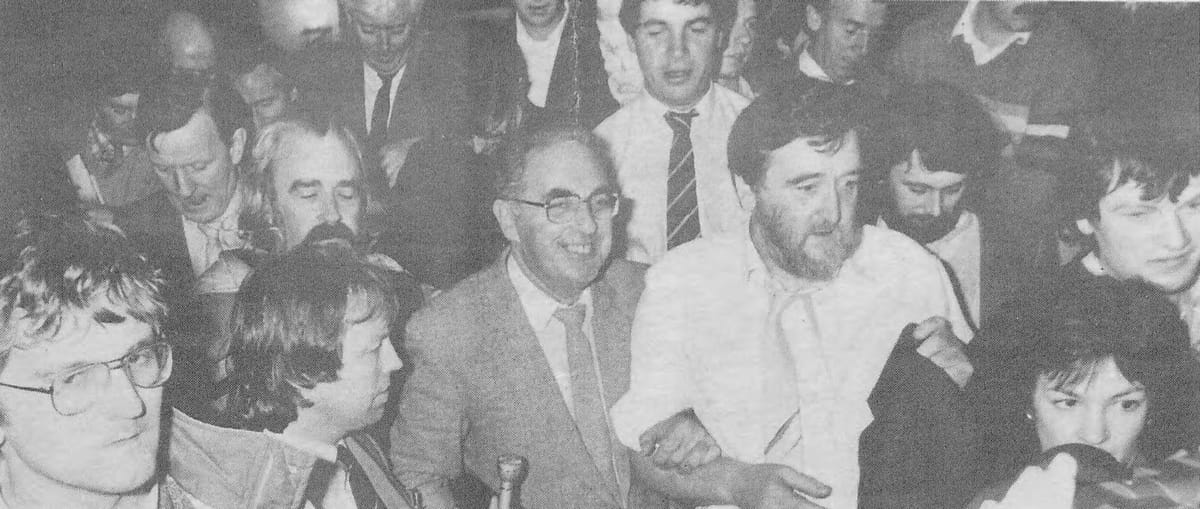
November 2nd, 2026, marks the 40th anniversary of the 1986 Ard-Fheis, that seminal moment in which Sinn Féin, the political wing of the Provisional Irish Republican movement, ended its abstentionist policy towards Leinster House, thus paving the way for elected party members to take their seats in the Free State parliament. After delegates narrowly voted by the necessary two-thirds majority in favor of the anti-abstentionist Motion 162 (429 voted for it, 161 against), about one hundred individuals led by Ruairí Ó Brádaigh walked out and reorganized themselves as Republican Sinn Féin (RSF). [1]
Four decades have elapsed since the Republican split over abstentionism, and much ink has been spilled over the decision’s rights and wrongs, both by historians and Republican activists. Interesting revelations about the dirty tactics deployed by the Adams-McGuinness leadership—both within Sinn Féin cumainn, the prisons, the IRA, and in Irish America—have emerged, with a recent book for instance suggesting that the outside leadership imposed an anti-abstentionist commanding officer on IRA prisoners in Portlaoise Jail to ensure compliance with the leadership’s new political line. [2] Robert White has also written extensively on the subject, recounting how the Provo leadership physically threatened dissenters in the lead-up to the Ard-Fheis, warning abstentionist Republicans not “to form another IRA” on pain of retaliation. [3]
While such conversations are important to scholars and convinced Republicans alike, this essay is not an attempt to rehearse the history of the abstentionist debate, nor does it introduce a novel scholarly interpretation of the events at hand (this may come at a later date). Rather, to mark the anniversary, we offer a short retrospective on the importance of 1986 and argue that the traditional abstentionist policy remains relevant to Irish Republicanism today.
Starting with the significance of 1986, many conventional narratives depict the Ard-Fheis as a road well taken. According to them, the split served as a crucial stepping-stone towards a new Republican politics—a politics culminating in the much-lauded Peace Process, the Good Friday Agreement, and the rise of Provisional Sinn Féin as a normalized political force on both sides of the Border. According to this interpretation, Republicanism should not be understood dogmatically. As writer and former IRA Volunteer Danny Morrison reflected, “To me our mandate [to fight] was the sense of oppression, physically, that we lived under, the conditions that we lived under and they and they alone justified armed struggle and that was our position.” Abstentionism and physical force may have been appropriate for a certain time, but changing conditions opened new possibilities. Now, Republican goals may be realized through other means, namely through a rapprochement with constitutional and democratic politics. [4]
The force of this argument is strong, and it seems that on surface-level, Provisional activists bargained well in their decision to adopt a constitutionalist posture towards Leinster House. The pragmatic decisions made in the decades following the ‘86 split have catapulted the Provos from an underground revolutionary movement into serious political contenders. At the time of writing, there is a Sinn Féin First Minister, Michelle O’Neill, in the North of Ireland—the first in a statelet founded upon Unionist supremacy. [5] In the South, the party holds a narrow lead in the polls, and it is certainly possible that they may win the most seats to Leinster House in a future election.
Yet this optimistic view is by no means the only way to see the situation.
It should be remembered that during the 1980s dropping abstentionism was not framed as a stepping-stone to a hard-won peace. If one reads material from the original debate, the Adams leadership painted entry into Leinster House as a tactical shift to be paired with unrelenting armed struggle. Addressing traditional Republicans in his presidential address at the 1986 Ard-Fheis, Gerry Adams said that if the decision went against the traditionalists and they walked out, they “have already decided to withdraw solidarity and support from the IRA and the armed struggle.” [6] The clear implication was that participation in Leinster House was to be predicated on a continuing, if not escalated, revolutionary struggle, thus avoiding the pitfalls that Ó Brádaigh and other abstentionists warned about when predicting that jettisoning the policy would “tip the scales” in favor of “parliamentary, constitutional, and reformist action,” leading to a capitulation of the Republican position. [7]
Adams’ argument may have sounded plausible in the mid-1980s, but events did not turn out as predicted. Since then, the Provisional IRA went on ceasefire, accepted the 1998 Good Friday Agreement, and disarmed. Resultantly, a minority of self-described Republicans—even some who supported the change in ‘86—have begun to see the merits of Ó Brádaigh’s position. Speaking in Jack Hepworth’s fine oral history on Republican subjectivities, Nuala Perry of the “dissident” group Saoradh reflected on the unacknowledged significance of the Ard-Fheis:
“You see, most of us, ordinary [IRA] volunteers on the streets, we couldn’t have told you, we didn’t care less about what was going on at the ard fheis in ‘86. When I look back on it, it was profound. […] I felt then that the ones who walked [Republican Sinn Féin] were wrong. I thought, ‘they’re splitting the republican movement, we should be trying to revamp and regain momentum and we have split’. Now I know the people who split, split for all the right reasons! We were too naïve to see that what was being played out at that point was basically a game of very bad brinksmanship. The people who walked had their eye on the ball. They knew where it was all going. It was a strange, strange time.” [8]
While this page does not support Ms. Perry’s organization (we stand with the late Mr. Ó Brádaigh), her sentiments reflect genuine grassroots disillusionment with the Provisional Republican project. Critics like Perry charge that political realities are less rosy than Provisional Sinn Féin lets on. Rather than seeing ‘86 as a success story, they believe that the Ard-Fheis inaugurated a trajectory of compromises and betrayals, pushing the movement towards the very reformist action that Ruairí Ó Brádaigh and Dáithí Ó Conaill warned against.
Indeed, over the last forty years, it is undeniable that the Provisionals have changed their position on a whole host of issues, from policing to governmentality to prisoners to even the armed struggle itself. They have, in the words of legendary Belfast IRA commander Billy McKee—one of the individuals who walked out in ‘86—“broke away from all ideals and constitutional points of the Republican movement.” [9] For those who sacrificed so much in struggle against British imperial occupation, their politics had not changed one scintilla. It was the sell-outs who changed, and that change began with abstentionism.
Seen in hindsight, then, it would not be unreasonable to say that Republicanism is haunted by the ghost of 1986, and therein lies the event’s importance. The end of abstentionism unleashed trajectories whose logic pushed Republicans along divergent paths. Most went down the road of constitutionalist revisionism, while a minority went the way of people like Republican Sinn Féin—down the road of a long and difficult dissidence.
Yet it is arguable that the ‘86 Ard-Fheis is significant on a deeper level, too. The transformation of Provisional Republicanism from a revolutionary movement into a vaguely progressive (but hardly radical) political outfit has left the Provos hardly resembling themselves, thus calling into question the meaning of the very identity they claim as their own. In fact, there is an ancient paradox, the Ship of Theseus, which confronts this very issue. In his short biography of the Greek hero Theseus, the Roman writer Plutarch says:
“The ship wherein Theseus and the youth of Athens returned [from Crete] had thirty oars, and was preserved by the Athenians down even to the time of Demetrius Phalereus, for they took away the old planks as they decayed, putting in new and stronger timber in their place, insomuch that this ship became a standing example among the philosophers, for the logical question of things that grow; one side holding that the ship remained the same, and the other contending that it was not the same.” [10]
If Provisional Irish Republicanism has been altered as radically as Theseus’ ship, it could be asked (as the philosophers did in Plutarch’s day) whether this modern iteration of Republicanism is Republican at all. While opinions on the matter differ between latter-day Provos and their critics, it is clear that 1986 poses a fundamental question that self-described Republicans must answer. Both Provisional Sinn Féin and its various “dissident” opponents claim to be Republican. But in order to know who has the best claim to that title, surely we must first be able to define Republicanism itself.
Perhaps this disagreement over definitions and over legitimacy is the most important legacy of the ‘86 split. The Longford Leader recognized this fact in an editorial penned soon after the walkout, stating that Ó Brádaigh was “the one man to emerge from the Sinn Féin debacle with his honour intact… at least Ruairí Ó Brádaigh has been true to his principles.” [11] According to this line of thinking, it was RSF that remained consistent with Republicanism as traditionally defined. Why is that? The answer lies in the crucial question of principles.
In order to define Republicanism, we must first acknowledge that there exist certain fundamental precepts which give concepts their shape. For example, there cannot be Marxism without the principle of historical materialism, or democracy without the idea of popular sovereignty. Fundamental principles are therefore a necessary part of defining political concepts, because without them the meaning of these ideals would become wholly arbitrary. A monarchist who is against monarchy would no longer be a monarchist in any genuine sense, and so on.
In this light, it is imperative to understand Irish Republicanism’s fundamentals, as it was precisely these principles which were at issue in 1986. Traditional Republicans objected to Motion 162 because they believed it violated the basics of Republicanism itself; and it was these following precepts which RSF’s organizers cited in their declaration following the split:
- The allegiance of Irishmen and Irishwomen is due to the sovereign Irish Republic proclaimed in 1916.
- The sovereignty and unity of the Republic are inalienable and non-judicable. [12]
To state this another way, to be an Irish Republican is to bear solemn allegiance to the All-Ireland Republic of 1916 and its legal successors. Republicans taking seats in any partitionist assembly would confer legitimacy on said body, thereby violating their loyalty to the Republic. The small band who walked out of the Dublin Mansion House did well to ensure that there would remain an organized body of men and women loyal to the Republic alone. In doing so, Ó Brádaigh, Ó Conaill, and the others did not initiate a new form of Republican dissidence, but instead carried on an unbroken tradition of resistance dating back to the United Irishmen. As far as they were concerned, their position was the exact same as that of Tone, Emmet, Mitchel, and Pearse. They had kept faith while others walked away from Republicanism altogether.
In this sense, 1986 is significant because it serves as a reminder of what Republicanism was and indeed still should be—an ideal anchored in definite principles. Traditionally, the fundamental principle is the Republic of 1916, which true Republicans see as the authentic manifestation of Irish nationality. From this bedrock emerges two further principles: non-recognition of the institutions of Partition and the right to resist British rule, by physical force if necessary.
A movement which compromises on its principles will, like a kite cut from its tether, be carried away by the wind. Forty years on, what is necessary is a return to these fundamentals. Many organizations claim Irish Republicanism’s mantle, yet few understand it rightly. Critics (such as the writer of this old post) might decry the “nonsense of the non-recognition of the legitimacy of the nation-state of Ireland” or accuse traditional Republicans of “being isolated into some sort of elitist group.” [13] But does the traditional abstentionist outlook not logically follow from Republicanism’s basic precepts?
Once upon a time, there was greater consensus on this fact, as made clear in an article published in the Irish Independent entitled What is Irish Republicanism? (1970):
“In a strict sense, an Irish Republican was one who gave allegiance to the 32-County Republic of Easter 1916 and who denied the right of the British Government to rule here. With the establishment of the first Dáil Éireann in 1919 as the Government of that Republic its supporters were Republicans, just as were those who opposed the setting up of the two partition States—Six County and 26 County—in 1921 and 1922.” [14]
In retrospect, the 1986 Ard-Fheis is a crucial reminder of this reality. But we must also be realistic. Today, those who maintain the traditional Republican ideal are marginal, even more so than four decades ago. While political majorities have no bearing on whether the Republican position is right or not, it is nonetheless important to recognize that Republican legitimism’s current trajectory is downwards. It is not our place as children of the diaspora to dictate policy to our cousins in Ireland, but all the same we passionately believe that Irish Republicanism cannot become a museum piece or an anachronism. As Ruairí Ó Brádaigh rightly pointed out, “To give depth and meaning to Republicanism—beyond just the right to fly the Irish Tricolour or to paint letter boxes green—is to see the Republican objective as one with political, social, economic and cultural dimensions.” [15]
Forty years after the split, there remains a pressing need to rebuild Republicanism from the ground up, beginning with the principle of abstentionism. There can be no compromise with the forces of revisionism, no bending on fundamentals. All the same, abstentionism cannot become an excuse for inaction, a purgatory in which the faithful sit, waiting for the Republic. Rather, the traditional Republican worldview should serve as a framework upon which activists can construct something new. Dogmatism on matters outside the purview of Republican principles will only serve to lead the cause into a cul-de-sac; so to speak, there must be room within Republicanism for a Seán Russell and a Frank Ryan alike. In this spirit, an openness to debate on issues such as socialism, immigration, and abortion—and a willingness to work alongside those who share the vision of 1916, but disagree on other political questions—is essential, as is becoming involved in real-world extra-parliamentary action. This agitation can take many forms. Social, cultural, and economic; but always national in outlook.
In truth, Irish Republicanism does not have to be an ideal of the left or the right. Many have sought to co-opt the national ideal for such sectional purposes, but these projects always failed to live up to the high ideals of Emmet and Tone. What is necessary today is not a Republicanism bound to constitutionalism or to imported ideologies, but a Republicanism which knows its roots. By reaffirming the centrality of the abstentionist perspective to the cause of Irish freedom, the 1986 split ensured an unbroken continuity between Republican past and present. The question now is whether Republicans can develop an alternative and authentic social and economic program which simultaneously creates real, revolutionary change for the Irish people whilst remaining faithful to Republicanism’s original precepts. The federalist Éire Nua program offers an excellent starting point, but more must be done to update it to current circumstances and promote its core tenets. Good ideas cannot be allowed to sit on some dusty shelf waiting to be found again. The time to act on them is now, lest the All-Ireland Republic becomes nothing but a pipe-dream.
The odds were long in ‘86, and they are longer now. But four decades on, the success of Motion 162 is not cause for mourning or defeatism. To say genuine Republicanism is a lost cause would be to abandon the revolutionary tradition, and to accept the Republican Ship of Theseus offered by the pro-Treatyites, Fianna Fáil, the Officials, Provisional Sinn Féin, and all those who broke faith with the All-Ireland Republic. There must remain a group of Republicans who remain the nucleus, which represents what Emmet represented, the soul of Ireland, the prophetic shock minority, those who have neither been purchased nor intimidated.
That is why abstentionism matters.
This article was originally published in The Inkling.
[1] Robert W. White, Ruairí Ó Brádaigh: The Life and Politics of an Irish Revolutionary (Bloomington: Indiana University Press, 2006), 307-308.
[2] Dieter Reinisch, Learning Behind Bars: How IRA Prisoners Shaped the Peace Process in Ireland (Toronto: University of Toronto Press, 2022), 89-90.
[3] Robert W. White, Out of the Ashes: An Oral History of the Provisional Irish Republican Movement (Newbridge: Merrion Press, 2017), 239.
[4] Marisa McGlinchey, Unfinished Business: The Politics of ‘Dissident’ Irish Republicanism (Manchester: Manchester University Press, 2019), 130.
[5] Brendan Hughes and Matt Fox, “Stormont: Michelle O’Neill Makes History as Nationalist First Minister,” BBC, 3 February 2024, https://www.bbc.com/news/uk-northern-ireland-politics-68180505.
[6] Gerry Adams, The Politics of Revolution (Belfast: Republican Publications, 1986), 6.
[7] Ruairí Ó Brádaigh, Selected Writings and Speeches, Volume I: 1970-1986, ed. Dieter Reinisch (Dublin: Cló Saoirse, 2014), 164.
[8] Jack Hepworth, “‘“We’re Getting the Victory We Fought For”, We Were Told’: Retrospective Subjectivities in Oral Histories of Irish Republicanism,” Oral History 48, no. 2 (2020): 75, https://www.jstor.org/stable/48615293.
[9] McGlinchey, Unfinished Business, 29.
[10] “Theseus by Plutarch,” The Internet Classics Archive, accessed 16 October 2026, https://classics.mit.edu/Plutarch/theseus.html.
[11] “A Man of Honour,” Iris na Poblachta, November 1986, 3.
[12] “Historic Sinn Féin Declaration,” Iris na Poblachta, November 1986, 1.
[13] White, Out of the Ashes, 379.
[14] Ruairí Ó Brádaigh, “What is Irish Republicanism,” Irish Independent, December 9, 1970. https://archive.org/details/irda-what-is-irish-republicanism-fff1d2a849.
[15] Ó Brádaigh, “What is Irish Republicanism,” Irish Independent, December 9, 1970.