Udder Dependence: Corporate Processors’ Power In The Dairy And Beef Sectors
Irish dairy and beef farmers have expanded production, yet continue to suffer from unreliable incomes as processors prioritise profits.
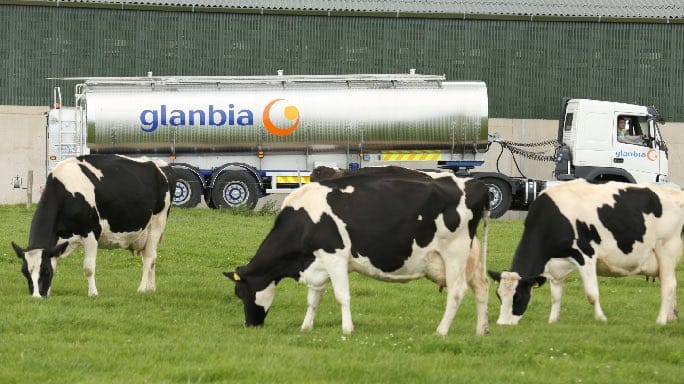
For more than a decade, dairy and beef farmers have operated as classic price-takers in a market dominated by a handful of large processors. While farm-gate returns swing wildly with global events and commodity cycles, input costs and structural power imbalances ensure that the bulk of value is captured further up the chain. The pattern is visible in milk-price leagues, factory cattle differentials measured in hundreds of euros (€) per head, and the extreme volatility of family farm incomes recorded by Teagasc. Controversies involving Kerry Group’s long-running leading-milk-price dispute and repeated Glanbia price cuts illustrate how contractual power and opaque pricing leave primary producers chronically exposed.
Following the abolition of EU milk quotas in 2015, dairy output in Éire expanded rapidly. According to the Central Statistics Office (CSO), dairy cow numbers rose by roughly 42 per cent between 2013 and 2023, while, as per Teagasc’s National Farm Survey, average herd size climbed from the mid-60s to around 98–100 cows during the period 2014-2024. The expansion was encouraged by state policy, yet the resulting surplus milk frequently coincided with sharp farm-gate price collapses. In 2015–16, base prices from major processors fell into the low-to-mid 20c/L range (including limited co-op support). Glanbia’s successive cuts in that period, and later reductions in 2019 and 2021, were publicly condemned by the Fresh Milk Producers (FMP), IFA and ICMSA as unjustified by market returns and damaging to supplier confidence.
The most protracted dairy controversy centred on Kerry Group’s “leading milk price” commitment. Suppliers argued that between 2015 and 2020, the processor failed to match the best comparable prices paid by other major buyers. Arbitration sided in favour of the farmer-owned Kerry Co-op against its parent, Kerry Group plc, and negotiations eventually produced a €50 million settlement fund, paid out in 2025 as part of the wider Kerry Dairy Ireland restructuring. Even then, some producer groups claimed the effective per-litre return fell well short of the 5.4c/L figure emphasised during the shareholder vote, particularly for expanded suppliers. The Kerry dispute exposed a structural irony at the heart of Irish dairy: a farmer-owned co-operative (Kerry Co-op), created to protect its members, found itself locked in ownership of a publicly listed PLC (Kerry Group) whose commercial priorities could override the very “leading milk price” guarantee those same farmers had been promised.
A couple of years ago, during Summer 2023, hundreds of Kerry Group milk suppliers even took to the streets in the town of Charleville, north-western Co. Cork, and outside the company’s headquarters in Tralee, North Kerry, staging high-profile protests over what they described as an unjustifiably low milk price and the failure of the processor to honour its long-standing “leading milk price” commitment. At the time, Kerry’s base price had fallen over 3c/L behind neighbouring processors such as Dairygold, costing an average supplier thousands of euro (€) less on milk alone and leaving many producers below the cost of production after two years of elevated input costs. The protests were backed by the Kerry Co-op board itself, as well as the IFA and ICMSA, and formed part of a wider pattern of supplier anger over abrupt price cuts, opaque contracts, and the structural power imbalance between farmers and large processors. The IFA's analysis of 2023 milk prices found a gap of more than €14,000 in annual revenue between the highest- and lowest-paying co-ops for an identical volume before sustainability bonuses, underlining persistent differentials among processors of similar scale.
Data produced by Teagasc quantifies the human cost of this volatility. Average dairy family farm income swung from €157,591 in 2022 to just €51,122 in 2023 - a collapse of roughly two-thirds - before recovering to €108,536 in 2024 and approximately €153,300 in 2025. Net margins per litre moved from deeply compressed levels to around 23.13c/L in the strong year of 2025. Forecasts for 2026 already point to a sharp reversal, with average dairy income projected to fall by 42% to approximately €80,000 as milk prices ease and costs remain elevated. These swings occur while processors continue to operate large-scale manufacturing plants and export businesses whose margins are far less exposed to the same short-term price risk.
Beef producers face a different but equally stark form of concentration. The three largest factory groups - ABP, Kepak and Dawn Meats - together with a small number of independents process the great majority of cattle. The ‘Irish Farmers Journal’ factory price leagues for 2024 recorded differences of up to €275 per head between the highest- and lowest-paying plants for the same grade and weight of animal. For U3 cows, the gap reached €247 per head; for steers the spread was still around €120 per head on average slaughter weights. Even in stronger years the same pattern persists: 2025 data continued to show differentials of €150–€223 per head across common grades once a minimum reporting threshold was applied. Farmers delivering identical animals to different factories therefore receive substantially different cheques, while the largest groups set the effective tone of the market.
Cattle-rearing and cattle-finishing incomes remain a fraction of dairy returns. Teagasc recorded average family farm incomes on cattle-rearing (suckler) farms of €6,996 in 2023 and €13,862 in 2024, rising to €23,291 in 2025. Cattle-other (mainly finishing) farms averaged €13,737 in 2023 and €18,141 in 2024 before climbing to €34,247 in 2025. Enterprise-level net margins on cattle-finishing farms stood at just €42 per hectare in 2023, recovered to €276/ha in 2024 and reached €374/ha in 2025 (figures that exclude family labour and most direct payments). In weaker market periods, finishers who bought stores at elevated prices have reported losses of several hundred euro per head when subsequent factory returns failed to keep pace. The Agri-Food Regulator’s publication of aggregated processor selling prices for forequarter, hindquarter and mince has begun to shed light on the gap between farm-gate and factory realisation, yet transparency remains limited.
The common thread across both sectors is structural imbalance. Processors control the timing and terms of price announcements, the allocation of volume bonuses or penalties, and access to key export markets. Farmers, bound by perishable product and high fixed costs, have little practical alternative. Ten years of post-quota expansion, repeated price crises, multi-year contractual disputes and factory-to-factory differentials measured in hundreds of euros (€) per animal demonstrate that market power continues to rest with the corporate and large co-operative processors. Until greater transparency, enforceable fair-dealing rules and genuine producer leverage are introduced, Ireland’s dairy and beef farmers will remain the residual claimants in a system designed to protect processor margins first.