The Vacant Chair: Evaluating George Gilmore’s ‘Labour and the Republican Movement’ in 2026
For today, the pamphlet’s central claim remains indispensable: there can be no sustainable republican politics without a working-class politics, and no serious working-class politics in Ireland without a break from imperialism.
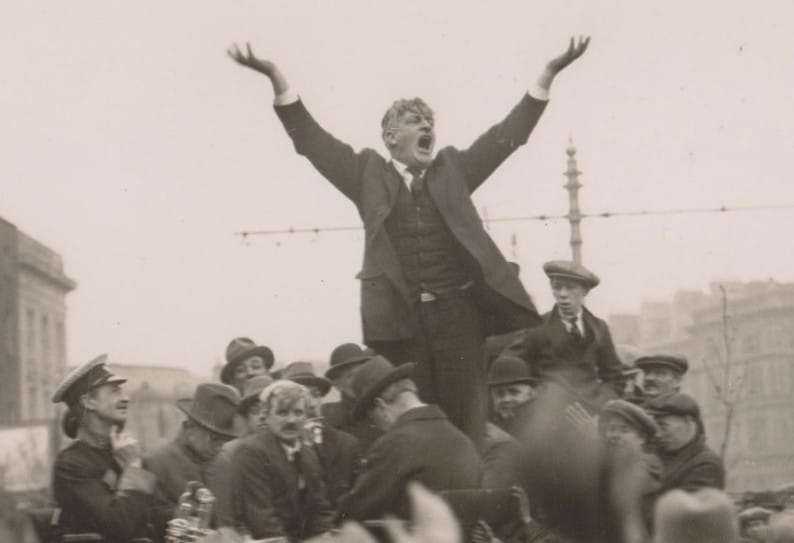
George Gilmore’s ‘Labour and the Republican Movement,’ published in 1966 with a short introduction by Peadar O’Donnell, is a valuable and still provocative intervention from the Irish republican movement. Written as a footnote to James Connolly’s ‘Labour in Irish History,' it argues that the independence struggle was defeated not simply by British force, but by the squeezing out of the organised Labour leadership from the vanguard of the movement. For today, the pamphlet’s central claim remains indispensable: there can be no sustainable republican politics without a working-class politics, and no serious working-class politics in Ireland without a break from imperialism.
His historical narrative is clear and partisan in the best sense. He contrasts Arthur Griffith’s originally ‘dual-monarchist’ Sinn Féin party with what he called the “Larkin–Connolly Labour movement.” Griffith, in Mr Gilmore’s account, sought a ‘Home Rule’ parliament within the imperial system, protective tariffs for Irish capitalists, and a boycott of Westminster rather than a social rupture with empire. His notion of “Irish freedom” supposedly meant freedom for Irish industrialists to manoeuvre within the imperial economy. James Connolly, by contrast, insisted that freedom required a break with the British Empire and the effective democratic ownership of Ireland by its people. In short, the republicanism of 1916 essentially drew its revolutionary social content from Connolly, whereas Griffith represented a generally cultural-nationalist, Home Rule-type politics that sought imperial accommodation, rather than a rupture with empire. The 1916 Rising, Gilmore argues, was the first Irish rebellion in which organised Labour played a leading role; it was James Connolly’s militant trade unionism that forced the pace. The Rising’s objective wasn't a merely “recognised national identity” - George Gilmore’s biting comparison with ‘Uncle Tom’ is aimed precisely at that politics - but national independence, the reconquest of Ireland by its people.
The pamphlet’s strongest section is its reconstruction of the pre-Rising antagonism between what he calls ‘Griffithism’ and ‘Connollyism.’ Gilmore quotes Jim Larkin’s ‘Irish Worker’ and Griffith’s ‘Sinn Féin’ to show that this wasn’t a genteel disagreement between allies. Griffith’s paper attacked Larkin as a “Communist,” an “Anarchist,” and even an “English agent”; it called on British armed forces to break a railway strike. Eamonn Ceannt’s angry letter of protest, quoted by Gilmore, exposes how far the official nationalist leadership was from the workers’ movement. He also recovers the radical internationalism of Theobald Wolfe Tone’s United Irishmen - their anti-slavery agitation and boycott of West Indian sugar, their links to women’s emancipation through Mary Ann McCracken - to show that Irish republicanism once had a social revolutionary content. James Connolly, he argues, was the leader who best understood that tradition and could relate it to the Ireland of “moneylords” and industrial employers.
The pamphlet’s central political judgement is that after the Rising, when the independence movement was reorganised, Griffith was installed in leadership while Labour was told to wait. De Valera’s initial formula that Sinn Féin aimed at international recognition of an independent republic, after which the people could choose their own form of government, left the door open for Griffithism. Peadar O’Donnell’s image, quoted by Gilmore, is powerful: the delegates cheered Griffith’s return, but “nobody noticed that Connolly’s chair was left vacant.” Labour waited - and for Gilmore, this was the great failure of his generation. The I.R.B., beheaded of its previously pro-Connolly leadership, threw its disciplinary weight behind Griffith; the Labour leaders, which he describes as “well-meaning, obviously” but without Connolly’s vision, blundered into support for the Treaty state; and a “politically leaderless” I.R.A. fought a guerrilla rearguard defence of the revolutionary Republic, which had been organised only a couple of years previously. Gilmore also shows how the Republican courts sometimes protected landlords and ranches (a scenario critiqued in Ken Loach’s Cannes-winning film, ‘The Wind that Shakes the Barley’) against landless men, quoting Austin Stack’s 'Constructive Work of Dáil Éireann’ with justified contempt. Fintan Lalor’s teaching, so admired by Pádraig Pearse, played no part in the conduct of the early conflict.
George Gilmore’s anticipation of neo-colonialism is remarkable. Quoting Madame Constance Markievicz, whom he refers to as “a disciple of James Connolly,” he notes that Westminster’s imperialism was working “by a change of names,” and that capitalist interests in England and Ireland were pushing the Treaty to block the march of working people. He then traces how the Twenty-Six County state, unable to sustain Arthur Griffith’s protectionist vision against partition and what he regarded as capitalist cartelisation, was forced back into closer integration with the British economy and what Gilmore calls “the Anglo-American alliance.” The pamphlet ends with a call for organised Labour to return to Connolly’s politics: the power of monied interests can only be met by the power of organised Labour.
The pamphlet has limitations. For a younger reader, the writing style may seem somewhat forceful and harsh, but this is to expected from George Gilmore’s generation. It’s heavily leader-centred and sometimes loses focus in its romanticisation of James Connolly and James Larkin, and says too little about the grassroots labour movement, women workers, and the sectarian dynamics of Belfast that Connolly himself had tried to confront. Its account of the I.R.B. is perhaps conspiratorial and occasionally schematic. However, these weaknesses don’t negate its central achievement. It’s very insightful for any individual with a passing interest in Irish history and George Gilmore restores class to the history of Irish republicanism, showing that the retreat from James Connolly wasn't an accident but a political choice with disastrous consequences, especially in the North.
There is every reason to read and appreciate this pamphlet in 2026. It’s sixty years since Gilmore wrote it and 110 years since the Rising it interprets, yet the official commemorative culture still prefers the safe, cultural-nationalist Griffith to the revolutionary Connolly. In a year of another round of 1916 anniversaries, Gilmore’s text is a useful antidote to the tendency to turn republicanism into heritage, identity and spectacle, while conveniently forgetting its social content. It also speaks directly to the Ireland of 2026: a housing and rental crisis, low pay and precarious work, underfunded public services, and a state still shaped by partition and by close integration with British and Anglo-American capitalism. Revisiting George Gilmore’s analysis is a way of insisting that the republican tradition is not the property of official commemorations, but a living argument about who owns Ireland and who works it. “Labour must wait” is still the private refrain of respectable nationalism; Gilmore’s answer - that Labour must lead - is as relevant as ever. We are fortunate in-so-far that the one of definitive cultural relics of the Rising - Sean O’Casey’s ‘The Plough and the Stars’ - recognises that the events of 1916 were grounded in the tradition of Connolly.
That is why the pamphlet remains relevant. Today, “Labour must wait” is still the refrain of ‘respectable’ nationalism and of those who ask workers to subordinate class demands to purely constitutional or identity politics. The same pressures towards deeper integration with British and Anglo-American capitalism, the same partition-shaped vetoes, and the same tendency to increasingly inegalitarian property relations, while calling it “fairness to all sides,” recur in new forms. Housing, land, low pay, and public services cannot be solved by a nationalism that courts capital. George Gilmore’s answer is the one people still need: an independent, organised working-class politics that refuses to wait, reclaims the radical republican tradition, and treats the campaign for Irish freedom as inseparable from the fight against capitalism and empire. James Connolly’s chair is still vacant - and George Gilmore’s pamphlet is a reminder of who should sit in it.