The Plough and the Stars: The IRA’s 1933 Vision For An Underground Republic
In November 1930, IRA 'Chief-of-Staff' Moss Twomey published a draft constitution titled ‘The Sovereignty of the People,' which asserted that the national community possessed extensive rights over natural resources and economic life.
When the Irish Republican Army (IRA) adopted its ‘Constitutional and Governmental Programme’ at the General Army Convention of March 1933, it wasn’t issuing a practically empty document in isolation. Instead, it was the culmination of nearly three years of internal debate about the social content of real Irish independence, and it followed closely on the heels of a highly significant manifesto issued in January of the same year. Prof. Brian Hanley’s study of the organisation between 1926-1936 showed that this period witnessed a genuine (if ultimately contested on matters of its exact contents) focus on social radicalism, one that both attracted new members and provoked internal debates and critiques. For an underground revolutionary entity, the 1933 programme was one of the most open expressions of that outlook, but the January manifesto reveals how the IRA sought to fuse its revolutionary social vision with a tactical intervention in the State’s electoral politics.
The roots of this approach lay in the late 1920s. The IRA had been crushed by a highly authoritarian, British-created military junta state - and its membership had collapsed as a result of harsh state repression, as well as social ostracisation and marginalisation (many IRA members were forced into emigration to escape destitution). For example, the IRA went from having a paper membership strength of 100,000 at the height of the ‘Tan War’ (though this really stood at 15,000 ‘actual’ members, 3,000 of whom were actively fighting at any one time), to a miserable low of 1,800 by the end of the decade. However, the radicalising conditions of the Great Depression saw the IRA’s numbers rocket back up to 10,000-12,000 in the early 1930s.
After the disappointments of the Civil War and the consolidation of the Free State, IRA ‘Chief-of-Staff’ Moss Twomey sought to clearly articulate the organisation’s purpose to the general population. In November 1930, he published a draft constitution titled ‘The Sovereignty of the People,' which asserted that the national community possessed extensive rights over natural resources and economic life. The proposal sparked heated internal debates on issues such as private property, signalling that the IRA was no longer content to be a purely paramilitary, guerrilla vanguard. This trajectory became explicit with the establishment of Saor Éire in 1931, a radical political formation backed by the IRA leadership, which called upon workers and small farmers to overthrow domestic capitalism and British imperialism. Although Saor Éire was swiftly proscribed by the Free State government and denounced from the oft-pro-State pulpit as communist, it established the vocabulary that would inform both the January manifesto and the March programme.
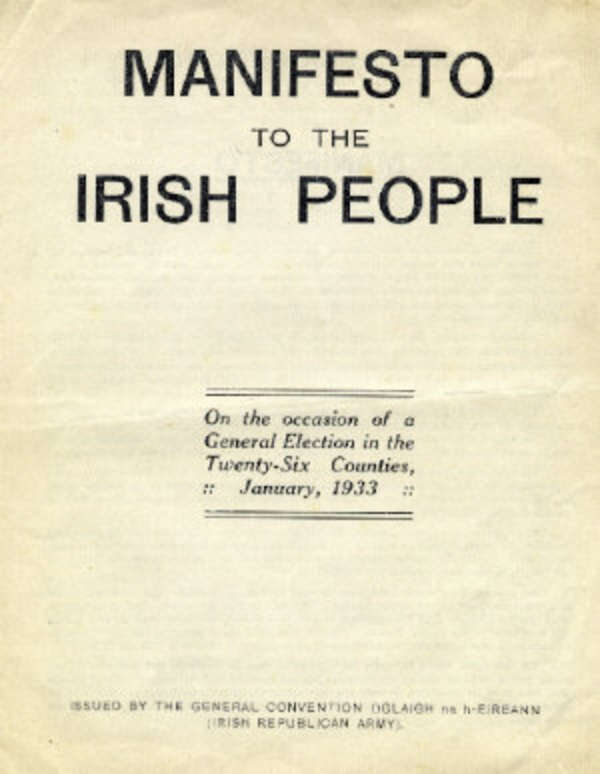
The ‘Manifesto to the Irish People,’ issued by the General Convention of the IRA on 8 January 1933, was a deliberately tactical document, produced “on the occasion of a general election in the Twenty-Six Counties”. Attacking the Cumann na nGaedheal administration, the IRA noted “with dismay its attempt to stabilise and build up an economic system which, for all that it alleviates unemployment at the moment, will perpetuate the evils of social injustice.” This gives expression to a critique whose contemporary resonance is hard to miss - that superficial reform, by making an unjust order more bearable, may only make it more durable.
Its central decision was to release the organisation from the restriction that had previously prevented it from taking part in elections, recommending that members “work and vote against the Cosgrave candidates”. The manifesto was careful, however, to insist that this didn’t mean an acceptance of Fianna Fáil policy. The IRA’s demands remained maximalist - the scrapping of the Treaty, allegiance to the revolutionary Republic of 1916, the abolition of partition, and complete severance from the British Empire. In practice, as the auction description of a rare pamphlet notes, this meant that “the Fianna Fail Government should be assisted into office again”. This was a strategic move to undermine the Cumann na nGaedheal, as the manifesto notes that the IRA didn’t support Fianna Fáil and criticised their first year in office for failures to act on promises in releasing prisoners and sluggishness in disrupting the Free State’s machinery. The manifesto thus captured the IRA’s ambiguous position in 1933. By advising its members, it was willing to indirectly use the ballot box tactically to weaken Cumann na nGaedheal, but it nonetheless refused to subordinate its revolutionary programme to de Valera’s constitutional politics.
The class dimension of the January 1933 manifesto is unmistakable, and it’s what distinguishes the IRA’s position from the more conventional economic nationalism then being consolidated by Fianna Fáil. The document explicitly refuses to allow the national struggle to become a vehicle for domestic enrichment. It points out that the IRA favours “shutting out British goods,” but “not… the enrichment of an exploiting manufacturing class here,” and it favours “separating our financial system from the British” not “to give Irish bankers power of our Irish life” but to secure for “the Irish people” the wealth generated from resources that are “the common inheritance of all our people.” In each instance, the formula identifies a class enemy within the nation - the corporate manufacturer and the banker - and aligns the republican project with “the mass of the people” rather than with a native propertied stratum. The manifesto’s demand for “the public ownership of the means of production distribution and exchange in a state based on the needs of the mass of the people” makes this explicit. The IRA asserts that national independence is to be measured by whether it transfers economic power to the popular classes, or merely substitutes an Irish elite for a British one. This is the inheritance of 1916 in its most direct form, and it supports Hanley’s reading of the period as one of genuine radicalism.
The ‘Constitutional and Governmental Programme’ of March 1933 translated the radical aspirations that had been building since 1930 into a comprehensive blueprint for a revolutionary republican government. Its preamble declared that “the resources and wealth of the nation are very largely in the possession and under the control of those sections who are hostile to national freedom” and insisted that “the machinery of the state was devised and has been developed to serve these interests”. The remedy wasn’t reduced to a change of flag, but a structural transformation of the state itself. The document envisaged an IRA that would supply not only armed struggle, but also “leadership and guidance in directing the thoughts of the people along constructive and revolutionary lines”.
The economic provisions invoke the republican-left and distributist traditions as part of an anti-imperialist lens and crusade against Britain. The soil of the nation and all its resources were declared “the property of the people”. Large, unproductive land holdings were to be redistributed; occupiers who complied with community requirements would receive security of tenure, while the state was to guarantee minimum prices for agricultural produce and promote voluntary co-operative organisation. All rivers, lakes, and inland waterways were to be public property, and the fishing industry was to be developed along co-operative lines with state credit. In industry, the national wealth and credit were to be applied by the state to create manufacturing capacity, with the resulting enterprises becoming “the property of the community”, operated by workers under state direction and management. Banking and credit creation were also to be a state monopoly. In this regard, Prof. Hanley has noted that this proposal was directly in line with Catholic social thought, which likely would’ve made such a measure more acceptable. He points out that it also drew from the ‘communalist’ ideas of Pádraig Pearse and was “much further to the left” than the Irish Labour Party of the period. In the 1930s-1940s, the IRA’s membership would feature a bizarre anti-capitalist combination of, for example, overt Nazis, Communist Party members, pro-USSR International Brigaders from Spain, proto-Fascist ‘Greenshirts’ and ‘Social Credit’ ideologues, as well as canvassers for the Irish Labour Party.
The programme extended to nearly every sphere of economic and social life. Distribution was to be organised co-operatively; private enterprise was permitted only on condition that it matched the employment standards of state-financed co-operatives and was excluded from state credit facilities. Imports and exports were to be controlled by a central marketing board, and public transport was to be operated by a body set up under a National Economic Council. Insurance was to become a state monopoly. The state was to assume responsibility for adequate housing, and after a fixed date the building of houses for sale or rent was to be declared illegal; unfit houses were to be demolished without compensation to landlords. Ground rents and landlordism were to be abolished, with land required for building acquired at agricultural value only. Taxation was to be sharply progressive, falling on unearned income, luxuries, and unproductive land, while the legal system was to be overhauled (promising the provision of legal aid, an idea most certainly ahead of its time in this domain), arbitration extended, and the penal code reformed to prioritise rehabilitation over punishment.
Prof. Hanley’s analysis situates both documents within a broader battle for the soul of the IRA. He contends that the organisation’s radicalism in the early 1930s wasn’t merely rhetorical, but represented a genuine attempt to construct a distinct Irish Republican political economy, arising out of the harsh economic conditions of the time and drawing on the progressive republican tradition of Wolfe Tone, Fintan Lalor, James Connolly, and Liam Mellows. Yet, the January manifesto and the March programme together also exposed the fault lines that would soon fracture the movement. Some of the most committed Volunteers were unsure about this drift and further IRA confrontation with the Catholic Church’s hierarchy in Ireland that it implied. As a consequence, they resisted the agenda (yet, the IRA would justify their ideas in reference to Catholic social teaching and distributist thought). The tactical decision to indirectly support Fianna Fáil electorally in January that year sat awkwardly with the March programme’s insistence on a revolutionary transformation that Éamon de Valera’s reformist government had, by that stage, no intention of enacting. The IRA’s social radicalism was genuine, but it was also internally divisive, and the organisation couldn’t agree exactly how it should be pursued. The 1933 documents remain vital artefacts of Irish republicanism, showing that in the 1930s the IRA sought not only to free Ireland from the chains of London, but also reaffirmed past ambitions to remake it. However, these historically intriguing goals were never realised and have been lost to the passage of time.
Bibliography
- Hanley, B. (2002) The IRA, 1926–1936. Dublin: Four Courts Press. Available at: https://archive.org/details/ira192619360000hanl/mode/2up
- Irish Republican Army (1933a) Manifesto to the Irish People, Issued by General Convention Óglaigh na hÉireann on the Occasion of a General Election in the Twenty-Six Counties, January 1933. Dublin. Available at: https://republicanarchive.com/wp-content/uploads/2025/09/irish-republican-army-manifesto-january-1933.pdf . Auction description available at: https://adams.ie/7025-lot-87-Manifesto-to-the-Irish-People-1933-Issued-by-General-Convention-Oglaigh-na
- Irish Republican Army (1933b) The IRA Constitutional and Governmental Programme for the Republic 1933. Transcribed at The Irish Revolution. Available at: https://theirishrevolution.wordpress.com/2019/05/24/the-ira-constitutional-and-governmental-programme-for-the-republic-1933/
- Poverty Bay Herald (1933) ‘Irish Elections: Republican Demands Terms of Participation’, 10 January, p. 9. Available at: https://paperspast.natlib.govt.nz/newspapers/PBH19330110.2.128
- Saor Éire (1931) Draft Constitution and Rules. Available at: https://www.leftarchive.ie/document/6252/
- Hanley, B. (2001) ‘Moss Twomey, radicalism, and the IRA, 1931–33: a reassessment’, Saothar, 26, pp. 53–60. Available at: https://www.jstor.org/stable/23198999
- English, R. (1994) ‘“Increasing Strains and Stresses Within the IRA”, 1932–1934’, in Radicals and the Republic: Socialist Republicanism in the Irish Free State, 1925–1937. Oxford: Clarendon Press, pp. 161–215. Available at: https://doi.org/10.1093/acprof:oso/9780198202899.003.0003
- ‘IRA troubled between wars’ (2003) The Irish Times, 11 January. Available at: https://www.irishtimes.com/news/ira-troubled-between-wars-1.345089
- Hopkinson, M. (2002) The Irish War of Independence. McGill-Queen's University Press. Available at: https://www.google.ie/books/edition/The_Irish_War_of_Independence/5e-uI55WN-gC?hl=en
- Macardle, D. (1937) The Irish Republic. London: Victor Gollancz. [As discussed in the preface to Wilk, G. (2014) Transatlantic Defiance: The Militant Irish Republican Movement in America, 1923–45. Manchester: Manchester University Press. Available at: https://doi.org/10.7765/9781847799517.00006