The French People Are Burning The Streets Because It Is The Only Language The State Understands
What began on the 21st of September, at a single high school in a Paris suburb where students walked out to protest against understaffing and crumbling infrastructure, has become something far larger, far angrier, and far more significant than a dispute about missing teachers.
Good day, Aontacht readers,
And, there is a moment in all uprisings when the state realises it has lost control, and it is not the moment the first window breaks or the first barricade goes up or the first tear gas canister is fired. It is the moment the people stop being afraid, the moment they look at the police and the institutions and the entire apparatus of coercion that has been built to contain them and they simply decide that they are not going to be contained anymore. France reached that moment this week, and it is worth paying close attention to what is happening there, because it is one of those rare occasions when the street is speaking more clearly than any parliament.
What began on the 21st of September, at a single high school in a Paris suburb where students walked out to protest against understaffing and crumbling infrastructure, has become something far larger, far angrier, and far more significant than a dispute about missing teachers. It has become a generalised revolt against a political class that has spent years telling the French people to tighten their belts while funnelling billions into the Ukraine war and austerity, a convergence of students, workers, Yellow Vests, farmers, and pensioners into a single undeniable demand: the Republic is no longer working for us, and we are done pretending otherwise.
from one school to the Bastille.
The conditions at that first Paris suburb school were not exceptional. They were the rule. Across France, students described classrooms without air conditioning in an era of 40-degree summers, buildings infested with rats, teachers absent for weeks at a time, timetables so overloaded that learning had become secondary to survival, and a university admissions system that rewarded connections over merit. When their initial protest secured a response from the government, extra staff deployed, the movement should have dissipated. Instead it spread, because anyone with eyes could see that one school’s problems were every school’s problems.
Watch: French students occupy their school chanting ‘Vive la comune’ or ‘long live the commune’ in English. A reference to the Paris commune 155 years ago, one of the first attempts at a worker’s state in history.
By early October, the movement had grown into the largest student uprising France had seen in years. On the 7th of October alone, the interior ministry counted 256,000 people on the streets nationwide, while unions put the figure at 450,000.
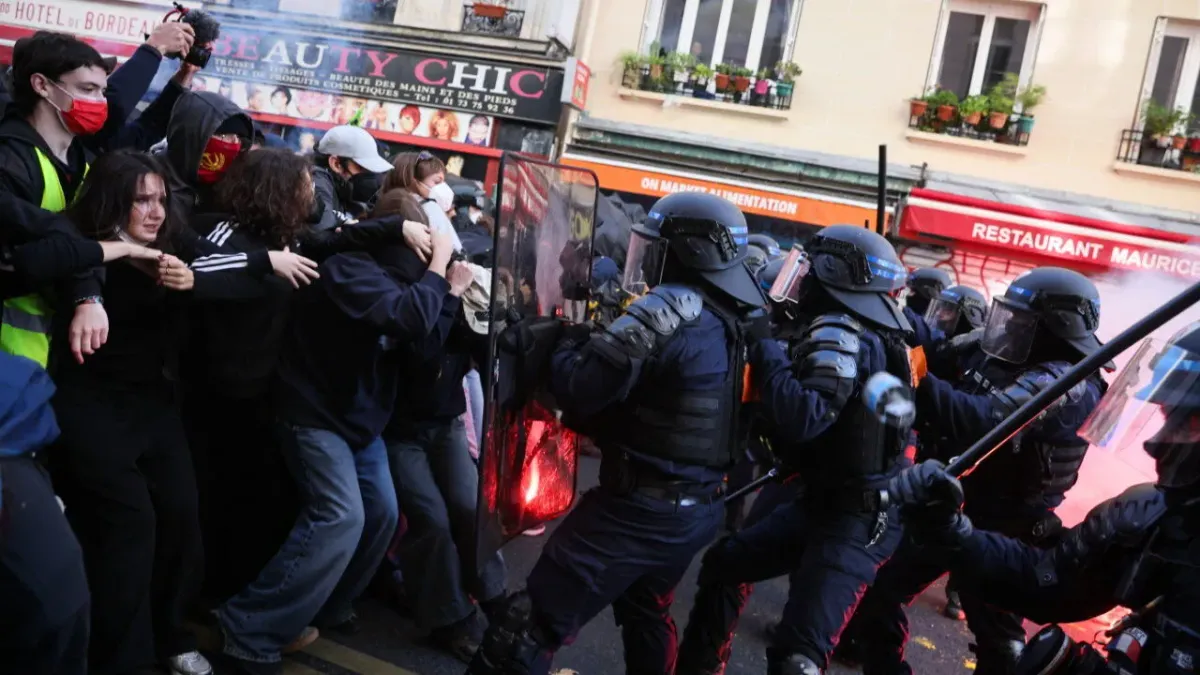
At this point, more than 6,100 people had been arrested, the vast majority of them minors. A 15-year-old in Lens lost his hand after police fired a stun grenade at him. A 14-year-old in northwest Paris was hit in the face with a tear gas grenade at such close range that he lost several teeth. Lawyers representing detained teenagers described clients arriving in custody having been beaten with batons, dragged on the ground, subjected to chokeholds. This is the response of a state that has run out of arguments and reached for the only tool it has left.
And then, on the 8th of October, the students did something that made the symbolism of the whole movement impossible to ignore. They stormed the Bastille:
Watch: Aerial footage from France where high school students stormed the Bastille on the 8th of October.
Thousands of young people surged into Place de la Bastille, the historic site where the French Revolution began in 1789. A banner was unfurled: ‘The Second Revolution.’ Police responded with water cannon, tear gas, and baton charges. The students held the square. They sang the national anthem. They refused to leave.
What made the images from the square so striking was not just the scale of it, but the discipline within the anger. These are not mindless rioters, and the French demonstrators know it, which is why, amid the blocked roads and the burning barricades, they have consistently and deliberately made way for ambulances and fire engines.
Watch: Demonstrators remove barricades to allow an ambulance to pass.
The blockades part. The emergency vehicles pass. And then the blockades close again.
Watch: Demonstrators remove barricades to allow a fire engine to pass.
This is a movement that is angry at a system, not at the people the system is failing to protect, and that distinction matters enormously, both morally and politically.
the Yellow Vests return.
By mid-October, the student movement had done what the French political class feared most, which is to say it had merged with the broader anger with capitalism andn neoliberalism that has been simmering beneath the surface of French society for years. The ‘gilets jaunes’ or the Yellow Vests, the movement that erupted in 2018 over fuel taxes and became a revolt against inequality, answered the students’ call, and what followed on Saturday the 17th of October was the kind of day that governments remember for a long time.
Watch: A boxer, alongside some Yellow Vests, beat back police officers on a bridge in Paris.
The interior ministry counted 550,000 people marching across France but the CGT union put the figure at 800,000. The demands were no longer just about schools. They were about fuel prices that had soared because of the war on Iran, wages that had stagnated for a generation, pensions being eroded, public services being gutted, and a government that had spent billions on military adventures while telling ordinary people there was no money for their children’s classrooms.
By evening, the streets around Place de la République had been, in the words of the city’s mayor, devastated. Cars were torched. Shops were looted. The town hall in Limoges was set ablaze. In Marseille, protesters stormed the city hall. In Lyon, the tourist office was set on fire. The interior ministry reported 400 arrests and 150 injured police officers. The prime minister, Sébastien Lecornu, condemned the violence with the well-practised gravity of a man who has never had to choose between heating his home and eating. Macron vowed that those responsible would be prosecuted and punished.
Watch: Protesters charge and fight the riot police on Place de la Bastille in Paris.
What neither of them said was why. They did not say why a generation of young people had decided that the only language the state understands is the language of the street. They did not say why the Yellow Vests were back, or why students and workers and farmers were marching together, or why the French people had stopped believing that their government was acting in their interests. They condemned the symptoms with great seriousness and ignored the disease entirely, which is the defining political gesture of the European centre-right in 2026.
Into this vacuum stepped Jean-Luc Mélenchon, the leader of La France Insoumise, who backed the student protests from the beginning, marched alongside them, and has positioned himself as the political voice of a movement that the establishment would prefer had no political voice at all. He is abrasive and confrontational and the centrists hate him, which in the current political climate is essentially a character reference.
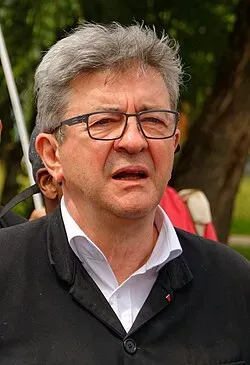
He is standing for the presidency in 2027 and the polls suggest he has a real chance of reaching the second round. The government has accused him of fuelling the protests and seeking to sow chaos. Macron’s spokeswoman described the students’ legitimate demands as being exploited for political purposes. This is the language of a government that has no answers and has settled on attacking the people asking the questions instead.
Ryad Rani, the head of the main high school students’ union, put it more plainly: ‘The government is trembling and it is right to tremble, because when the French people are angry, they never let up.’
what this is, and what it means.
The storming of the Bastille was not a random choice of location. It was a deliberate act by a generation that has grown up being told that the French Revolution was the founding moment of modern democracy, that the values of liberty, equality, and fraternity are the birthright of every French citizen, and that those values are in fact applied selectively, to the comfortable, to the connected, to the people who do not need to worry about whether their child’s school has functioning air conditioning. The banner that read ‘The Second Revolution’ was not a threat. It was a statement. It said: we know what this country claimed to be built on, and we are here to ask why those claims do not extend to us.
The lesson that France is currently teaching is one that applies far beyond its borders, and spectacle readers in Britain, in Ireland, in the United States, in every country where the same austerity and the same contempt and the same degradation of public services is being imposed by governments with no mandate and no answers, should be paying close attention. The French are demonstrating something that is easy to forget when you are watching from inside a system that has been designed to make organised resistance feel futile: the state does not respond to reason alone. It does not move because of petitions or polite letters or even electoral pressure, because all of those things can be absorbed, delayed, managed, and eventually forgotten. It responds to disruption, to the credible assertion that the country cannot function normally while its people are being ignored, and the French people have been making that assertion, with remarkable consistency and remarkable discipline, for weeks.
They let the ambulances through. They block the roads and then they open them for the fire trucks and then they close them again, because they understand that their anger is not directed at the people the state is also failing to protect. They have chosen their targets carefully, and their message is clear. The system that is telling you there is no money for schools spent billions on war. The government that is cutting your pension sent its children to private school. The state that fires tear gas at 14-year-olds is the same state that has an answer for every question except the ones that matter.
Britain is watching. Ireland is watching. Europe is watching…and they should be taking notes.
And on that thought, I will let you go and feel free to wish me a happy birthday below as it’s my birthday!
This article was originally published in the Spectacle.