Is Ireland Imperialist?
The Irish working class is ultimately a net loser in its relationships with the imperial powers, and the argument that Ireland is imperialist cloaks this fundamental relationship, and the potential Ireland has to construct socialism by redirecting its stolen economic output into self-development.
What debunking urban legends and ghost stories for Marxists can tell us about our eerie economy.
Two theories are currently circulating within the Irish Marxist left. These hypotheses take on the unenviable task of trying to make sense of the dizzying halls of mirrors through which our nation wins its daily bread.
The first, and more novel of the two theories, posits that Ireland is an imperialist economy, a begrudgingly welcomed new member to the WASP-y golf club called ‘the centre’ which exploits the periphery through unequal exchange, led by an imperialist finance class which makes a claim on the surplus value of nations lower down on the pyramid. These parvenus are in turn vassals to the pharaonic elite in the US who stand at the top of the pyramid. This is largely a fitting of Ireland’s role in the world into the conventions of dependency theory and the established norm amongst States in the “West”.
The second, older theory posits that Ireland is the Birmingham of the 21st century, where the ascendant middle class are the captains of industry driving a dynamic domestic economy, exploiting a high-productivity workforce underpinned by high organic composition of capital, increasingly surpassing the old foe in terminal decline across the Irish Sea. This is a more optimistic but less defensible update to the Workers’ Party line in the 1980s, back when state policy in Ireland still included a fig-leaf commitment to nurturing indigenous industry. The function of this argument is historically contingent and important for anti-republicanism, since it likewise supports the argument that the primary contradiction in Ireland is unrelated to imperialism, and thus the conditions of the working class in Ireland are the same as those in Britain, and therefore the national question is moot.
How the other 0.0001% lives
An inspection of Ireland’s list of 12 billionaires can provide an insight into the illusory nature of a global imperialist stratum in Ireland. The top three fortunes are all held by individuals with a nebulous connection to Ireland:
• The Collison brothers ($20bn combined): Both US-based.
• Shapoor Mistry ($9.3bn): An India-based fortune held under Irish citizenship.
• John Grayken ($7.3bn): A US capitalist with naturalised Irish citizenship for tax purposes.
There is a significant gap between these fortunes and those of indigenous capitalists, each of whom holds net assets of less than €3bn:
• Eugene Murtagh – owner of Kingspan, a manufacturing company listed in Dublin and London which primarily holds assets in other high-income countries.
• Denis O’Brien – owner of Digicel, a business empire now lost and probably no longer belonging on this list.
• Dermot Desmond – financier, with asset portfolio primarily in the UK.
• John Magnier– Coolmore Bloodstock, a stallion-breeding company.
• JP McManus – currency trading, gambling/leisure interests.
• Goodman – Beef empire.
• Luke and Brian Comer – Rental property empire in Ireland and Britain.
A motley crew of characters which seems a far cry from the classic Leninist image of the imperialist orchestrating a global web of exploitation of low-paid labourers and ruthless resource extraction. One need only swim a short distance to Britain or France to observe modern-day specimens of these blood-sucking vampires, little evolved from their 19th-century predecessors. The only homegrown capitalist who somewhat fits the perp’s description is Denis O’Brien, and tellingly, he sank in the hyper-competitive, shark-filled waters of global capital, where he, unlike his counterparts, did not have an obliging, captured nation-state to socialise his debts and rig the game in his favour.
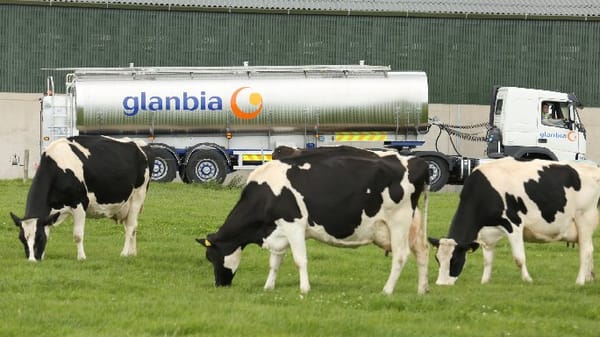
Of our remaining herd of billionaires, three (Goodman and the Bloodstock owners) derive their fortune from the (admittedly high-value) trade in livestock and its products. Three more (Desmond and the brothers Comer) earn their keep on the rentier economy, mainly property speculation and public-private partnerships. A single dishevelled figure remains in the form of Eugene Murtagh, flying a lonely flag for the much-vaunted domestic Irish capitalist class and good old primitive accumulation. All the sadder then, for the second hypothesis, that much of this manufacturing empire is inexplicably dislocated from the blast furnaces and spinning jennies of Dublin’s concrete jungle.
This gaggle of amateurs cannot be compared favourably to our nearest neighbours, with tallies reporting a whopping 156 bigwigs in Britain. A slightly higher density of social parasites even when adjusted for the host population. If our feckless national bourgeoisie can’t be bothered to pull themselves up by their bootstraps, maybe we can overcome our disappointment and join the great game ourselves by popping over to the stock exchange.
A Trip to Holland
If the fancy takes us, we can first head to the Euronext exchange in Amsterdam and invest some of the hard-earned fruits of our labour power in Shell plc’s extraction of liquid gold from the far-flung corners of empire. If this doesn’t seem like an edifying choice for Marxists, we can consider getting in on the military-industrial semiconductor rush through ASML Holding. If all this geopolitical risk is working up a thirst, we can get gezellig with some Heineken stocks. With a market capitalisation of €1.75 trillion, there is no want of choice.
What a shock then, when we return home and head up to our national exchange at Euronext Dublin (itself a Dutch company), only to find a measly market capitalisation of €110bn, with 45% concentrated in two companies: Ryanair and AIB. So much for freedom of choice under capitalism. This isn’t looking like a great outing for imperialism, and access to the animal energies of the Irish industrial revolution has been somewhat stymied by the traitorous defection of these companies to the New York Stock Exchange. This represents a fairly clear choice for FDI over local investment, even within indigenous companies.
The next place to turn is the more sensible option of the pension/insurance market. With Irish households holding €281.5bn in such entitlements, it seems to hold potential for one of our hypotheses, and perhaps we can finally find the kernel of Irish capitalism. This is a big letdown for the domestic powerhouse theory, as the bulk of its capital is invested in the US market. Bad news for the piggyback version of the imperialism hypothesis, also, as the majority of US-invested capital is realised within the US domestic economy, rather than in US productive assets abroad.
We have now reviewed three capital pools – the personal wealth of the haute bourgeoisie, the indigenous capital available for homegrown corporate ventures, and the institutional wealth invested by Irish households en masse.
The third capital pool, the largest but most diffuse of the three, represents a mixture of small-capitalist and labour-aristocratic participation in the US economy, and its driving engine is rentier-profits from Ireland’s role as a conduit for global capital flows. It is driven by the wages and rents garnered by Ireland’s labour aristocracy, rather than the valorised returns of a native capitalist class.
Why Does it Matter?
The fundamental conclusion to be drawn is that Ireland is a freak of nature. It has skipped the key step of industrialising before moving to a service economy, instead relying on foreign direct investment and an educated workforce to borrow one ready-made. This is not at all unusual, and many lower-income countries have fallen into a similar development trap. What has differentiated Ireland and created its present political economy is the ability of the State, the small capitalists, the professional-managerial stratum, and a quasi-labour aristocracy to siphon off rents from the movement of global capital flows of redomiciled PLCs.
Ireland almost completely lacks an indigenous capitalist class rooted in finance capital, and its domestically focussed capitalists are even more anaemic today than they were in the 1980s when infant industries like automotive manufacturing still existed.
The enormous "finance capital" physically present on Irish soil, the €5 trillion funds industry, the SPVs, the MNE treasury operations, is merely passing through. The classic imperialist finance-capitalist model is largely absent as an indigenous formation; what Ireland has instead is a modest indigenous productive-capital-export sector, a thin and partly non-native layer of globally diversified personal fortunes, and a broad-but-shallow pension-rentier interest. The vast majority of Ireland’s exported industrial production is owned by FDI, and the surplus value valorised as profit, once wages and rents are deducted, is simply returned to these foreign finance-capitalists.
There is neither a productive domestic market for Irish capitalists to invest in, nor the historical motor needed to produce the capital for investment. Ireland’s ruling class is ultimately a fake, a hanger-on to the interests of the United States and the European bourgeoisie, with no productive substance behind it. The Irish workers who benefit the most from this arrangement in the form of high-paid jobs are nonetheless heavily exploited by foreign capitalists due to their high productivity. The redistributive character of the State allows the creation of a faux-bourgeoisie and faux-labour aristocracy by sharing some of the rents from global capital flows through social welfare-generated domestic demand for services, and direct subsidies for small indigenous capitalists such as lucrative public contracts, and more recently the hospitality VAT reduction. These rents are generated by the global network of imperialism and neo-colonial exploitation, but the Irish ruling class do not have an owning share in this process. They, rather, provide a service to the owners of this process on a macro-economic level which can in turn be utilised for an economy politically stabilised by large-scale clientelism.
Ireland on the whole is not a net beneficiary of this arrangement. The net transfer of surplus value from FDI operating in Ireland is weighted heavily in favour of investors, and the rents extracted by the State and service providers like legal consultancies are only a small fraction of the flow of wealth from Irish workers to international capital. The comprador class is very happy with this arrangement at present, but the majority of Irish workers derive most of their high productivity from their labour power, and the high organic composition of capital produced by FDI capital intensity. The commodity-trade basis of the unequal exchange argument is also difficult to bear out, given the dependence of Ireland’s export economy on technologically and capital-intensive processes (tech and patented pharmaceuticals) rather than those heavily dependent on raw material inputs.
Conclusion
Any rigorous application of Marxist analysis to the Irish economy intended to illuminate rather than obscure the class character and balance of forces within our society must not be based on generalisations and simplifications of theory into neat templates. Our material conditions are ultimately sui generis, and this requires theoretical templates to be adapted to Irish conditions, rather than Irish conditions being contorted to fit theoretical templates.
Ireland is not an imperialist power, but its ruling class does receive benefits from imperialism. Acceptance of this fact enables us to explain and predict their collective behaviour as a class, the crucial scientific test for Marxist analysis. The Irish working class is exploited by imperialist powers such as the US, Britain, France and Germany, but it receives redistributive social transfers from the ruling class which mask the nature of this relationship. This has in turn led to false consciousness on a mass scale and promoted an identification with the imperialist powers which even seeps into communist analysis.
The status of sections of the Irish working class as a labour aristocracy is a temporary status which can be removed at a moment’s notice. It is a falsified aristocratic title conferred by finance centres in London and New York, rather than by the national bourgeoisie. While the national bourgeoisie need to maintain a labour aristocracy to protect themselves from class unrest, Ireland merely plays a convenient role in inter-capitalist competition. This reliance on the goodwill of international capital ultimately makes our comprador ruling class all the more desperate to serve the interests of imperialism, because if they lose favour, there is nothing left.
The Irish working class is ultimately a net loser in its relationships with the imperial powers, and the argument that Ireland is a prominent actor in imperialism itself cloaks both this fundamental relationship, and the genuine potential Ireland has to construct socialism by redirecting its stolen economic output into self-development.