Indians In Dublin Stand In Solidarity With National Protests
Anyone who thinks a fascist government would not go after them because they fit the criteria of an “ideal” citizen must consider India.
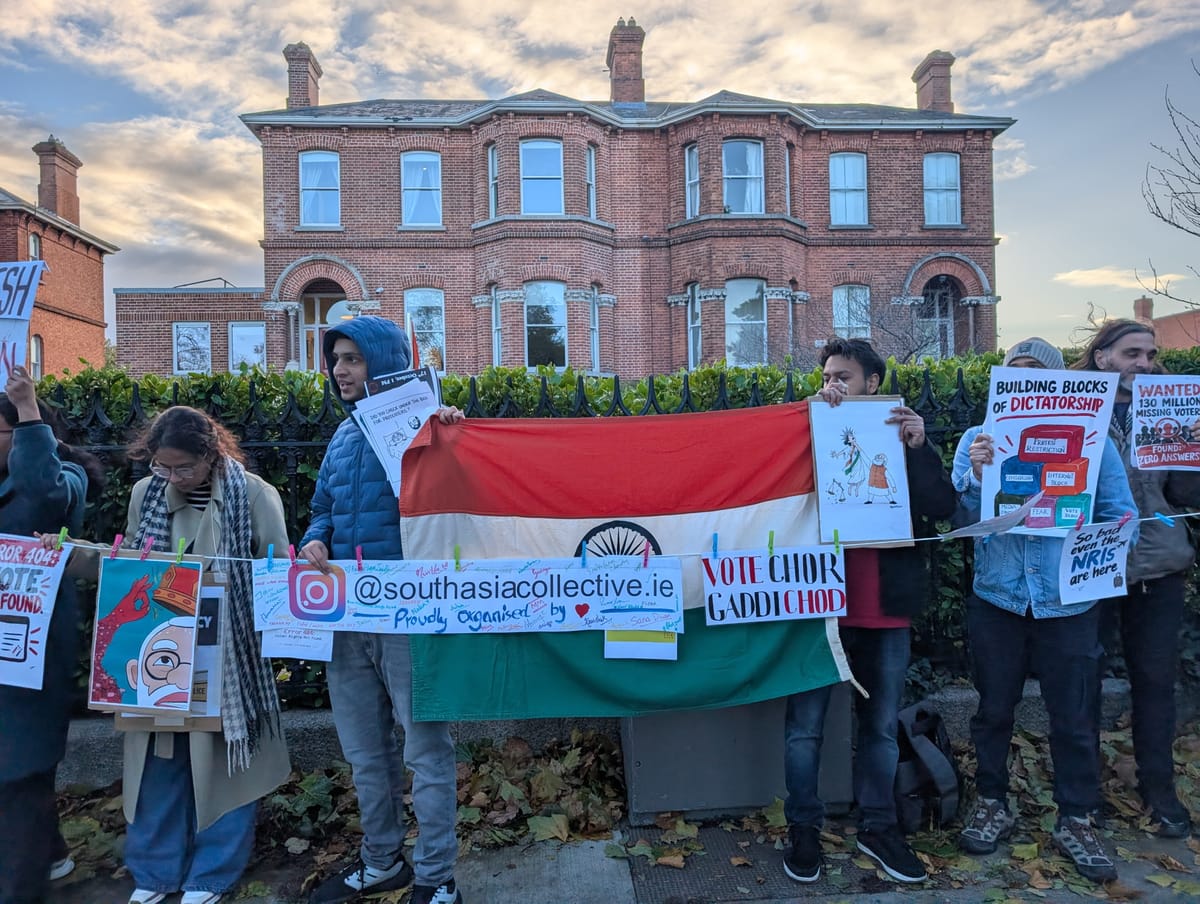
Anyone who thinks a fascist government would not go after them because they fit the criteria of an “ideal” citizen must consider India. Despite proudly wearing the badge of “largest democracy” since 1951, the Election Commission deleted 130 million voter IDs, which included upper-class, upper-caste, Hindu, cis-het men, sparking protests across the country.
No sooner had the movement erupted than , thousands of young people were detained. Key faces of the protest, like student activist and president of the All India Student Association, Neha Bora, pressure group leaders of the Cockroach Janta Party (CJP), Abhijeet Dipke, Saurav Das and Ashutosh Ranka and members of the opposition party alliance, INDIA, were taken down by the puppets of the ruling party, BJP.
When detentions were not enough to restrict the voices of millions of Indian youths, the government used Meta as a tool to deter even the shadows of protest on social media.
The government had pulled every string to choke these voices within the territory, forgetting Indian migrants all across the globe. South Asian Collective is one of the many non-profit independent organisations that have staged various protests in Dublin to stand with Indian brothers and sisters, whom they left behind years ago. The members of the organisation are long-standing dissenters of the Modi regime in India, so it provided a channel for young Indian immigrants to speak on issues that they have not been able to when they were in India.
Covering their latest protest on 23 October in front of the Indian Embassy in Dublin 4, I got to speak to a lot of people on why they would protest for a place that they have now escaped. Suriya, one of the organisers, said, “Our right to dissent does not magically disappear just because we live in a different country. Whatever Modi does on a global scale affects us, even though we do not live in India.” He added, “We are privileged to be able to voice our dissent outside the embassy, which represents the Indian government.”
Another protester said, “This protest doesn’t impact me personally, but it doesn’t matter. I’ve been living in Ireland for a long time and I’ve made a good life for myself, but that doesn’t mean that I don’t have compassion for many others who are impacted directly.”
The group had originally responded to the nationwide call for protests at Jantar Mantar on Oct 10, with a solidarity gathering at the GPO where about 20 people showed up. In the week that followed, their online reach through WhatsApp & Instagram accelerated, necessitating a much more intentional approach to structure and organise the community, amplify the voice of India, and create cross-border solidarity with diaspora across the globe.
Consequently, the South Asia Collective Ireland was born as a community of progressive diaspora members and allies based in Ireland, standing unequivocally against fascism, casteism, and human rights violations. On Oct 17, they joined forces with the Indian diaspora from Australia in the East to Canada & the US in the West for a Global Day of Solidarity & Action. In Europe and in the UK alone, they collaborated with several countries including the Netherlands, Sweden, Finland, Germany, Spain, and Czech Republic, under the overarching banner of “Jantar Mantar is Everywhere”.
It is crucial to note that marginalised communities in India have repeatedly faced systemic oppression and for years it went unnoticed by the majority. Until now, when the sky is falling on the middle and upper classes, we chose to react collectively. An eye-opening moment for the larger population as they realise no amount of bootlicking would safeguard them from a fascist government that has and will work for the top 1% of society.
The realization is not restricted to the Indian political landscape. Citizens of countries like the Czech Republic, France, Nepal, Pakistan, Albania, Serbia, Germany, Italy, Spain, and Indonesia are on the streets today not because they didn’t know it was a fascist and authoritarian government, but because they didn’t think the same government would oppress and deprive them as it did minorities.