Bend That Stick! Historicizing Lenin's What Is To Be Done?
An explainer of Lenin’s What is to be Done? (1902), its historical context and thoughts on the latent confluence between the anarchist and Leninist concept of the vanguard.
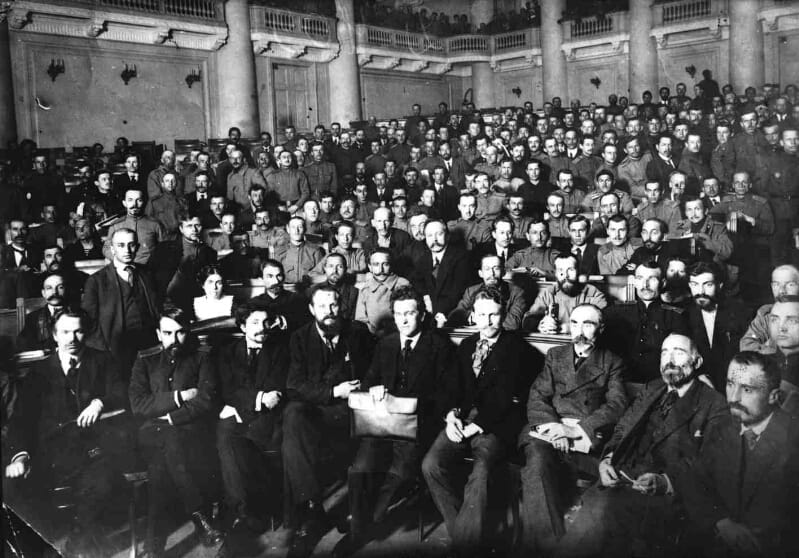
What is a vanguard? It is a formation which is naturally occurring and the only one which is able to appropriate social energies towards revolution. György Lukács in History and Class Consciousness from 1923 explains that the "vanguard" is something which naturally occurs. People who desire change of a certain kind will find each other through social discourse, eventually assembling as a group (or multiple groups!) through an arduous process. A socialist vanguard is a formation which amasses all the class conscious elements of society, expressing the potentiality of system-transition within the actuality of capitalism, therefore it is a logical necessity that it exist, in some form or another, as a historic bloc. This is the question of the revolutionary minority organising itself. It is impossible to argue with the correctness of the need for organisation. Some may change its name, but as Friedrich Engels said in On Authority from 1872, "these gentlemen think that when they have changed the names of things they have changed the things themselves". An organisation is an assemblage of different elements, which must be evaluated concretely. There are different levels of centralisation, checks-and-balances and worldviews embedded in each. The discourse around this is often dogmatic, based on inane wordplay, and overly-formalist, from both the left-deviation and right-deviation of socialist thought.
The Bolshevik vanguard Party was not like how it became narrativized in the late 1920s by Grigori Zinoviev et al. It was a vibrant Party of various socialist tendencies all under one umbrella. Hal Draper speaks of this in "The Anatomy Of A Micro-Sect", written in 1973, which is a useful reading to clear away such misconceptions about the idea of the vanguard. It was fluid. In 1917, Vladimir Lenin chucked out the Party and appealed directly to the rank-and-file, at his most anarchist; but in 1921, he banned factions within the Party, at his most authoritarian. There are many such zig-zags in his writings. This is why it is not wise to seek out fixed dualisms in history, but rather, ever-changing fluidities.
The anarchists came to recognize the need for a vanguard with the platformist tendencies à la Nester Makhno, which also recognized a possibility for a ‘degree of centralisation’; the anarcho-syndicalists in Revolutionary Catalonia had a vanguard of the ‘organised minority’ in 1936-1936, which shifted on the sliding scale from decentralism to centralism, they just had a different name for it; and this recognition was taken up later by the South American especifista movement with their ‘dual organisationalism’. Lenin makes this point to Zinoviev in 1920 where he defends the anarcho-syndicalists and compares them to the Bolshevik mode of organisation, as Ian H. Birchall explained in his contribution to the 2024 book Lenin: The Heritage We (Don’t) Renounce. There is confluence between the left-deviation and the right-deviation here, depending on which aspect is emphasized.
However, the anarchist movement insists that the mistake of the Leninists is in allowing the Party, at one point, to overrule the class itself, thus detaching and becoming a new ruling class. Joe White in Anarchist organisation from 1990 argues that the “leadership of ideas” essentially differs from the Leninist conception of the vanguard Party, which again, is debatable, as it pertains to what slice of history is under examination, and whether one could transition into the other should there be grave enough pressures on leadership. What is apparent here is that this is not necessarily a question of the correctness of the vanguard idea, moreso about the elements of organisation, or rather, a political difference on how organisation is used. It can thus be understood that the abstract idea of the vanguard is a natural necessity, but appears in different ways, with different implementations, even differing from moment to moment as material conditions demand or influence it.
Lenin’s What Is To Be Done?, published in 1902, is often misunderstood, as it is taken out of context, as it is not historicized but taken at face value. This is the mistake of the dogmatist. Why did he write this book? Well, what is political writing? Political writing is a time-limited intervention in the current conjecture. Lenin is a theorist of the conjuncture, of the concrete, of what is necessary in the moment, to shift the general political line towards a certain direction, leftwards or rightwards. As with Karl Marx, when he is writing against his idealist opponents, he is bending the stick. So, for instance, he will emphasize the economic determination in society precisely to act as a counter-balance to idealistic conceptions. He will then walk back his claims in later pieces (as seen with Engels’ letter to Joseph Bloch in 1890).
The book advocates for a “strict” Bolshevik vanguard against the other side of the eventual 1903 split in the Russian Social Democratic Labour Party (RSDLP), the Mensheviks, who advocated for broad membership in the Party. The book also claims that workers on their own can only develop trade union consciousness. As such, there is a need to introduce the Party as the "political" factor in raising class consciousness. This claim is made in a general sense, and even in the general sense, it is still bending the stick, over-emphasizing the claim so as to over-correct the mistake from the opposing side, as Lenin points out in 1907 in Twelve Years. It is precisely the Mensheviks who underplay the political, and over-emphasize the economic determination of revolutionary consciousness. They fetishize spontaneity. This is called economism.
Think Eduard Bernstein, as quoted by Rosa Luxemburg in the introduction to Reform or Revolution from 1900 : "The movement is everything, the final goal is nothing", with a mass Party where everyone is allowed in and there is little talk of socialism, which is seen as a distant aim. Ring a bell? That is the Socialist Workers’ Network, the dominant faction in People Before Profit, and that was the Mensheviks, (and that was the Girondists too roughly who exhibited similar tendencies of hesitancy against “forcing” a moment of rupture) who believed that there is an auto-transition into revolutionary consciousness as a result of different struggles coming together as an avalanche. The idea is: "While each demand is reformist, when these reformist demands are pushed against the system, and the system cannot meet these demands, then we have revolution!". Opposed to the Menshevik line, Lenin introduces the Party as the "political" factor, which raises class consciousness, and is thus opposed to economic determinism professed by the Mensheviks. This is why in that particular moment, he bends the stick, in order to assert the need for an explicitly revolutionary socialist group. The Mensheviks' mistake is later shown - rather than support the 1917 October Revolution, they hesitate, they roughly say: "Where is the economic struggle which snowballed into revolution? This is just the Bolsheviks forcing history!". In fact, the Bolsheviks, through conscious political intervention, are making history happen, giving history a push, a push which leads to a historical rupture and one which would otherwise not have arisen merely out of the totality of economic struggle.
Bibliography
Draper, Hal. “Hal Draper: Anatomy of the Micro-Sect (1973).” Marxists.org, 1973. https://www.marxists.org/archive/draper/1973/xx/microsect.htm.
Engels, Friedrich. “Marx-Engels Correspondence: Engels to J. Bloch 1890.” www.marxists.org, 1890. https://www.marxists.org/archive/marx/works/1890/letters/90_09_21b.htm.
———. “On Authority.” Marxists.org, 1872. https://www.marxists.org/archive/marx/works/1872/10/authority.htm.
Ian H. Birchall, p.145, in Jorge Joffre-Eichhorn, Hjalmar . Lenin: The Heritage We (Don’t) Renounce, 2024.
Lenin, Vladimir. “Lenin: What Is to Be Done?” www.marxists.org, 1902. https://www.marxists.org/archive/lenin/works/1901/witbd/.
———. “Preface to the Collection Twelve Years.” Marxists.org, 1907. https://www.marxists.org/archive/lenin/works/1907/sep/pref1907.htm.
Lukács, György. “History and Class Consciousness.” Marxists.org, 1923. https://www.marxists.org/archive/lukacs/works/history/.
Luxemburg, Rosa. “Rosa Luxemburg: Reform or Revolution (Introduction).” Marxists.org, 1900. https://www.marxists.org/archive/luxemburg/1900/reform-revolution/intro.htm.
White, Joe. “Anarchist Organisation.” The Anarchist Library, 1990. https://theanarchistlibrary.org/library/joe-white-anarchist-organisation.