A Raid At Magazine Fort: The IRA’s Famous Christmas Surprise
On the night of 23 December 1939, a small group of Irish Republican Army (IRA) volunteers achieved what remains one of the most spectacular - and ultimately self-defeating - coup in the organisation’s history.
On the night of 23 December 1939, a small group of Irish Republican Army (IRA) volunteers achieved what remains one of the most spectacular - and ultimately self-defeating - coup in the organisation’s history. In a carefully orchestrated operation, they overwhelmed the guard at the Magazine Fort in Dublin’s Phoenix Park and made off with almost the entire reserve of small-arms ammunition belonging to the Irish Army. The action, quickly christened the “Christmas Raid,” was a propaganda triumph that underscored the IRA’s capacity for daring action. Yet, as the government’s response would soon demonstrate, it was also a strategic blunder that provoked a severe crackdown and failed to address the organisation’s deeper weaknesses.
The raid must be understood within the context of the IRA’s ’S-Plan,’ a bombing and sabotage campaign directed against British economic and military targets that had begun earlier in 1939. The campaign was intended to force a British withdrawal from Northern Ireland, but it placed enormous strain on the IRA’s resources. By the autumn of 1939, the organisation was desperately short of arms, ammunition, and money. Seán Hayes, who had become acting chief-of-staff while Seán Russell was in the United States, recognised that the S-Plan had provoked harsh security responses in both jurisdictions. In Northern Ireland, internment had been introduced; in Éire, the Fianna Fáil government of the IRA’s former friend-turned-foe Éamon de Valera had passed the Offences Against the State Act, giving the authorities sweeping powers to suppress the IRA. With its operational capacity shrinking, the IRA leadership looked for a dramatic stroke that would replenish its stocks and demonstrate its continued relevance.
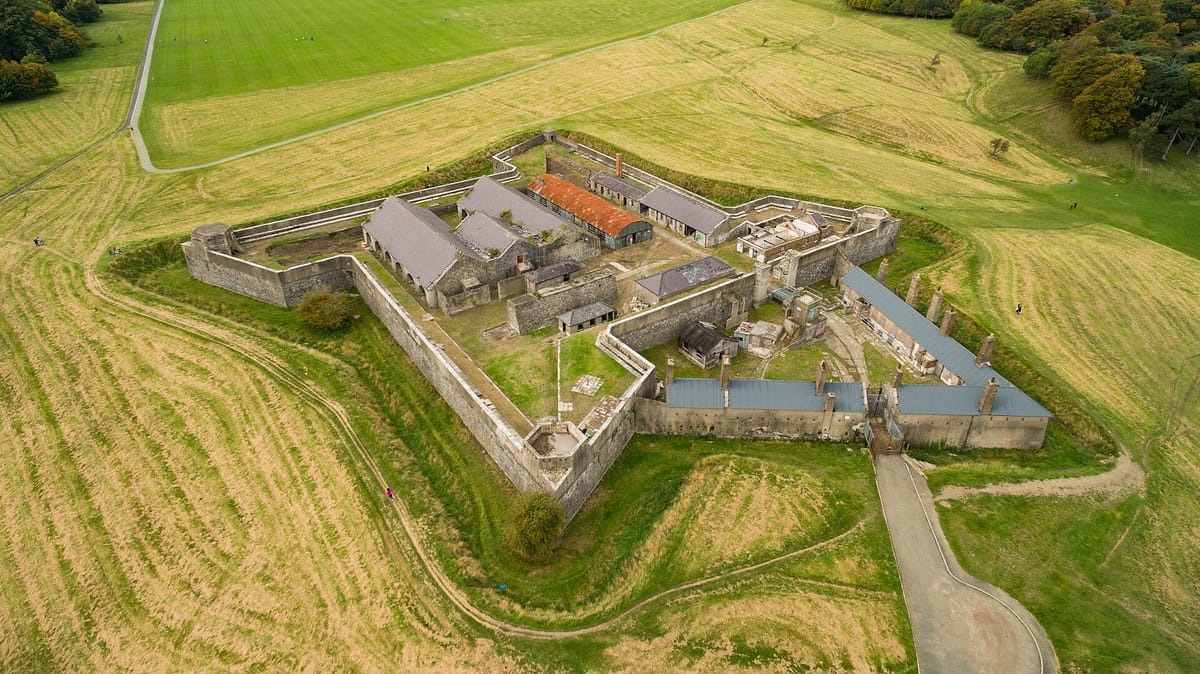
The target was irresistible. The Magazine Fort, a Georgian military installation completed in the 1730s, had served as a symbol of imperial military authority in Dublin. It had famously been the site of the opening shots of the 1916 Easter Rising, when members of Na Fianna Éireann raided it as a signal for the broader insurrection. More than two decades later, on 23 December 1939, it was again thrust into the national spotlight during the IRA’s “Christmas Raid”. The fort was then being used by the Irish Army as its principal munitions depot, and its capture would offer the IRA a windfall of weapons and ammunition on an unprecedented scale. The plan, devised by Hayes in November 1939, was ambitious. It envisaged simultaneous raids on the Magazine Fort and the nearby Islandbridge army barracks. In the event, the attack on Islandbridge was abandoned, but the assault on the Phoenix Park depot went ahead. Contemporary newspaper reports described how a man in military uniform approached the main gates of the fort and handed in a parcel addressed to the commander. Once the gate was opened, armed men rushed forward, overpowered the sentry, and held up the guard. Shots were fired at a military policeman nearby, but the raiders succeeded in loading their loot onto waiting lorries. Estimates suggested that between fifty and one hundred IRA members took part, and the vehicles disappeared without immediate trace. According to the Dictionary of Irish Biography, thirteen lorries were used to remove more than 1,000,000 rounds of ammunition - nearly the entire reserve stock of the Irish defence forces.
The immediate reaction from the state government was one of shock and embarrassment. Speaking in the Dáil on 5 January 1940, the Minister for Defence, Frank Aiken (himself a former IRA chief-of-staff), admitted that the raid had given him “a most terrible shock.” He conceded that there was “no excuse for what had taken place.” Aiken sought to downplay the significance of the operation, describing it as “only a ‘stunt,’ put into action without full consideration of the ultimate consequences”. The government moved swiftly to introduce the Offences Against the State (Amendment) Bill, which provided for internment without trial and other draconian measures. Aiken expressed the hope that little call would be made upon the Government’s powers of internment, but he warned that if jailing and internment didn’t put an end to such activities, “worse consequences might befall the country”.
In practical terms, the raid was far less successful for the IRA than it first appeared. The organisation had acquired a vast quantity of ammunition, but it lacked the money and the men to make effective use of it. As the Dictionary of Irish Biography (DIB) notes, the IRA needed cash and bomb-making equipment rather than ammunition, and it was in no position to deal with the volume that had been taken. Worse still, the raid triggered an intensive search operation by the authorities. By the beginning of January 1940, the government had succeeded in recovering more than 800,000 rounds of ammunition. The ‘Irish Times’ later reported that three-quarters of the stolen munitions - some 850,000 rounds - had been recovered. The subsequent government raids also resulted in the rounding-up of more IRA members, and on 29 December the radio that Hayes had used to establish contact with Nazi German intelligence was seized. The organisation was forced deeper underground, and Hayes himself became the only active member of the executive council in Ireland by early 1940 .
The Christmas Raid thus encapsulated both the audacity and the limitations of the IRA’s campaign in the late 1930s. It demonstrated that a depleted, yet determined group could strike at the heart of the state’s military infrastructure and capture the public imagination. The operation was celebrated in IRA folklore and even inspired ‘A Ballad of the Phoenix Park’. Yet, the raid also exposed the organisation’s strategic incoherence. The seizure of ammunition it couldn’t use, followed by the rapid recovery of most of the stock and a sweeping security crackdown, left the IRA weaker than before. The “stunt,” as Minister Aiken called it, had handed the government the justification it needed to crush the IRA - the revolutionary group he once led. In the end, the Christmas Raid was a dramatic episode that highlighted the IRA’s tactical ingenuity, but also its chronic inability to translate daring engagements into lasting revolutionary gains.
Bibliography
- “Audacious Raid By Irish Republicans.” Manawatu Times, 26 December 1939, p. 7. Papers Past, National Library of New Zealand, https://paperspast.natlib.govt.nz/newspapers/MT19391226.2.59
- Bell, J. Bowyer. The Secret Army: The IRA, 1916–1976. Dublin: Academy Press, 1979. Accessed via Internet Archive. https://archive.org/details/secretarmyira1910000bell_t4b3/mode/2up?q=magazine
- Dictionary of Irish Biography. “Aiken, Francis Thomas (‘Frank’).” Royal Irish Academy. Accessed November 2, 2026. https://doi.org/10.3318/dib.000070.v1
- “Hayes, Seán.” Dictionary of Irish Biography, Royal Irish Academy, https://www.dib.ie/sites/default/files/dib-xml-archive/9780521633314_3880.xml
- Heritage Ireland. “Open House: The Magazine Fort.” Office of Public Works, https://heritageireland.ie/whats-on/open-house-the-magazine-fort/
- Irish Newspaper Archive. “IRA Christmas Raid – 23.December.1939.” https://www.irishnewsarchive.com/wp/page/31/
- “Magazine Fort Raid merely a ‘Stunt’.” The Irish Times, 5 January 1940, https://www.irishtimes.com/news/magazine-fort-raid-merely-a-stunt-1.231109
- “Buildings at Risk: Ammunition fort in Phoenix Park fires up for revival.” The Irish Times, 3 December 2015, https://www.irishtimes.com/culture/heritage/buildings-at-risk-ammunition-fort-in-phoenix-park-fires-up-for-revival-1.2451837